Clear Sky Science · en
Distribution law and control of the second invariant of deviatoric stress in gob-side entry retaining
Why this underground story matters
Far below ground, modern coal mines must carve out tunnels that stay safe even as nearby coal is removed. One increasingly popular method, called gob-side entry retaining, lets miners reuse a tunnel instead of abandoning it behind a wall of untouched coal. That saves valuable resources but makes the remaining tunnel vulnerable to squeezing and collapse as the roof rocks shift. This study from a deep Chinese coal mine shows how a new way of tracking rock stress can predict where failure is most likely to occur—and how smarter supports can keep these lifelines stable from the start of mining through to the end.
Keeping a tunnel alive beside a collapsing void
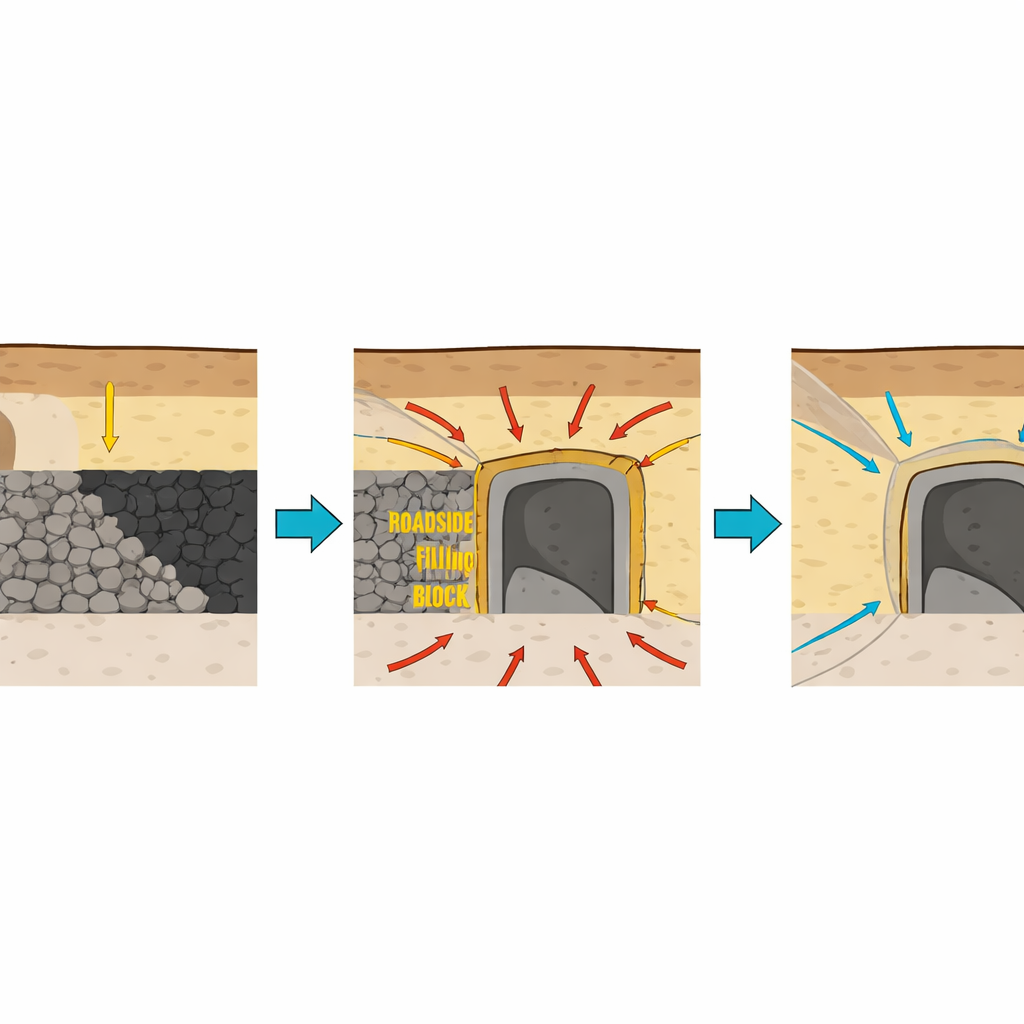
In gob-side entry retaining, miners take out coal along a longwall face while preserving a roadway directly beside the mined-out void, or “gob.” Instead of leaving a thick coal pillar as a barrier, they build an artificial wall known as a roadside filling body between the roadway and the gob. This filling body must do several jobs at once: quickly carry load as the roof caves, tolerate large compression without breaking, and seal the roadway from gas and loose rock. The team analyzed a 690‑meter-deep panel in the Xinzhuang Coal Mine, where a rectangular roadway was retained alongside the gob and supported by a one‑meter‑wide cement-based filling body plus rock bolts and cables in the surrounding rock.
Watching how rock stress builds and shifts
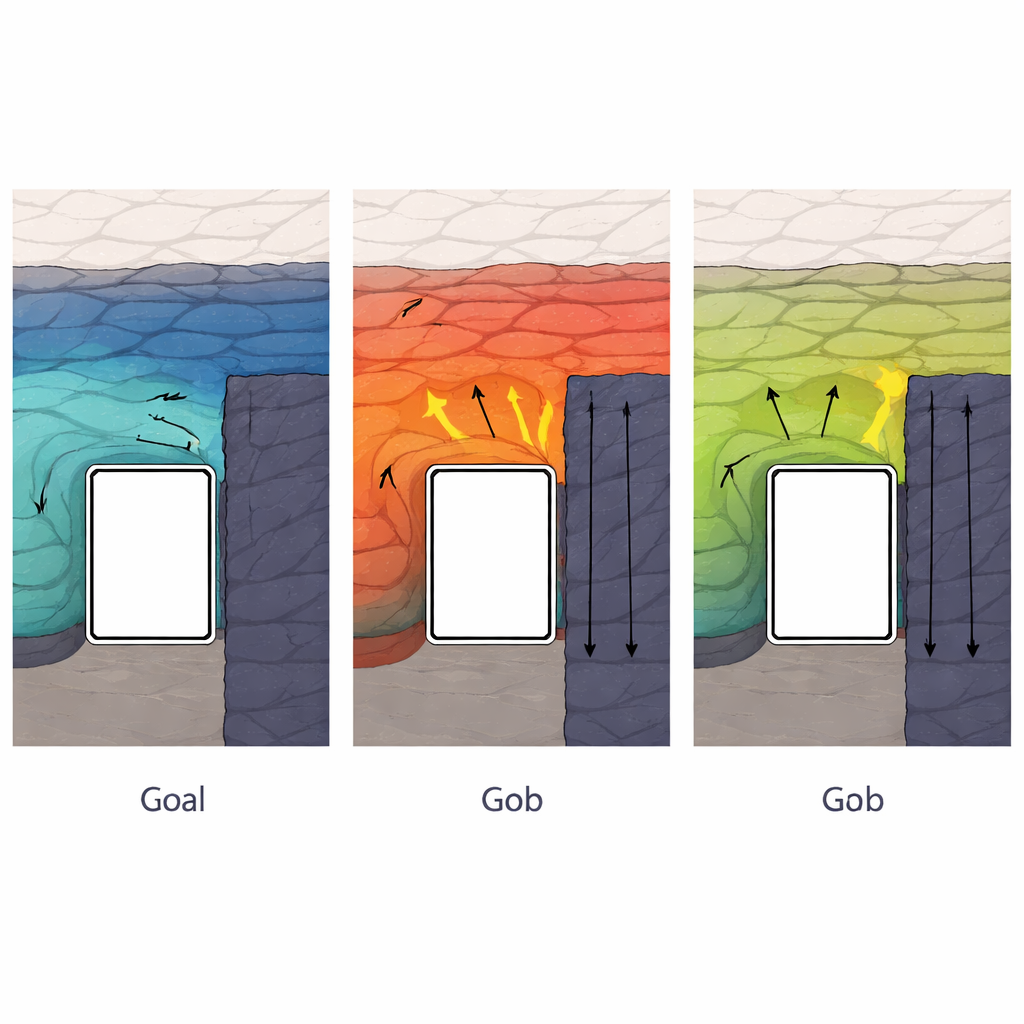
Rather than only looking at simple pressure levels, the authors focused on how the shape of the rock changes under load, using a quantity called the second invariant of deviatoric stress—here treated simply as an overall measure of how strongly the rock is being distorted and pushed toward failure. With detailed computer models, they simulated the entire life of the roadway: from early excavation, through intense mining near the face, to the later period when the gob behind has largely compacted. They tracked how this stress measure formed ring-shaped zones around the tunnel, how its peaks moved deeper into the roof and coal wall as mining advanced, and how plastic (permanently deformed) regions grew and then stabilized.
Three stages of danger around the roadway
In the early stage, long before the mining face reached the roadway, the stress around the opening formed an uneven ring with modest peaks about 2.5 meters into both the roof and the solid coal side. Near the surface, stresses were relatively low, matching a zone already relaxed by excavation. As the face approached and passed (the middle stage), the rock experienced much stronger disturbance: peaks grew and shifted deeper, to about 4.5 meters in the roof and 3.5 meters in the coal rib, and narrow bands of high stress formed near the roof corner on the coal side. In the late stage, after the face had moved tens of meters away and the collapsed rock in the gob had become more compact, stresses in the shallow layers on the gob side eased, but the deep peak zone at the coal-side roof corner kept widening and intensifying before eventually leveling off.
How the artificial wall shares the load
The filling body behaved differently from the natural rock. Stress within it rose almost linearly from the gob side toward the roadway side, reflecting how it gradually picked up load in place of the removed coal. As the distance behind the working face increased and the gob compacted, the tendency for stress to concentrate inside the filling body weakened, meaning the surrounding broken rock began to help support the roof. Mechanical calculations showed that, given the rock properties and roof behavior, a one‑meter‑wide filling body with a strength of about 20 megapascals could supply enough resistance to encourage the roof to break in a controlled way instead of forming a long, heavy overhanging slab.
Designing supports that reach the hidden hot spots
By mapping where the stress peaks appeared and how they shifted, the researchers identified “must-control” zones in the roof and solid coal rib several meters beyond the roadway wall. Conventional short bolts mainly reinforce the shallow, already fractured rock, but do little for these deeper danger zones. The team therefore designed a combined support system: dense rock bolts and mesh in the shallow roof and ribs; a flexible cement-slab wall and internal bolts to stiffen the filling body; and long anchor cables angled so they pass directly through the high-stress bands revealed by the stress invariant. Field monitoring showed that, under real mining conditions, roadway deformation was held below about 30 centimeters and the filling body compressed by less than 10 centimeters, confirming that the tunnel remained serviceable throughout the mining cycle.
What this means for safer, more efficient mining
The study demonstrates that looking at how rock is sheared and distorted—rather than just how hard it is squeezed—can pinpoint where deep-seated failures are likely to start around a reused roadway. By aligning long anchors with these hidden stress peaks and giving the roadside wall the right width and strength, engineers can keep tunnels open beside mined-out voids without wasting coal in thick pillars. In practical terms, that means better resource recovery, fewer new excavations, and safer working conditions, all guided by a more nuanced understanding of how the underground rock really responds as mining progresses.
Citation: Jiang, D., Guo, J., Sun, G. et al. Distribution law and control of the second invariant of deviatoric stress in gob-side entry retaining. Sci Rep 16, 12803 (2026). https://doi.org/10.1038/s41598-026-37680-y
Keywords: gob-side entry retaining, coal mine roadway stability, rock stress and failure, roadside filling support, numerical simulation in mining