Clear Sky Science · en
High performance Raman amplifier: applications in optical communication and biomedical devices
Bringing clearer signals to our digital and medical worlds
Modern life depends on light racing through hair-thin glass fibers, carrying our videos, cloud data, and even hospital scans. But over long distances these light signals fade and pick up noise, just as a whispered message gets lost in a noisy room. This paper explores a way to give those signals a powerful "boost" inside the fiber itself, helping both faster internet links and sharper medical images.
How light can be turned into its own helper
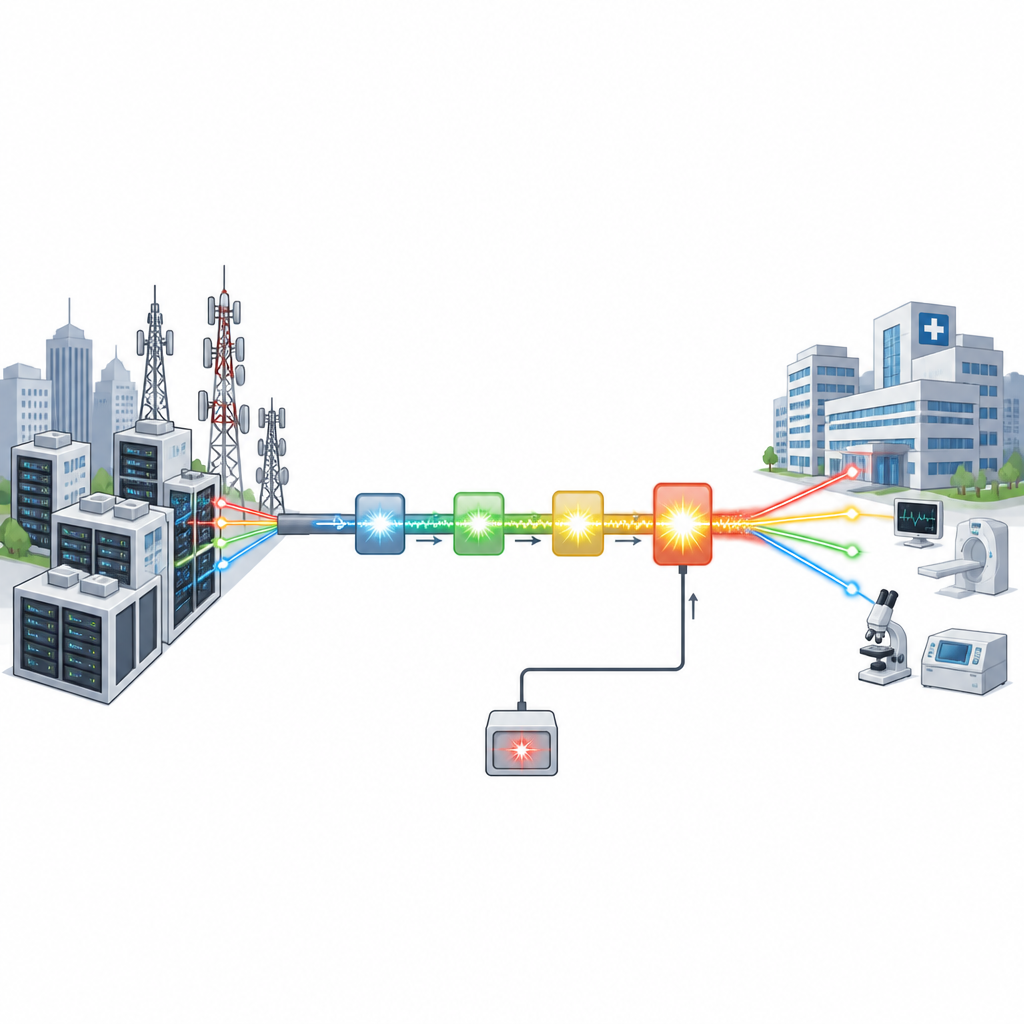
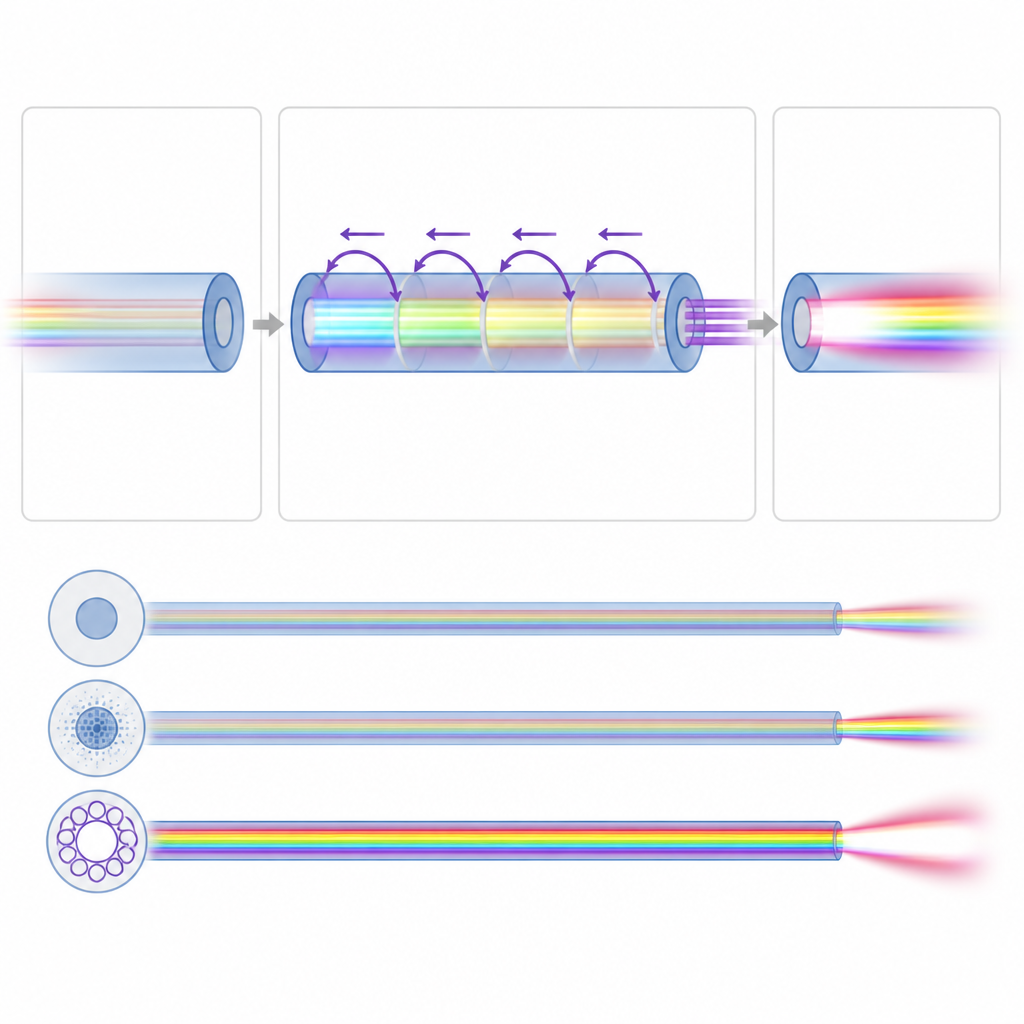
Inside an optical fiber, a strong beam of light can hand over some of its energy to a weaker beam that travels alongside it. This effect, known as Raman amplification, lets engineers build amplifiers directly in the fiber instead of constantly converting light back to electricity and then again to light. The authors focus on a style called backward pumping, where the strong beam is launched from the far end of the fiber and meets the faint data signal coming the other way. This approach keeps added noise low and spreads the signal boost more smoothly along the cable, which is vital for long routes and high data rates.
Stacking boosters along the fiber
The study compares several ways of chaining these light boosters, called Raman amplifiers, along a 100 kilometer span of fiber. First, they describe a basic single amplifier and then three improved layouts that use two, three, and four amplifiers connected in sequence. Using detailed equations and computer simulations, they track how the signal grows and fades along the cable, and how different pump powers affect performance. The key idea is that by carefully choosing the pump strength and the placement of each stage, the system can keep the signal healthy across the whole distance instead of only at the ends.
Why the type of glass matters
Not all optical fibers behave the same. The team tests three common types: standard single mode fiber, and two specialty designs called FreeLight and TrueWave. These differ in how strongly they support Raman amplification and how much they resist other unwanted effects. The simulations show that with the same pump power and layout, TrueWave fiber gives the highest signal gain, followed by FreeLight, with standard fiber trailing behind. When four amplifiers are used with TrueWave and the pump is set to 600 milliwatts, the signal gain reaches about 63 decibels and the output power climbs to nearly 60 decibels relative to a milliwatt, far above the other options.
From undersea cables to hospital scanners
Stronger, cleaner light signals are useful well beyond long distance internet lines. The authors explain how these amplifiers can sit inside hospital fiber networks that move large imaging files from CT and MRI machines to servers without losing quality. In optical coherence tomography, a laser-based scanner used for eye and heart exams, Raman amplifiers can boost the very weak light reflected back from deep inside tissue before it reaches the detector. This extra lift improves the contrast, depth, and fine detail of the images, especially when doctors are trying to see subtle changes in low-reflectivity tissue. Similar ideas apply to fiber sensors wrapped around MRI or CT gantries, where faint signals must travel long paths inside strong magnetic and radiation fields.
What this means for everyday technology and care
In simple terms, the work shows that using four carefully arranged Raman amplifiers inside a suitable type of glass fiber can make long light paths far more efficient. With the right design, the signal becomes stronger, travels farther, and keeps its quality, all while adding only modest extra noise. For communication networks, this means more data over longer spans without so many electronic repeaters. For medicine, it means crisper scans, more reliable sensor readings, and faster movement of large images around a hospital. The study does not claim to solve every challenge, but it maps out a practical way to squeeze more performance from the same strands of glass that already tie together our digital and medical worlds.
Citation: Mustafa, F.M., Sayed, A.F., Aly, M.H. et al. High performance Raman amplifier: applications in optical communication and biomedical devices. Sci Rep 16, 16253 (2026). https://doi.org/10.1038/s41598-026-37650-4
Keywords: Raman amplifier, optical fiber, optical communication, medical imaging, optical coherence tomography