Clear Sky Science · en
A probabilistic approach to predicting alfalfa’s winter survival using local conditions, weather and management factors
Why winter matters for this humble crop
Alfalfa may look like just another green plant in a pasture, but for dairy and beef farms it is a cornerstone of animal feed and soil health. In cold regions, however, large patches of alfalfa can die over winter, forcing farmers to replant and cutting into both yields and profits. This study tackles a practical question with big economic and environmental stakes: given the unique mix of soil, weather, and field decisions on a farm, how likely is an alfalfa stand to survive the winter and stay productive over time?
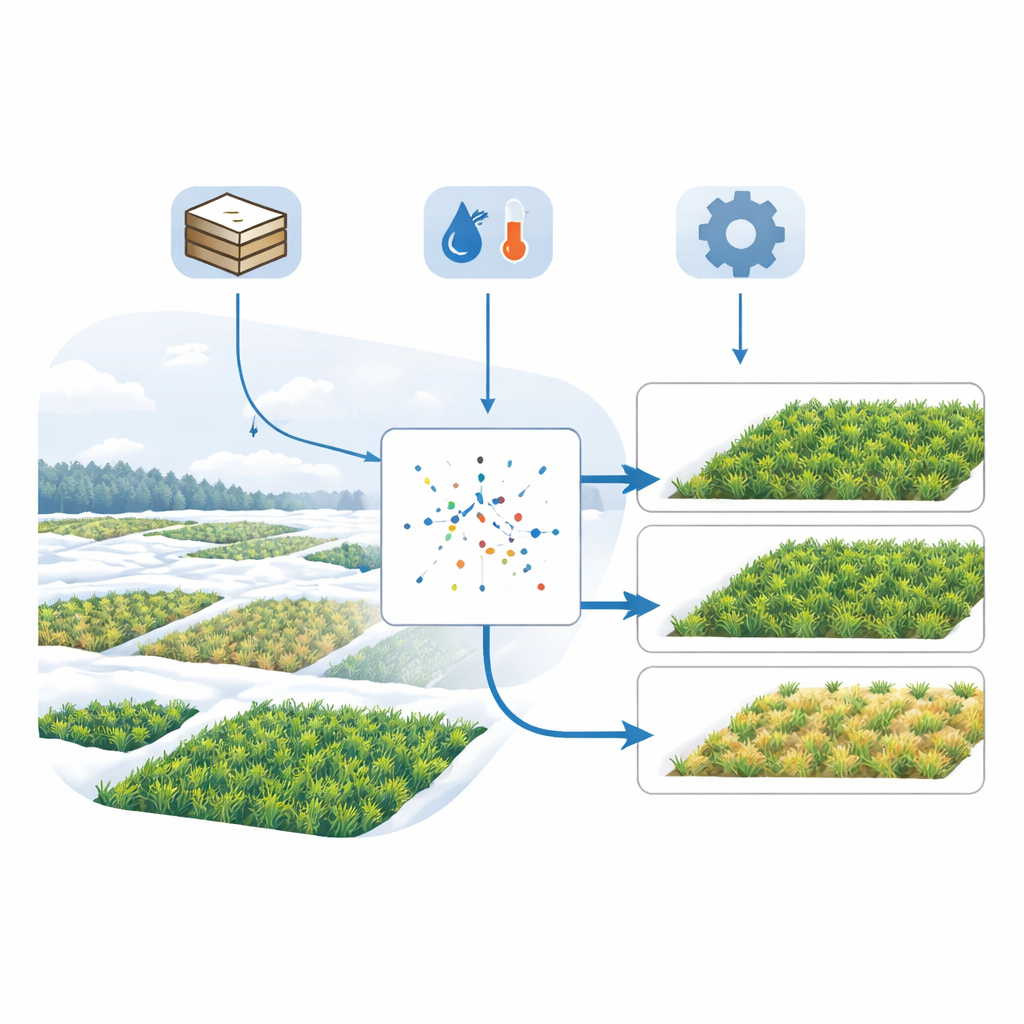
Taking the pulse of alfalfa fields across Canada
The researchers assembled one of the most detailed pictures to date of alfalfa performance in cold climates. Working with 56 farm advisors and 166 producers, they sampled 566 fields on 225 farms in four provinces—Nova Scotia, Quebec, Ontario, and Manitoba—over three years. At more than 2,100 permanently marked spots, they counted how many stems of alfalfa grew inside a hand-sized frame each spring and fall from 2021 to 2023. These repeated measurements showed that while many fields stayed within the range considered healthy, the average stem count slipped from 49 to 37 over the study period, a sign of gradual thinning and winter injury.
Soil, slope, rain, and farm choices all play a role
To understand why some stands persisted and others faltered, the team paired the stem counts with a rich set of information about each site. They analyzed soil samples for key properties such as acidity, organic matter, and nutrients like phosphorus and potassium. They mapped the land’s shape using laser-based elevation data, capturing how steep or flat fields were, how water tended to collect or drain away, and whether slopes faced north or south. They drew on weather records to calculate how much heat plants accumulated through the season, how much rain or snow fell, and how many “cold-hardening” days alfalfa experienced before winter. Finally, they documented real-world management choices: how much fertilizer had been applied, how good the drainage was, and how many times and when the crop was cut.
Turning field experience into a probability-based tool
Rather than building a single rigid equation, the authors developed a flexible, probability-based decision tool they call NumericAg. Inspired by an established “Wisconsin scoring” system used by crop advisors, the tool groups information into three main blocks—soil, weather, and management—and looks for past field situations that closely resemble a user’s current conditions. Using a similarity matrix, the system weighs thousands of historical records according to how closely they match the user’s soil tests, topography, climate, and practices. It then converts the pattern of match quality and past stem counts into probabilities: for example, the chance that a field will end up with strong, moderate, or very weak alfalfa stands after winter. Because the method is non-parametric, it can handle mixed data types, missing values, and complex combinations of factors that do not follow neat mathematical distributions.
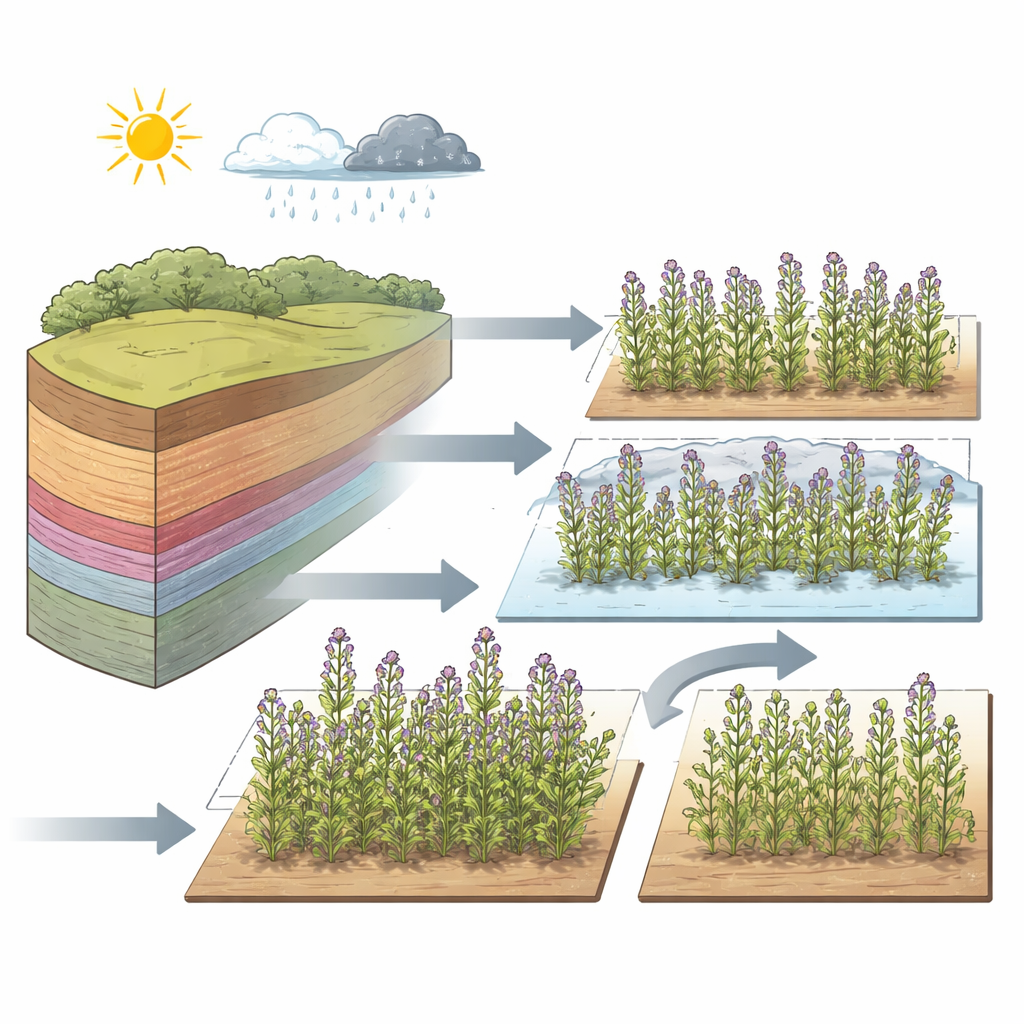
What good, average, and bad years look like
To show how the model behaves, the researchers defined three realistic scenarios. An “optimum” case combined neutral to slightly alkaline soils, high potassium and phosphorus levels, good organic matter, gentle slopes, well-managed drainage, and favorable heat and moisture patterns. Under these conditions, the model predicted a 60–80% chance of high stem counts, indicating dense, resilient stands. An “average” case mixed moderate fertility, middling drainage, and typical weather; here, stem counts clustered in a middle range, suggesting acceptable but not outstanding performance. In the “worst” case—with acidic, nutrient-poor soils, poor drainage, and harsh weather—the probabilities flipped, with a strong likelihood of very low stem counts and major winter loss, especially in the later seasons of the study. These scenario graphs give advisors and farmers an intuitive way to see how combinations of choices and local conditions shift risk.
Practical takeaways for farmers and planners
For a non-specialist, the core message is straightforward: winter survival of alfalfa is not random, and it is strongly shaped by a manageable mix of soil health, landform, weather timing, and field practices. Fields with good soil reaction (pH above about 6.5), ample potassium and organic matter, balanced moisture, and thoughtful fall cutting schedules have much higher odds of entering spring with vigorous stands. By wrapping these many influences into a single probability-based dashboard, the proposed tool can help growers and advisors test “what if” scenarios, compare fields, and prioritize actions—from liming and drainage upgrades to adjusted harvest timing. In the long run, such decision support can reduce costly winterkill, improve forage reliability, and support more sustainable livestock systems across cold-climate regions.
Citation: Saifuzzaman, M., Adamchuk, V.I., Leduc, M. et al. A probabilistic approach to predicting alfalfa’s winter survival using local conditions, weather and management factors. Sci Rep 16, 11529 (2026). https://doi.org/10.1038/s41598-026-37585-w
Keywords: alfalfa winter survival, forage crop management, soil and weather risk, decision support tool, probabilistic modelling