Clear Sky Science · en
Image contraction through fuzzy soft outerplanar graph structures
Turning Noisy Pictures into Clear Stories
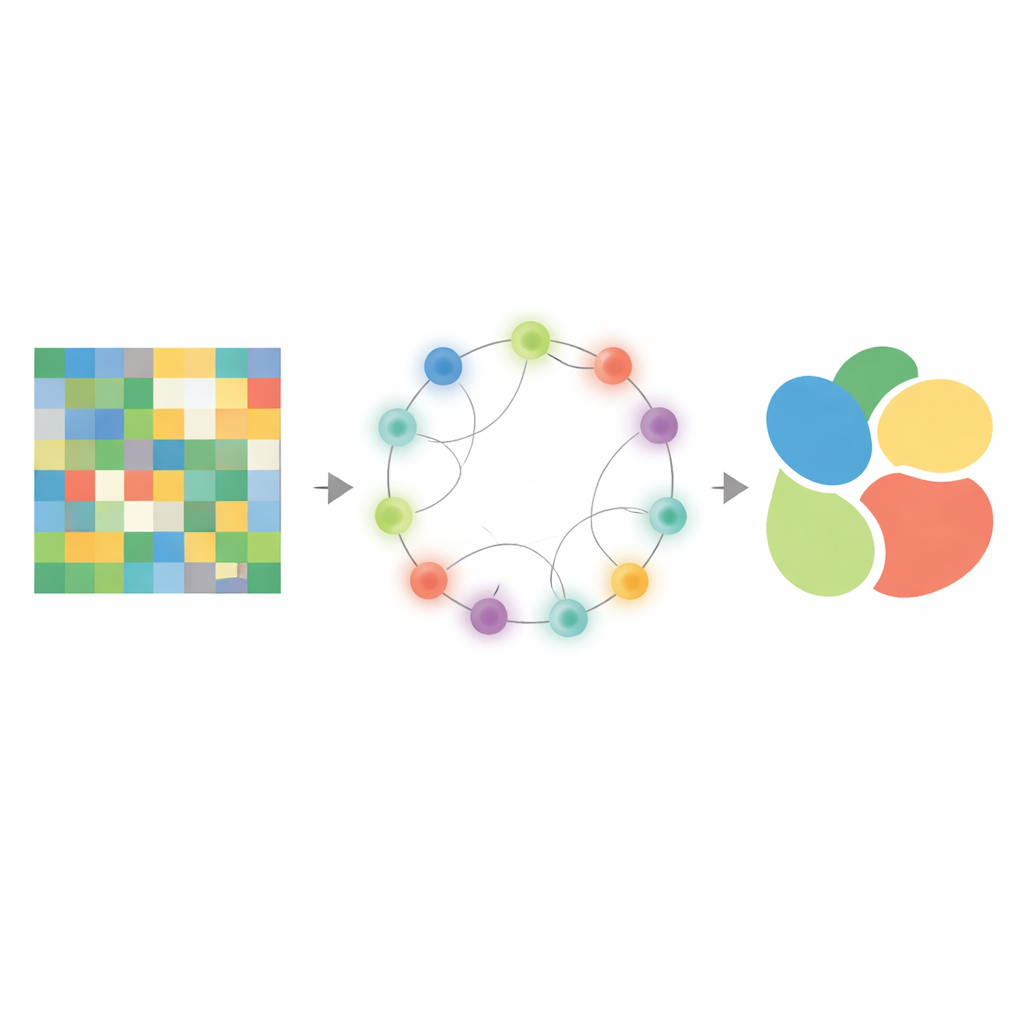
Digital images are full of tiny uncertainties: shadows blur edges, colors blend, and sensor noise hides clean boundaries. This paper presents a new mathematical way to tame that mess, so computers can shrink or simplify images while keeping the important structure. The authors introduce a tool called a fuzzy soft outerplanar graph, a carefully organized network that turns a cluttered picture into a clean sketch of regions and their relationships, making later tasks like compression or analysis more reliable.
From Messy Data to Gentle Shades of Belonging
Traditional graphs treat connections as all-or-nothing: two pixels are either linked or they are not. Real images are rarely that crisp. Here, each pixel and connection is given a graded strength, reflecting how strongly it belongs to a region or how similar it is to its neighbors. This is the “fuzzy” part: membership values run from completely in to barely in, rather than a simple yes or no. At the same time, different viewpoints on the same image—such as color, brightness, or texture—are handled as separate “soft” parameters. Together, these ideas let the model describe an image in layered, nuanced ways that match how humans see uncertain edges and overlapping objects.
Keeping the Picture Simple with Outer Boundaries
Even a clever graph can become tangled, with edges crossing and loops forming in every direction. To keep things manageable, the authors insist on a special structure called an outerplanar layout: all key points sit on the outer boundary of the drawing, and connections can be drawn without crossing. This restriction acts like good design in a subway map, removing needless twists so the routes are easy to follow. The new fuzzy soft outerplanar graph (FSOG) combines soft, graded information with this clean outer layout. The authors show how to recognize when such a structure appears, how to break it into simpler pieces, and how to relate these pieces to a corresponding “dual” graph that tracks the regions between the lines instead of the lines themselves.
Pruning and Shrinking While Preserving Shape
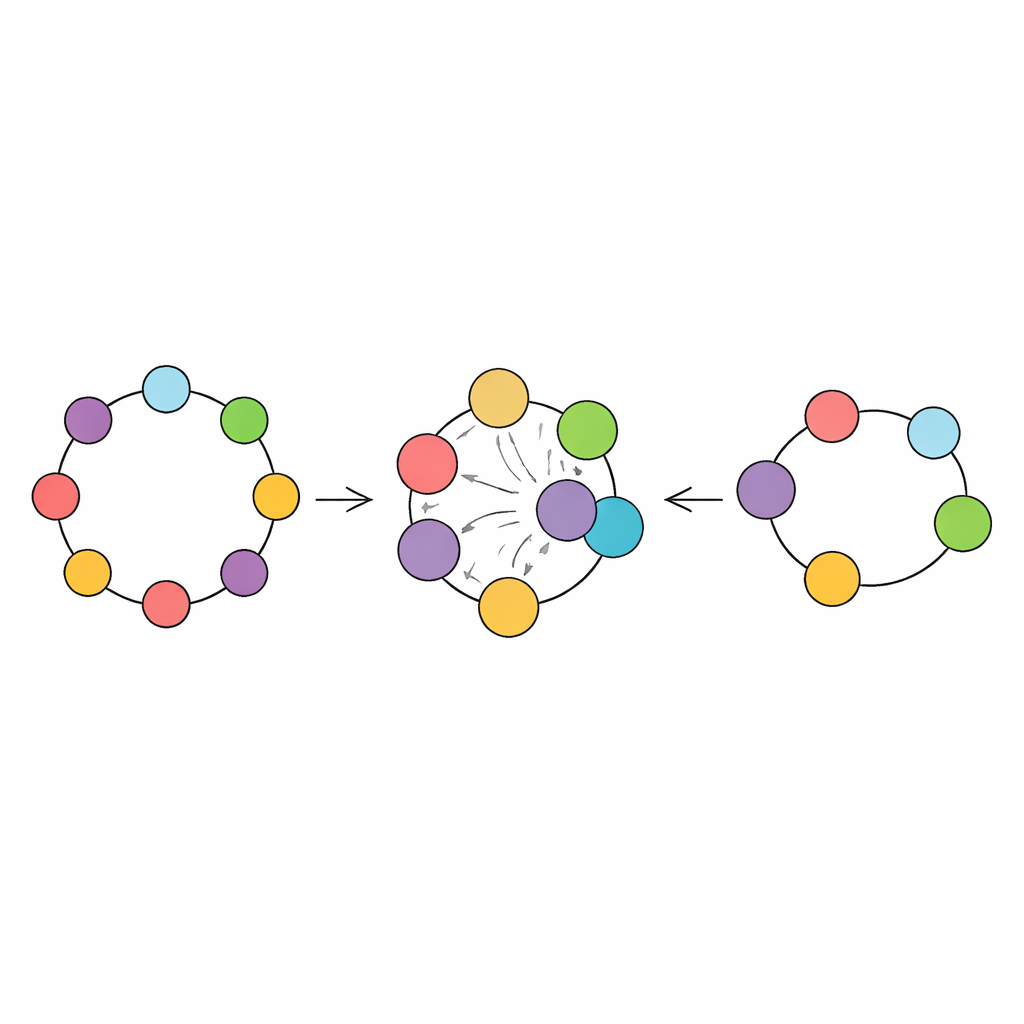
Once an image is represented as an FSOG, the network can be simplified in a controlled way. The paper develops rules for what happens when certain points (vertices) or connections (edges) are removed from the graph. Some deletions lead to smaller graphs that still respect the outer boundary layout; these are called vertex- or edge-deleted outerplanar subgraphs. Among them, the authors distinguish between “maximal” versions, where no more deletions are possible without breaking the outer layout, and “maximum” versions, which keep as much fuzzy information as possible. This careful vocabulary lets them reason about how far a graph can be compressed while still faithfully representing the main structure of the original image.
Building an Image Pyramid from Graph Contraction
The heart of the application is a step-by-step image contraction process. Starting from a segmented image, every pixel becomes a fuzzy soft vertex, and neighbor similarities determine the strength of edges between them. These edges form an FSOG that outlines meaningful regions as “faces” in the graph. A companion dual graph then turns each region into a single node, revealing how regions touch one another. Using a rule that merges nearly homogeneous neighbors, the method repeatedly contracts clusters of vertices or regions, building an image pyramid: the base layer is the detailed image, and higher layers are progressively simpler versions with fewer, larger regions. Throughout this process, the outerplanar structure helps avoid tangled crossings, so boundaries stay clear even as details are collapsed.
Why This New Map of Images Matters
For a non-specialist, the main takeaway is that this work offers a new kind of map for images, one that blends graded, multi-attribute information with a disciplined, easy-to-analyze layout. By unifying fuzzy degrees of belonging, parameter-based views (like color and brightness), and a simple outer boundary structure, fuzzy soft outerplanar graphs let computers shrink images without losing the shapes that matter. The result is cleaner, more interpretable contracted images and a general framework that can also benefit other areas where uncertain networks must be simplified without destroying their essential form.
Citation: Jaisankar, D., Ramalingam, S. & Zegeye, G.B. Image contraction through fuzzy soft outerplanar graph structures. Sci Rep 16, 9779 (2026). https://doi.org/10.1038/s41598-026-37570-3
Keywords: fuzzy graphs, image contraction, graph-based image processing, outerplanar networks, soft set theory