Clear Sky Science · en
The role of reactivations during consolidation in the structure and accessibility of episodic autobiographical memories
Why some moments stay with us
Everyone has memories that feel as if they happened yesterday—a first kiss, a frightening near‑accident, or a vivid holiday scene—while countless ordinary days blur together. This study asks why certain experiences become rich, lasting personal memories and how much it matters that we think back to them later. Using an immersive virtual‑reality city, the researchers show that quietly replaying events in our minds can both strengthen what we remember and subtly distort it.
A walk through a virtual city
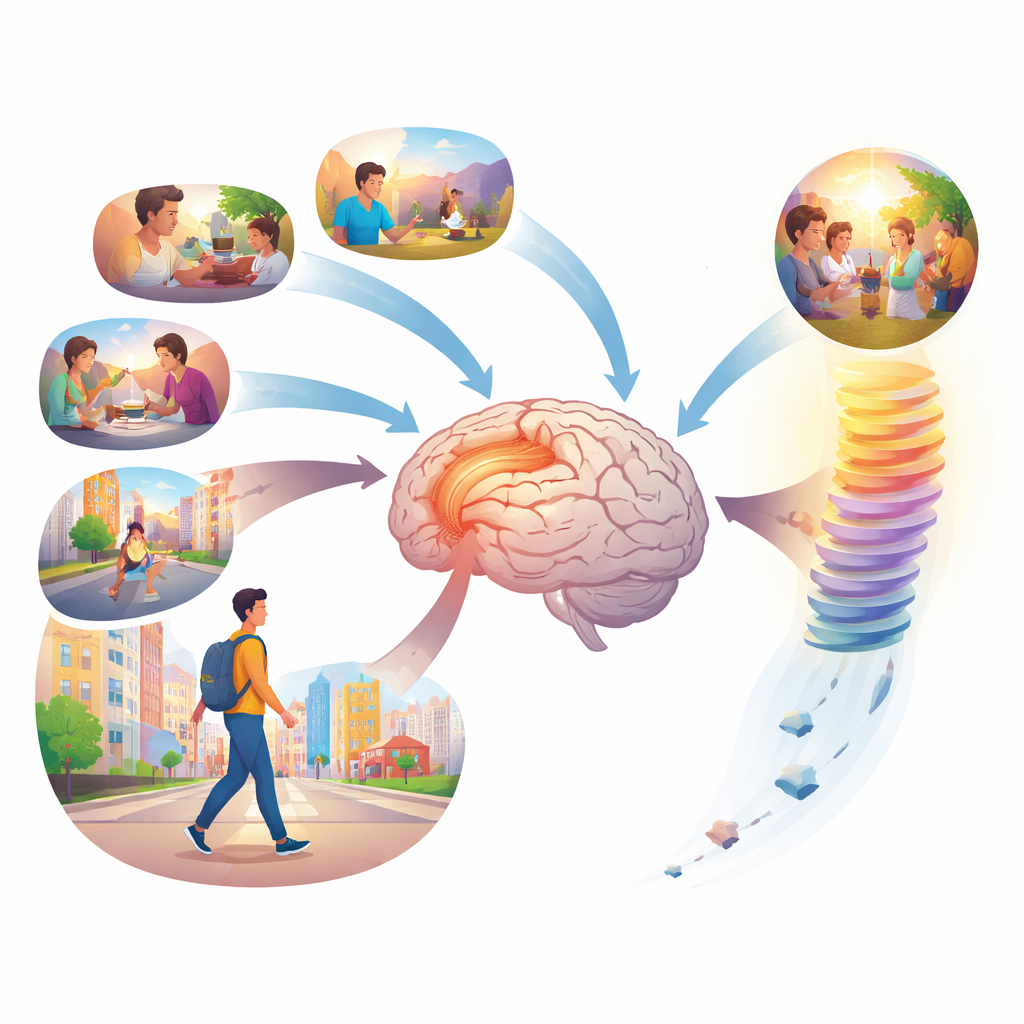
To study memory in lifelike conditions without losing scientific control, the team invited 60 healthy adults to stroll through a detailed virtual city that resembled Paris. Along the route, each person encountered 30 brief scenes: some pleasant, some neutral, some negative. In half of them, participants simply observed what was happening, such as a jogger running by; in the other half, they acted, for example donating coins to a street musician or trying to extinguish a small trash‑can fire. After this one‑time tour, they rated each event on how emotional, self‑relevant, and image‑rich it felt, and how likely they thought they were to think or talk about it later.
Remembering now, remembering later
The researchers then split people into two groups. One group was tested three times: immediately after the walk, a week later, and a month later. The other group had no interim tests and was only examined after a month. At each test, volunteers freely described as many events as they could, including what happened, where and when it occurred, and how they felt and thought at the time. Finally, everyone completed a recognition test in which they decided whether pictures came from their original virtual walk or were similar but new scenes designed to trick them.

Replay boosts detail—but invites mistakes
One month later, those who had practiced recalling the events performed clearly better in free recall. They remembered more scenes and, crucially, more details about what happened, where it occurred in the city, and when it took place along the route. In contrast, people who had not been tested in between lost much of this rich context, even though their ability to recognize the scenes from pictures was just as good. This suggests that the memories were still stored, but they were harder to access in a detailed, narrative way. However, there was a trade‑off: the reactivation group was more likely to confidently misidentify new but similar scenes as old ones, illustrating how revisiting memories can also open the door to subtle distortions.
What makes an experience stick
By linking long‑term memory performance to the original ratings made right after the walk, the study identified two core ingredients that supported lasting memories in both groups. First, events that felt more novel—less like everyday routines—were better remembered. Second, scenes that triggered richer mental images at encoding were more likely to be recalled later; people seemed to retain what they had pictured most vividly. When participants experienced intermediate reactivations, extra factors came into play: emotionally negative or otherwise emotionally charged events, and episodes they expected to think or talk about in the future, were especially well preserved. In addition, physiological arousal measured through skin conductance during the walk weakly predicted later memory quality, but only for those who went through repeated recall sessions.
Why this matters for everyday life and health
Altogether, the findings support a dynamic view of memory. Our personal memories are not fixed snapshots; they are living records that depend both on how we first experience an event and on how often and how deeply we revisit it. Reactivating memories—through reflection, conversation, or therapy—can help preserve the rich fabric of what, where, and when, but it can also make us more vulnerable to confident errors. By pinpointing the roles of novelty, mental imagery, emotion, and self‑relevance, this work offers clues for designing training and rehabilitation programs, for example in virtual reality, to strengthen healthy memory and carefully manage how past experiences are revisited in clinical settings.
Citation: Lenormand, D., Gaston-Bellegarde, A., Orriols, E. et al. The role of reactivations during consolidation in the structure and accessibility of episodic autobiographical memories. Sci Rep 16, 12778 (2026). https://doi.org/10.1038/s41598-026-37539-2
Keywords: autobiographical memory, memory consolidation, virtual reality, emotional events, memory reactivation