Clear Sky Science · en
Semantic centrality and emotional valence contribute to word memorability in an associative memory task for Chinese words
Why some words stick in our minds
We all know the feeling of certain words lingering in memory while others vanish almost instantly. This study asks why that happens for Chinese words. By looking at how words are related in meaning, and whether they carry emotional weight, the researchers show that both a word’s place in a network of meanings and the feelings tied to it help determine how memorable it is—but in some surprising ways.
Words in a web of meaning
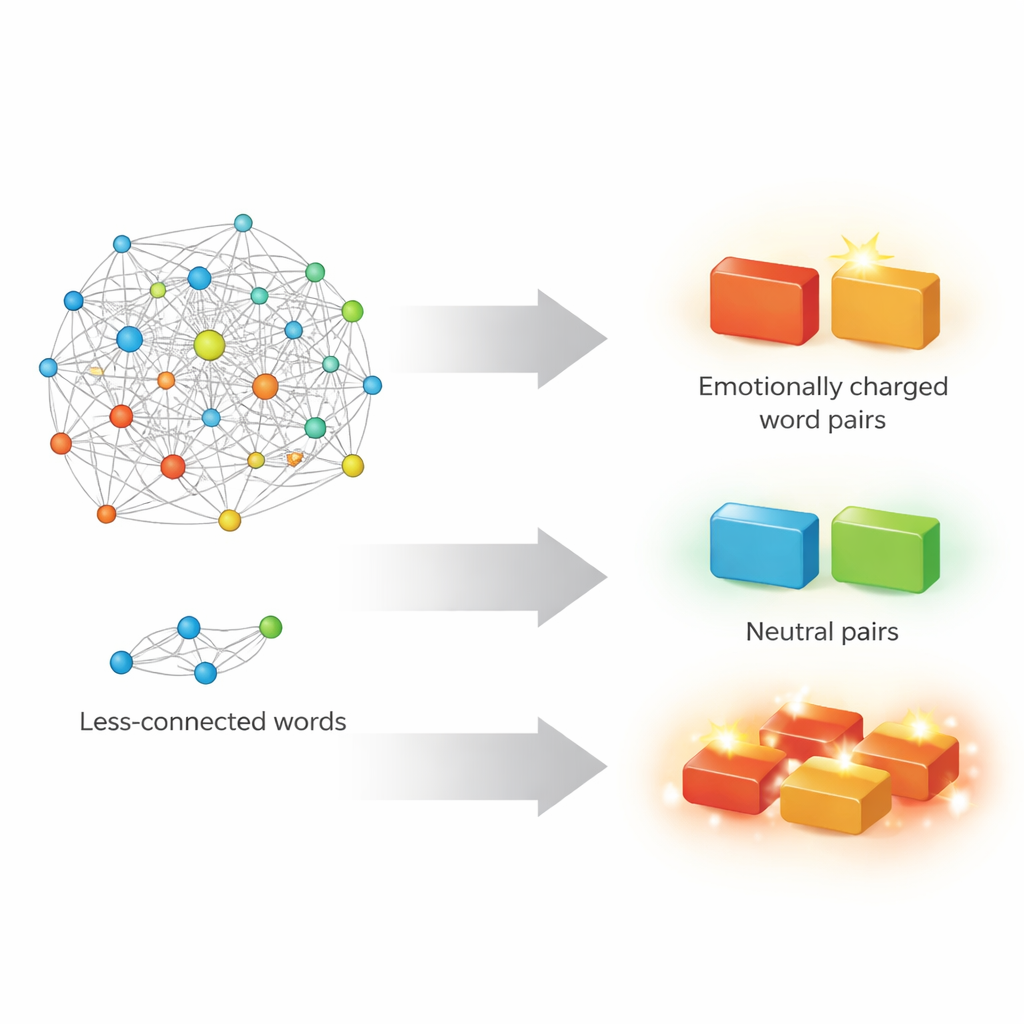
Every word lives in a mental neighborhood of related ideas: “wedding” may sit near “champagne,” “ring,” and “celebration.” The authors turned this intuition into a mathematical map for 300 two-character Chinese nouns, using a large text database to estimate how similar each word is to every other. A word that is strongly linked to many neighbors is said to have high “semantic centrality,” while a word with few or weaker links has low centrality. This property was treated as an intrinsic feature of each word, independent of any particular experiment or person.
Testing memory with word pairs
To see how this semantic web affects memory, the team ran three experiments with university students whose first language is Mandarin. In all experiments, participants saw pairs of Chinese nouns on a screen and tried to remember them. After a short distraction task, they saw one word from each pair and had to type the missing partner. This “cued recall” setup emphasizes connections between words rather than memory for single items alone. Across experiments, each word served many times as the missing partner, allowing the researchers to estimate how likely each word was to be successfully recalled—a direct measure of its memorability.
A surprising twist in word networks
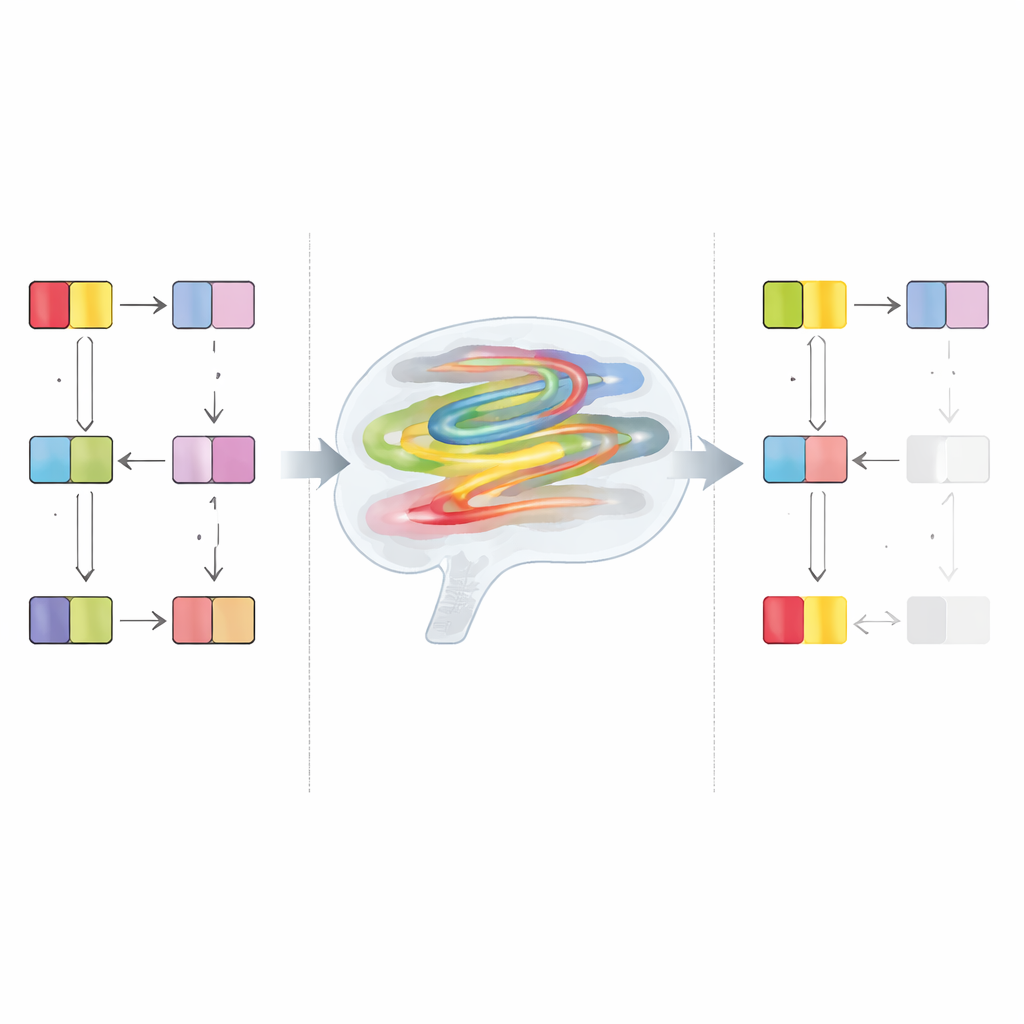
Previous work with English words found that highly central words—those tightly woven into the semantic web—were easier to recall. In contrast, this study consistently found the opposite pattern for Chinese nouns. Across all three experiments, words with lower semantic centrality were more likely to be remembered. In other words, words that were less enmeshed in the network of meanings stood out more and were recalled better. These effects remained even when other properties such as how often the word appears in print, how concrete it is, or how visually complex its characters are were taken into account. The result suggests that in Chinese, distinctiveness in the semantic landscape may aid memory more than connectedness.
Feelings that bind word pairs
The second and third experiments added emotional flavor by including positive, negative, and neutral nouns. The focus was not just on whether a single word was emotional, but on how well-matched the feelings of each pair were. When both words in a pair carried emotion—whether both positive, both negative, or one of each—memory for the missing partner was better than when at least one word was neutral. Pairs in which both words were positive showed the strongest advantage. Importantly, this emotional “boost” did not vanish when the researchers controlled for other word features, indicating that emotion provides genuinely extra help for forming and retrieving associations.
Independent roles for meaning and emotion
When the team modeled the data, the semantic and emotional effects added together rather than interacting. Low-centrality words were more memorable, and emotionally matched pairs were more memorable, but these two influences did not amplify or cancel each other. The authors suggest that the unusual role of semantic centrality in Chinese may reflect differences in language structure—such as heavy use of meaningful character combinations—or in cultural habits of holistic versus analytic thinking. Whatever the deeper cause, the key takeaway is clear: in Chinese associative memory, words that are a bit off the beaten semantic path, and that are woven into emotionally coherent pairs, are especially likely to stick in mind.
Citation: Haoyu, Z.A., Bainbridge, W.A., Sun, P. et al. Semantic centrality and emotional valence contribute to word memorability in an associative memory task for Chinese words. Sci Rep 16, 11047 (2026). https://doi.org/10.1038/s41598-026-37531-w
Keywords: word memorability, Chinese language, semantic networks, emotion and memory, associative recall