Clear Sky Science · en
Evaluation of the durability and shielding properties of high-strength concrete incorporating locally available materials and carbon additives
Concrete That Does More Than Just Hold Up Buildings
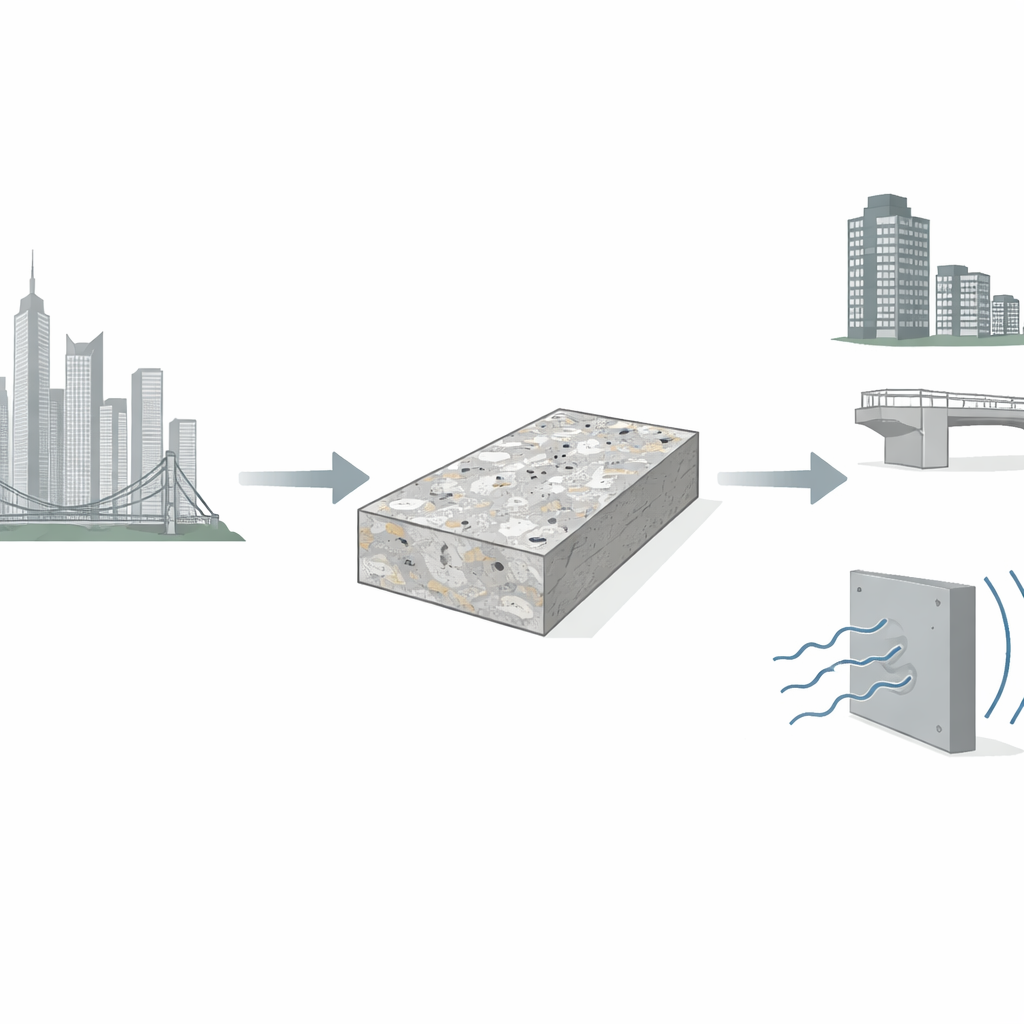
From skyscrapers crowded with electronics to bridges packed with sensors, modern structures need materials that are not only strong but also smart. This study explores a new kind of concrete that can both carry heavy loads and help shield sensitive equipment from stray electromagnetic waves, the same kind of energy used in Wi‑Fi, radar, and mobile phones. By carefully adjusting local sands and adding tiny bits of steel and carbon, the researchers set out to create concrete that is tough, durable, and able to weaken unwanted signals—without relying on expensive imported ingredients.
Why Strong and “Smart” Concrete Matters
Traditional high‑strength concrete allows engineers to build taller, slimmer towers and longer bridges by packing more load‑bearing capacity into smaller columns and slabs. Separately, “conductive” concrete, which carries electric current thanks to metal or carbon additives, has gained interest for purposes like self‑heating pavements, built‑in strain sensing, and electromagnetic shielding. But combining these two abilities in a single mix is challenging: ingredients that help conduct electricity can also weaken the material or make it more prone to cracking over time. The goal of this research was to close that gap and develop conductive high‑strength concrete that meets structural demands while adding useful electrical behavior.
Shaping the Right Mix with Local Sands
The team started by designing several high‑strength concretes using only fine materials—cement, industrial by‑products, and two types of sand—while leaving out coarse gravel. They varied the amount of “dune sand,” a very fine local sand, to see how it affected strength. By comparing the grain size distribution of each mix to mathematical packing models, they found that a recipe with a relatively low portion of dune sand formed the densest internal structure. This mix, called LDUNE in the study, reached compressive strengths of about 100 megapascals (roughly three times that of common structural concrete) and showed the highest bending strength as well. In simple terms, a modest amount of desert sand helped fill voids, but too much created extra gaps and weakened the concrete.
Steel Fibers Help, Carbon Powders Hurt the Structure
Once the best base mix was identified, the researchers turned it into three variants: the original LDUNE, a version with added steel fibers, and a third that combined steel fibers with fine carbon powders. The thin steel fibers acted like tiny reinforcing bars scattered through the material. They slightly increased the already high compressive strength, boosted bending strength by about one‑fifth, and made the concrete stiffer. Just as important, they cut long‑term shrinkage and creep—the slow tightening and sagging that can lead to cracking—by roughly a quarter and a tenth, respectively. In contrast, when carbon powders were added alongside the fibers, overall strength dropped, and both shrinkage and creep increased. The very fine carbon particles demanded more mixing water and did not bond well with the surrounding paste, creating weak spots that undermined the mechanical benefits of the fibers.
How the New Concrete Handles Electromagnetic Waves
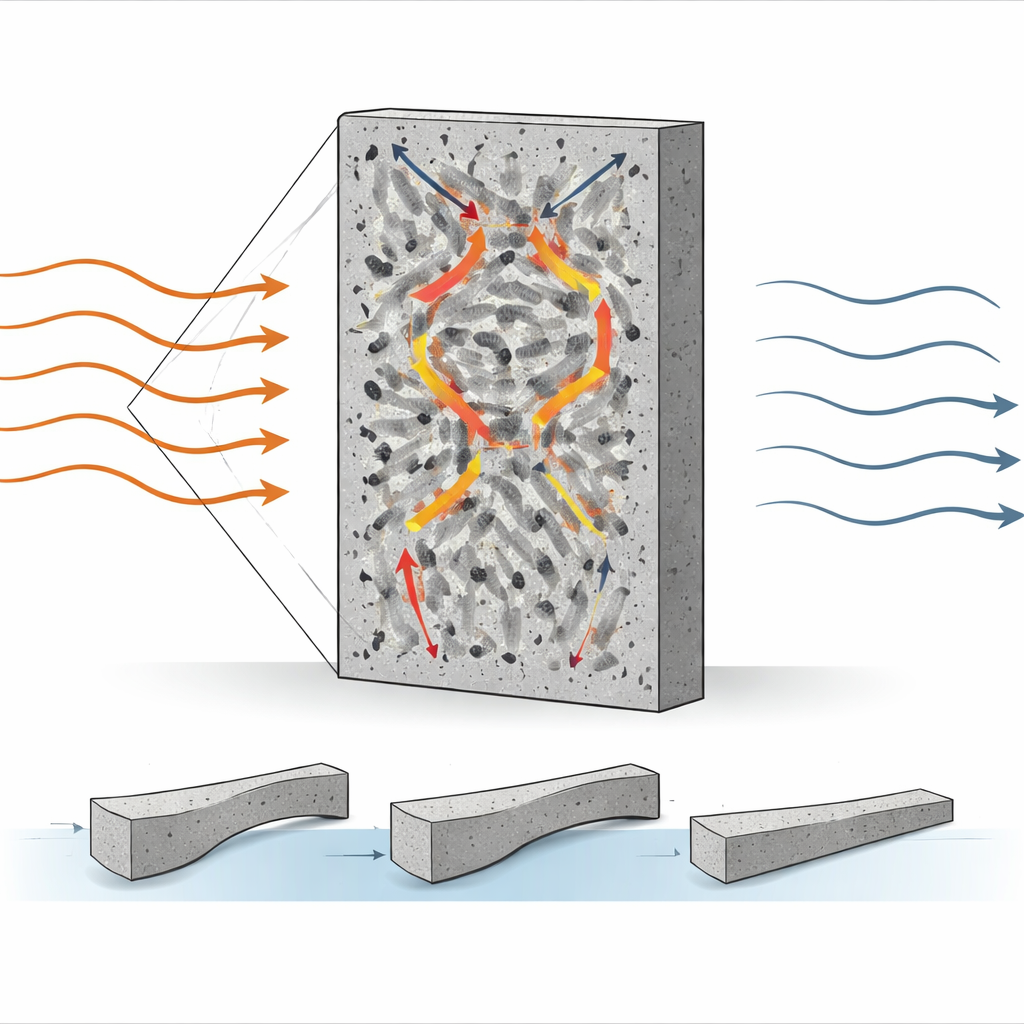
The electrical tests focused on how well the mixes conducted current and blocked radio‑frequency signals. The steel‑fiber concrete showed significantly lower electrical resistivity than the plain high‑strength mix, forming internal pathways that interact with passing waves. When radio signals in the gigahertz range were sent through thin panels, the steel‑fiber slabs cut the outgoing power far more than ordinary concrete, approaching the performance of some existing shielding materials. Surprisingly, adding carbon powder on top of the steel fibers did not deliver a meaningful extra benefit: its panels attenuated signals to about the same degree as those with steel alone. Over a two‑year period, all mixes lost some shielding power as the concrete continued to harden and its internal moisture changed, but corrugated panel shapes maintained better long‑term performance than flat ones.
What This Means for Future Buildings and Infrastructure
For everyday terms, the study shows that it is possible to make concrete that is both very strong and reasonably good at softening stray electromagnetic waves, simply by optimizing local sands and adding the right amount of steel fibers. This “dual‑purpose” concrete stands up well under load, resists long‑term cracking, and can help protect devices and spaces from electronic noise, without resorting to metallic linings or specialized wall systems. Attempts to further improve shielding by sprinkling in carbon powders, however, had trade‑offs: they made the material weaker and more prone to long‑term deformation while adding little to its ability to block signals. For designers of high‑rise buildings, smart infrastructure, and facilities packed with electronics, steel‑fiber high‑strength concrete using local materials emerges from this work as a practical, multifunctional option.
Citation: Othman, O., Yehia, S., Qaddoumi, N. et al. Evaluation of the durability and shielding properties of high-strength concrete incorporating locally available materials and carbon additives. Sci Rep 16, 10167 (2026). https://doi.org/10.1038/s41598-026-37449-3
Keywords: high-strength concrete, conductive concrete, steel fiber reinforcement, electromagnetic shielding, shrinkage and creep