Clear Sky Science · en
Noninvasive temperature sensing technologies and the role of ferromagnetic nanoparticles in future applications
Why Keeping Fuel Cells Cool Matters
Hydrogen-powered vehicles promise clean, quiet transport, but inside their fuel cells things can get hot and complicated. Tiny differences in temperature deep within a fuel cell can decide whether it runs efficiently for years or fails prematurely. Yet those temperatures are hidden behind sealed layers of material, where conventional thermometers cannot reach without disturbing the system. This study explores a new way to take a temperature map from outside the cell, using special magnetic particles and a beam of neutrons as a kind of remote thermal camera. 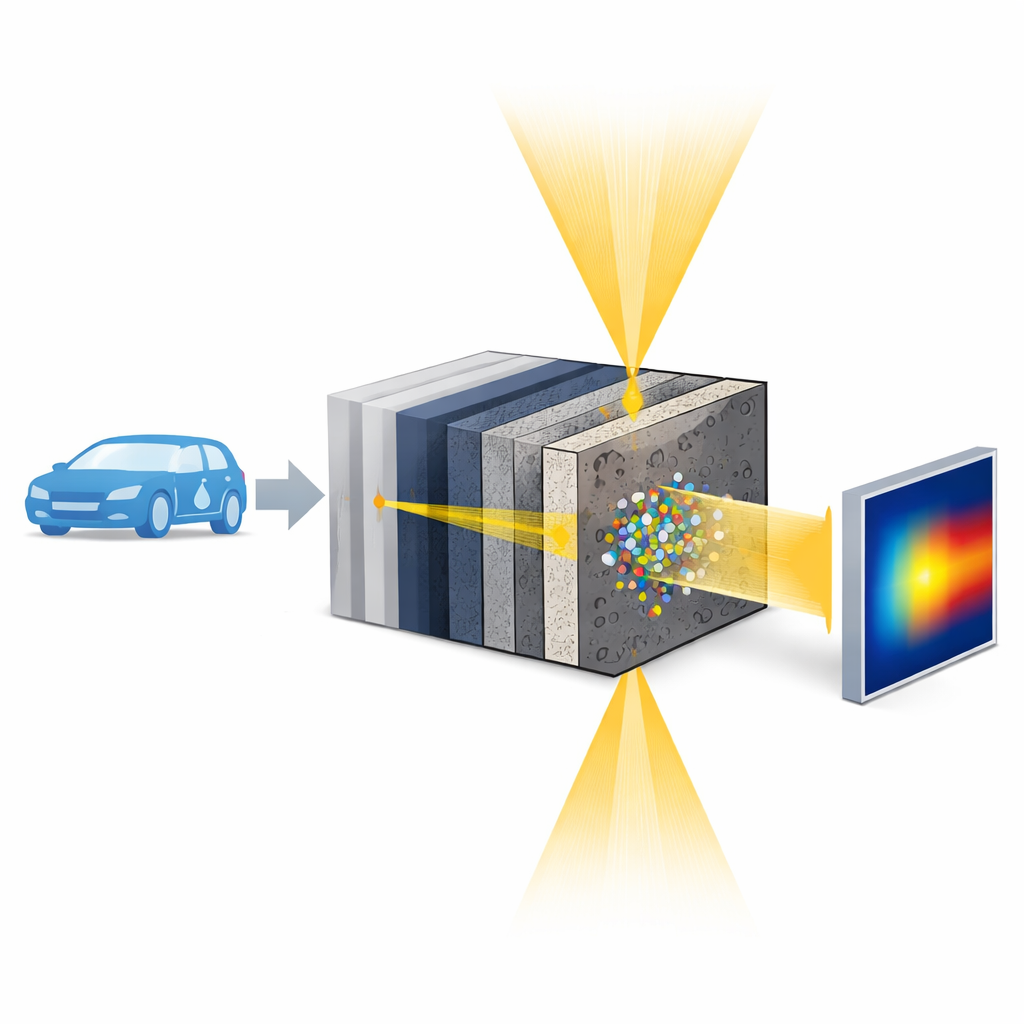
How a Fuel Cell Works Under the Hood
Polymer electrolyte fuel cells, the type targeted in this work, power many prototype hydrogen cars and trucks because they are compact, light and operate at relatively low temperatures around 80 °C. At their heart is a thin membrane assembly that guides protons while forcing electrons to flow through an external circuit, delivering useful electricity. As hydrogen and oxygen react, the cell also produces heat and water, which must be carefully balanced: too much water floods the tiny pores and chokes off gas access; too little dries out the membrane and shortens its life. Temperature gradients inside the membrane and porous gas diffusion layers strongly influence where water forms and evaporates, but measuring those gradients without cutting into the cell has long been a major challenge.
Limits of Today’s Thermometers
Researchers have tried several clever solutions to this measurement problem, from embedding micro-thermocouples between membrane layers to adding thin metal foils, infrared windows and microscopic electronic chips. Each method came with trade-offs. Physical sensors were often too large, disrupting proton transport or gas flow. Optical approaches needed clear lines of sight or transparent parts, forcing awkward redesigns of the fuel cell hardware and sometimes encouraging unwanted water accumulation. Even when the materials themselves could survive the harsh environment, their sensitivity to small temperature changes was limited. The field needs a technique that can sense temperature from outside, without rewiring the cell’s structure or blocking its electrochemistry.
Using Tiny Magnets as Invisible Thermometers
The authors propose a different strategy: sprinkle ferromagnetic particles, made of nickel or iron, into the porous layers of the fuel cell and read their temperature-dependent magnetism using polarized neutron imaging. These materials behave like many tiny bar magnets whose strength and internal domain structure subtly change with temperature, especially near their characteristic Curie temperature. When a beam of polarized neutrons passes through a region filled with such particles, the neutrons’ spins precess and become partly scrambled, an effect known as depolarization. By capturing images of how much the neutron polarization is reduced after crossing different regions, experimenters can infer where the material is hotter or colder, effectively building a two-dimensional temperature map from outside the sealed cell. 
Finding the Right Size and Amount of Particles
To see whether this idea is practical, the team systematically tested nickel and iron powders spanning from bulk grains down to tens of nanometers, mixing them with a Teflon-like powder to mimic the pores of a real gas diffusion layer. They measured each sample’s magnetic behavior and its effect on neutron depolarization over temperatures from 30 to 100 °C. A clear trade-off emerged. Very small particles showed the strongest relative change in signal with temperature, meaning they are highly sensitive sensors. However, their absolute depolarization—how big the signal is in the first place—was much weaker, in part because their magnetic saturation drops at the nanoscale and their smaller magnetic domains disturb the neutron beam less. Larger particles, particularly bulk nickel, produced much stronger depolarization and larger absolute changes with temperature, making them easier to detect at low concentrations.
Balancing Sensitivity with Real-World Constraints
The researchers then compared these measurements with a theoretical model that relates particle size, magnetic strength and neutron behavior. The model agreed well with the data, reinforcing the physical picture. When they added practical constraints from fuel cell design—fibers around 10 micrometers thick and pores near 20 micrometers across—it became clear that truly bulk particles are too large to be embedded without blocking pathways. At the same time, the tiniest nanoparticles would have to be loaded at unacceptably high concentrations to generate a readable signal. From this analysis, the authors identify an appealing compromise: nickel particles shrunk from bulk down to roughly one micrometer should retain much of bulk nickel’s excellent temperature response and neutron visibility while still fitting comfortably within the porous network.
What This Means for Future Clean Energy Devices
In simple terms, the study shows that you can turn tiny magnetic grains into internal thermometers for fuel cells and read them from outside using a specialized neutron imaging technique. The work clarifies how particle size and composition determine the strength and temperature sensitivity of the signal, and it points to micron-scale nickel as a sweet spot between strong detection and gentle integration. If such particles can be uniformly embedded into real fuel cell layers using standard manufacturing steps, engineers could one day watch temperature patterns evolve inside working devices without opening them up. That capability would help diagnose problems like flooding or dehydration, improve designs and extend the life of hydrogen-powered vehicles and other clean energy systems.
Citation: Ruffo, A., Busi, M., Strobl, M. et al. Noninvasive temperature sensing technologies and the role of ferromagnetic nanoparticles in future applications. Sci Rep 16, 13611 (2026). https://doi.org/10.1038/s41598-026-37266-8
Keywords: polymer electrolyte fuel cells, magnetic nanoparticles, neutron imaging, temperature sensing, hydrogen energy