Clear Sky Science · en
Numerical modeling of CZTS based heterostructured solar cell for high efficiency PV performance
Turning Sunlight into Cleaner Power
Solar panels are already a familiar sight on rooftops and in fields, but today’s technology still leaves a lot of sunlight unused. This study explores a new way to design thin-film solar cells using earth-abundant, non-toxic materials, aiming to squeeze more electricity out of every ray of sunshine. By carefully rethinking the layers inside a solar cell, the authors show—through computer simulations—how to boost efficiency while avoiding rare or hazardous elements such as cadmium. Their findings point toward cheaper, safer solar power that can be scaled up worldwide.

A New Recipe for Thin-Film Solar Cells
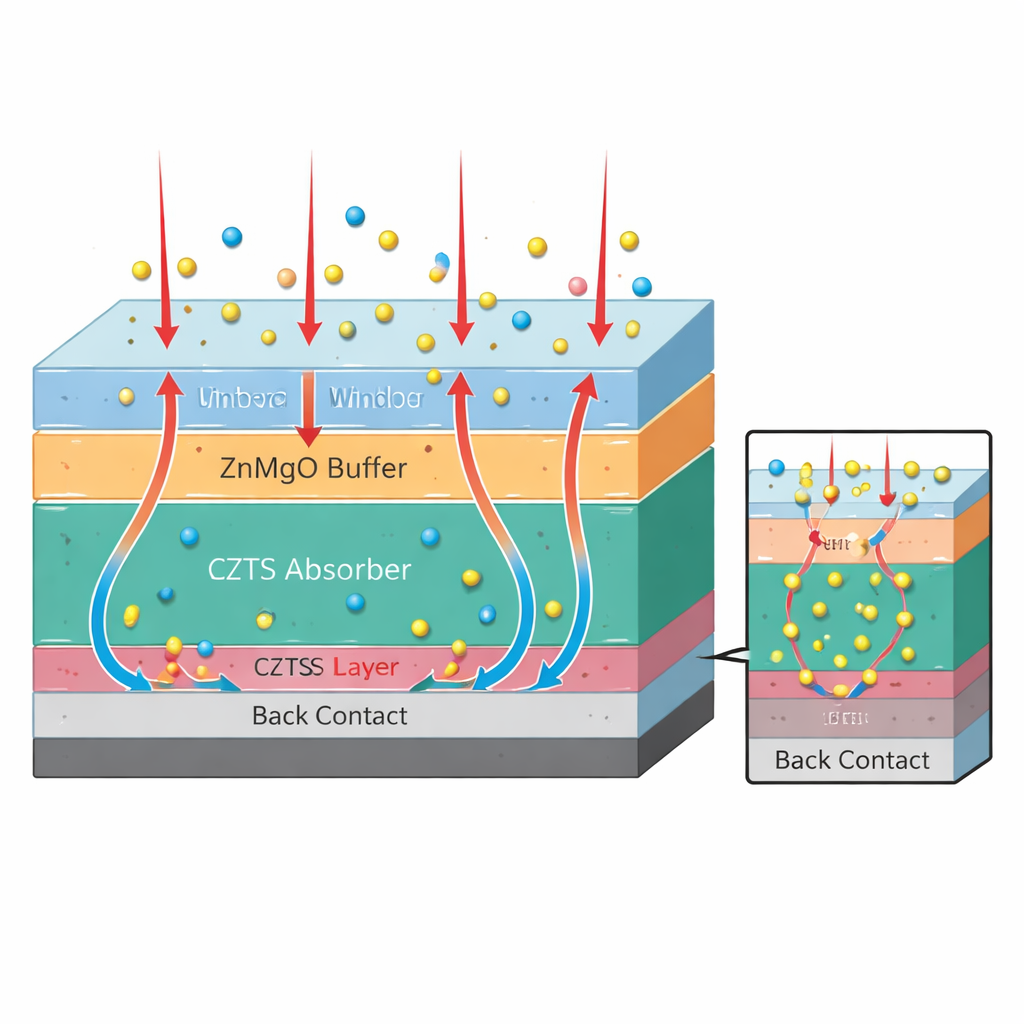
The work focuses on solar cells built around a material called CZTS, made from copper, zinc, tin, and sulfur—elements that are plentiful and environmentally friendly. In conventional thin-film devices, CZTS often sits next to a buffer layer made of cadmium-based compounds that help guide charges but raise toxicity concerns. The authors instead use a buffer made from ZnMgO, an alloy of zinc, magnesium, and oxygen. This layer is chosen because it pairs well with the surrounding materials, reduces internal strain, and wastes fewer incoming photons. The team models a realistic, multi-layer stack that includes a transparent conducting top layer, a thin insulating window, the ZnMgO buffer, and one or two CZTS layers on a metal back contact.
Adding a Helper Layer at the Back
The key twist in the design is a so-called back-surface field (BSF) layer, created by splitting the CZTS absorber into two parts. The main absorber (CZTS1) captures most of the light, while a much thinner, more strongly doped CZTS2 layer is added just above the rear metal contact. This extra layer acts like a gentle barrier that pushes minority charge carriers away from the back contact, where they would otherwise be lost, and steers them back toward the front of the device where they can be collected as current. By comparing simulated devices with and without this BSF layer, the authors show that the modified structure can significantly reduce unwanted recombination of charges deep inside the cell.
Fine-Tuning Layers, Defects, and Contacts
To understand what really matters for performance, the researchers systematically vary many design knobs in their computer model. They scan through different energy gaps for the two CZTS layers, adjust their thicknesses, and change how strongly they are doped with charge-carrying atoms. They also explore the impact of crystal defects, which act as traps that kill useful charges, and test a range of electrical contact properties. The sweet spot they identify uses a slightly wider energy gap for the front CZTS1 layer and a slightly narrower one for the rear CZTS2 BSF layer, with thicknesses of about 800 nanometers and 70 nanometers, respectively. Keeping defect levels low in the absorber proves crucial: as defect density rises, simulated efficiency collapses from around 24% to only a few percent. Choosing a suitable metal for the back contact, with a work function that forms a good electrical match to CZTS, further improves extraction of charges.
How Heat and Electrical Losses Shape Performance
Real solar panels must operate under hot sunlight and imperfect wiring, so the team also examines temperature and resistive losses. As the modeled device warms from 300 to 400 kelvin (roughly from room temperature to a very hot day), the open-circuit voltage gradually falls because the material’s energy gap shrinks and charges recombine more easily. Current changes only slightly, but the net effect is a steady drop in efficiency. Similarly, the simulations show that low series resistance (the internal “friction” to current flow) and high shunt resistance (which suppresses leakage paths) are both essential. Using experimentally realistic resistance values from earlier studies, the optimized design with the BSF and ZnMgO buffer reaches a power conversion efficiency of 23.67%, about four percentage points higher than an otherwise similar cell without the BSF.
What This Means for Future Solar Panels
To a non-specialist, the message is straightforward: by carefully arranging and tuning ultra-thin layers inside a solar cell, it is possible to get more power from safer, more abundant materials. The combination of a ZnMgO buffer and a tailored CZTS back-surface field layer helps guide photo-generated charges to the right place before they are lost, much like shaping the banks of a river to channel more water through a turbine. While these results come from detailed numerical modeling rather than factory-built panels, they provide a practical roadmap for experimentalists. If realized in the lab, this design could pave the way for low-cost, high-efficiency, and environmentally friendly solar modules suitable for large-scale deployment.
Citation: Dakua, P.K., Bhadauria, R.V.S., Jayakumar, D. et al. Numerical modeling of CZTS based heterostructured solar cell for high efficiency PV performance. Sci Rep 16, 14618 (2026). https://doi.org/10.1038/s41598-026-37248-w
Keywords: CZTS solar cells, thin-film photovoltaics, back-surface field, ZnMgO buffer, solar cell simulation