Clear Sky Science · en
Assessing the influence of using nano titanium dioxide on the microstructure behavior and geotechnical properties of clayey soil
Why stronger ground matters
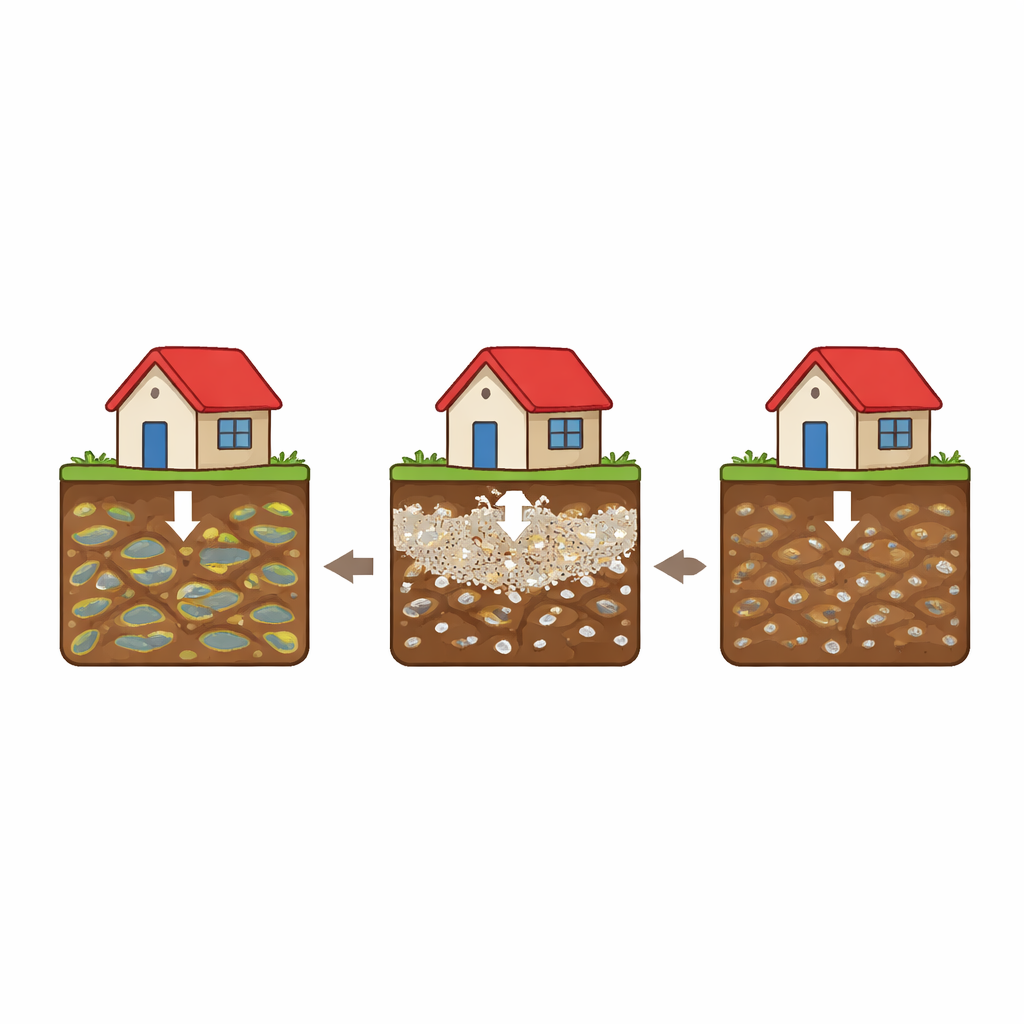
Buildings, roads, and embankments all rely on the soil beneath them to stay safe and stable. In many regions, especially where clay is common, the ground can be soft, weak, and easily deformed, forcing engineers to use more concrete, deeper foundations, or costly ground treatments. This study explores whether adding extremely small particles of titanium dioxide—measured in billionths of a meter—can help ordinary cement do a better job of firming up clay soils, making the ground stronger and more resilient without radically changing current construction practices.
Tiny helpers in the ground
The researchers focused on a natural clay from northern Iran, a typical "everyday" construction soil that is neither extremely weak nor particularly strong. They mixed this clay with small amounts of ordinary Portland cement, which is already widely used to stabilize soft ground, and then blended in nano titanium dioxide at very low dosages. These nanoparticles are so small that they can occupy the tiniest gaps between clay grains. By carefully varying the cement content and nanoparticle content, the team could see when the particles helped and when they did not. This approach mirrors real-world decisions, where engineers must balance added strength against cost and practicality.
How the soil behaved in the lab
To understand how the treated soil would respond in the field, the team ran a suite of classic geotechnical tests. They first measured how much water the soil could hold while still behaving like a plastic, moldable material. Adding nano titanium dioxide made both the liquid and plastic limits climb, meaning the clay could take up more water without turning to sludge or crumbling. Next, they performed unconfined compression tests, which simply squeeze cylindrical soil samples until they fail, and direct shear tests, which slide soil blocks past each other to mimic how the ground might give way along a surface. Across these tests, the presence of nanoparticles consistently boosted strength when enough cement was present, and it increased the soil’s resistance to sliding without noticeably changing the "stickiness" or cohesion between grains.
What happens inside the soil
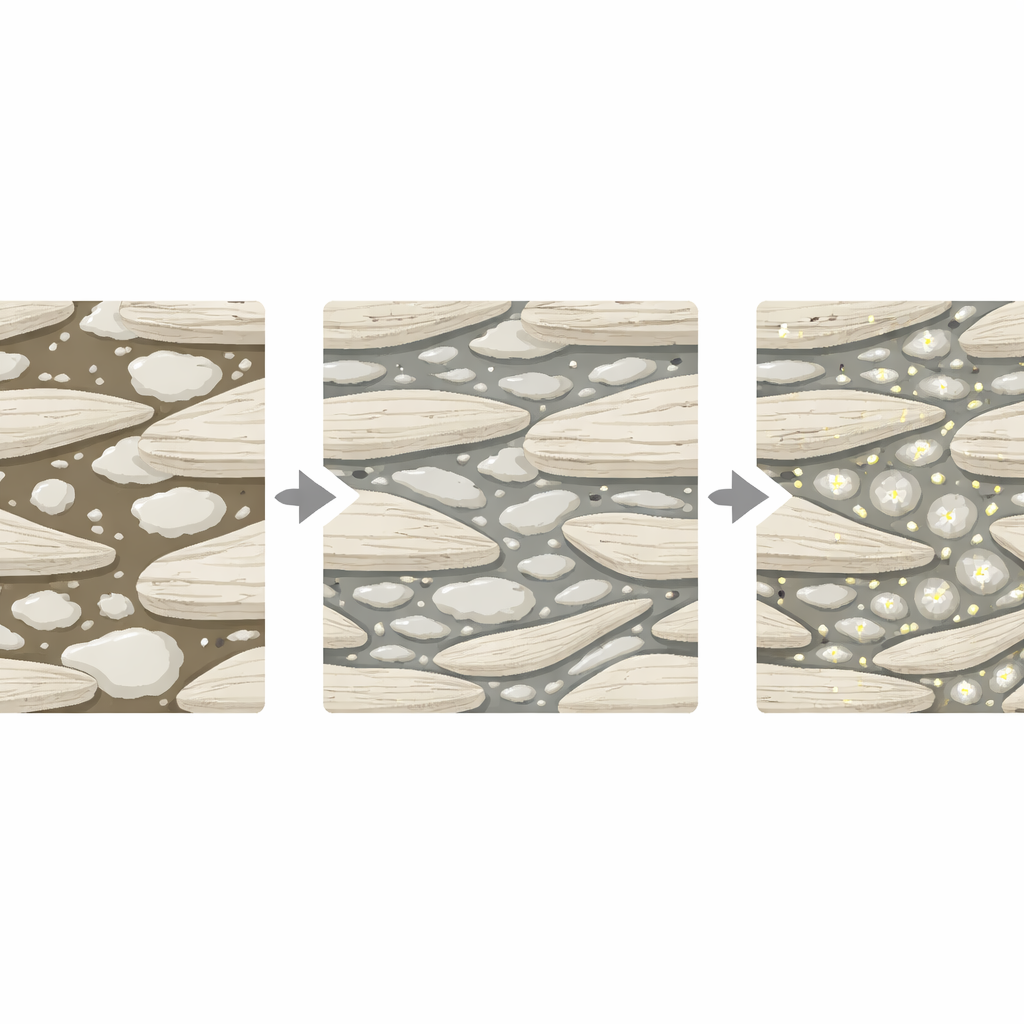
The most revealing insights came from looking directly at the soil’s inner structure using electron microscopy. Untreated clay mixed with cement showed a relatively loose fabric, with visible pores and interrupted contacts between particles. When a modest amount of nano titanium dioxide was added, these images changed: pores between clay and cement grains became smaller and less connected, and the particles appeared more tightly packed. This indicates that the nanoparticles act like ultra-fine filler, tucking into spaces that cement paste alone does not fully occupy. They also provide extra surfaces where cement crystals can begin to grow, gently speeding and spreading the hardening process without introducing new chemical reactions of their own.
Finding the sweet spot
The experiments also showed that more is not always better. At low cement contents, adding too many nanoparticles did little to further increase strength and could even cause slight reductions, likely because the tiny particles clumped together instead of spreading evenly. At higher cement levels, however, strength continued to rise with increasing nano titanium dioxide, up to the largest dose tested. Over days and weeks of curing, the treated soils kept gaining strength, suggesting that the improved packing and extra nucleation sites for cement continued to refine the microstructure over time. In practice, this means that the best dosage of nanoparticles depends on how much cement is available and how long the soil will be allowed to cure.
What this means for real-world building
In plain terms, the study finds that nano titanium dioxide behaves like a smart, passive ingredient that helps cement-treated clay soils become denser and more resistant to deformation, especially in terms of how they carry weight and resist sliding, rather than making them chemically different. It does not replace cement or turn the soil into a new material, but it does make the cement work more efficiently when used in the right amounts. For engineers, this points to a future where ground improvement can be fine-tuned from the inside out, using tiny particles to tailor strength and stability while potentially reducing the need for more heavy-handed measures.
Citation: Choobbasti, A.J., Kutanaei, S.S., Vafaei, A. et al. Assessing the influence of using nano titanium dioxide on the microstructure behavior and geotechnical properties of clayey soil. Sci Rep 16, 10002 (2026). https://doi.org/10.1038/s41598-026-37167-w
Keywords: soil stabilization, nanoparticles, clay soil, cement-treated ground, geotechnical engineering