Clear Sky Science · en
A city-based framework identifies wild Hedychium species suitable for near-nature urban landscaping in China
Why wild flowers matter to city life
Cities everywhere are trying to stay cooler, greener, and more livable as the climate warms. One promising but underused tool is wild ornamental plants that can flourish in parks and streetscapes with little or no watering. This study focuses on Hedychium, a group of showy ginger lilies native to tropical and subtropical Asia, and asks a practical question: which species can be planted in Chinese cities in a near-wild way, thriving mostly on local rainfall while helping make urban life more pleasant and resilient to climate change?
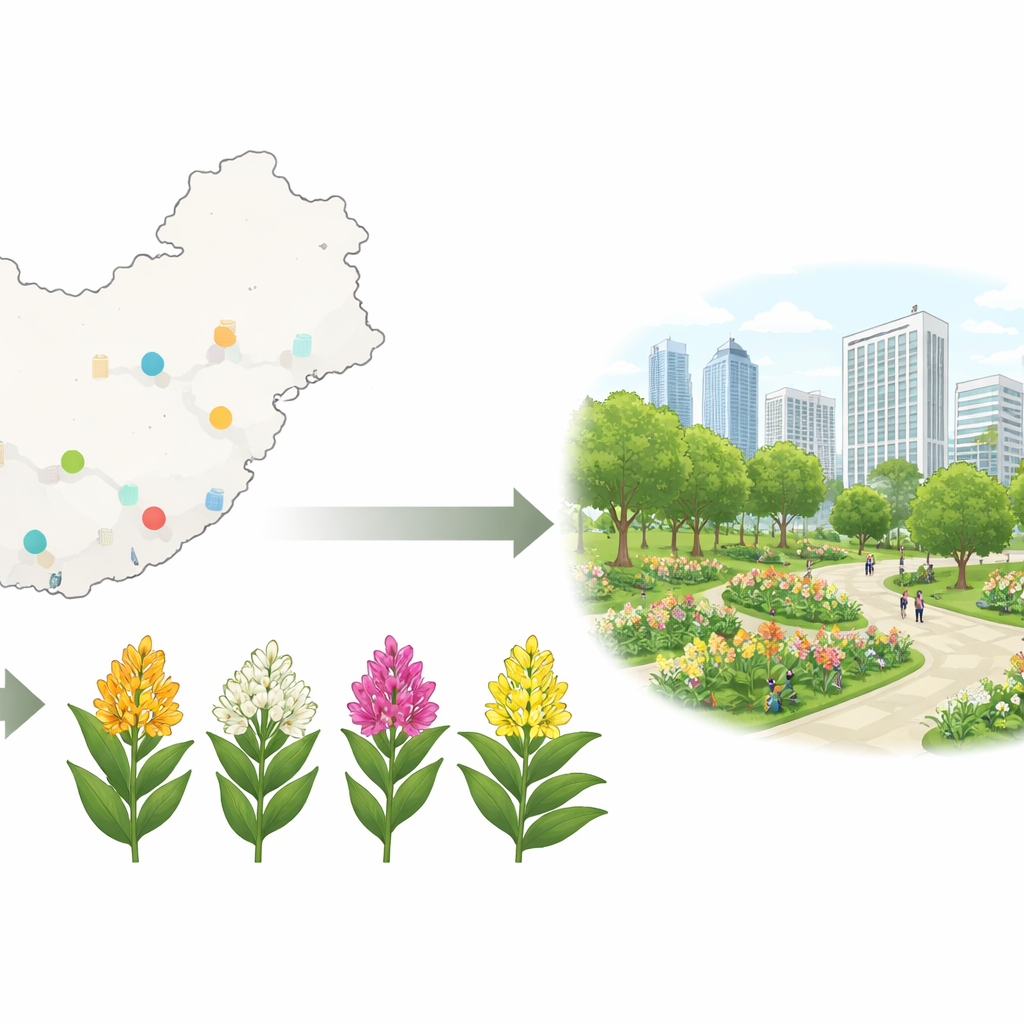
From wild mountains to city parks
The authors start from a simple idea: plants that already thrive in certain wild climates should also do well in cities with similar temperature and rainfall, without expensive irrigation or soil replacement. They selected four Hedychium species that represent different ecological types, from evergreen lowland forms to a cold-tolerant mountain specialist. Using detailed records from herbarium specimens, field surveys, and trial plantings, they mapped where each species occurs naturally across China. Then they combined these occurrence points with high‑resolution climate data to build computer models of each species’ preferred environmental conditions.
Using smart maps to guide planting
To translate this ecological knowledge into guidance for urban planners, the team used a popular species distribution tool called MaxEnt. Instead of trying to mimic every detail of a plant’s natural habitat, they focused on broad climate patterns—especially temperature and rainfall—that matter most when gardeners are not constantly tending plants. By feeding the model 19 climate variables, they generated maps showing how suitable each part of China is for planting the four Hedychium species under near-natural conditions. They then checked and refined these maps using real-world cultivation results from several cities, ensuring that “high suitability” on the map matched healthy, low‑maintenance growth in gardens.
How a warming climate reshapes flower-friendly cities
The study did not stop with today’s climate. The researchers projected their models into the 2070s under two standard climate scenarios: a moderate warming path and a high‑emissions, fossil‑fuel‑driven future. Across both, suitable zones for Hedychium generally shift northward and to higher elevations, echoing the broader pattern of species moving uphill and poleward as the planet warms. One species, Hedychium coccineum, gains the most new ground, taking advantage of milder winters. Others respond more delicately: Hedychium villosum expands in a moderate future but loses ground if warming becomes extreme, while the cold‑loving Hedychium sinoaureum shrinks along hot coastal lowlands yet finds new opportunities in cooler interior highlands.
Finding future-friendly flower hubs
By zooming in on 15 large Chinese cities, the team translated these broad shifts into clear recommendations. Kunming and Guiyang, plateau cities with mild, moist climates, consistently support all four species now and under both future scenarios, making them prime hubs for conservation plantings and demonstration gardens. Many southern cities—including Guangzhou, Nanning, Haikou, and Chengdu—can support two or three species, though the exact mix changes with the climate pathway. One species, Hedychium coronarium, stands out as the most reliable all‑rounder, remaining suitable across a wide swath of central and southern cities even as conditions change, and thus serving as a “safe bet” for low‑maintenance urban greening.
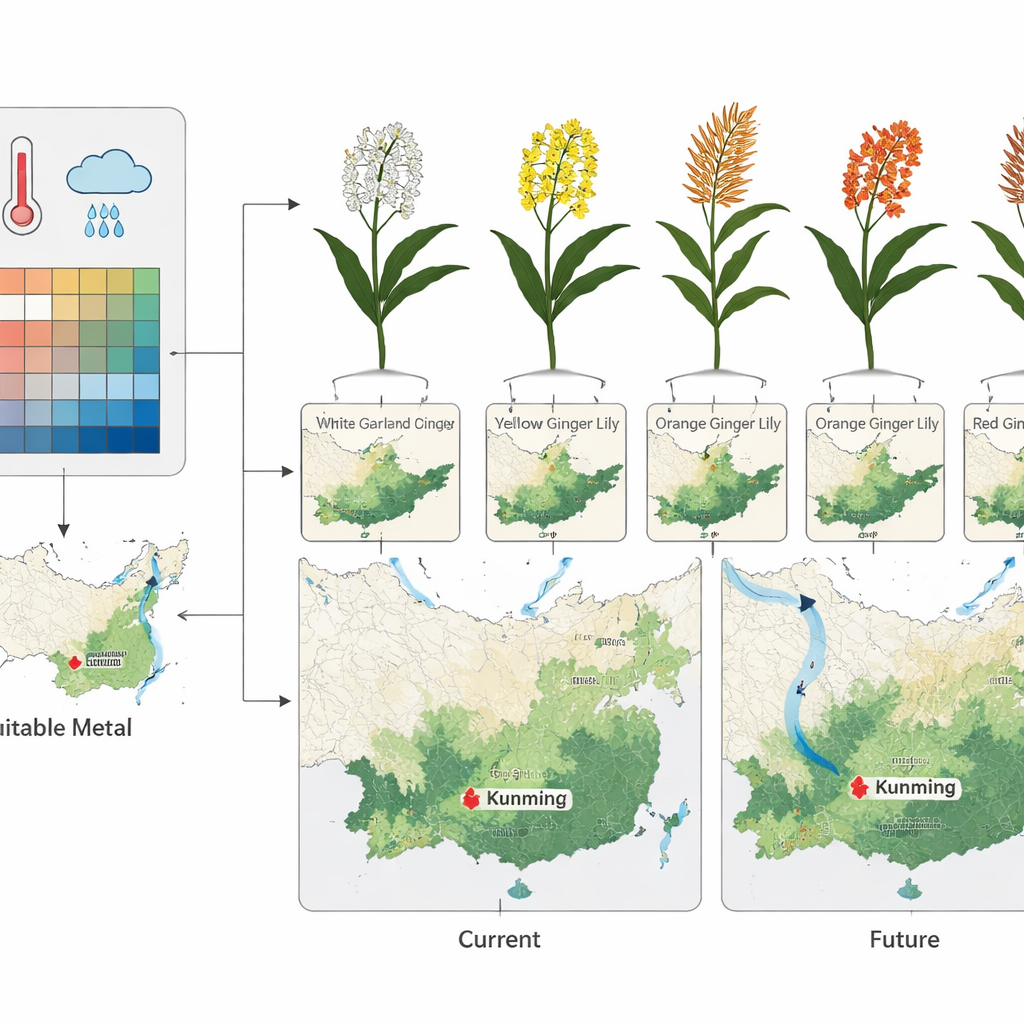
What this means for greener cities
For non‑specialists, the key message is that we can use smart ecological mapping to pre‑test which wild plants will thrive in future cities before expensive planting starts. By matching Hedychium species to cities whose climates already resemble their natural homes—or are expected to do so in coming decades—urban planners can create colorful, fragrant landscapes that need far less watering and care. This city‑based framework can be extended beyond ginger lilies to many other wild ornamentals, helping build cooler, more diverse, and more resilient urban green spaces while using water and other resources more wisely.
Citation: Liu, X., Lai, C., Zhong, Y. et al. A city-based framework identifies wild Hedychium species suitable for near-nature urban landscaping in China. Sci Rep 16, 11935 (2026). https://doi.org/10.1038/s41598-026-37132-7
Keywords: urban greening, climate-resilient plants, species distribution modeling, Hedychium ginger lily, near-natural landscaping