Clear Sky Science · en
Differentiable multiphase flow model for physics-informed machine learning in reservoir pressure management
Keeping Underground Pressure in Check
Deep underground, we inject and extract fluids for purposes like storing carbon dioxide, producing oil and gas, generating geothermal power, and disposing of wastewater. But pushing too hard on these hidden reservoirs can crack rocks, trigger earthquakes, or cause stored gases to leak. This paper presents a new way to use machine learning tightly coupled with physics-based simulation to keep subsurface pressure within safe limits, even when the underground geology is highly uncertain and complex.
Why Underground Pressure Is Hard to Control
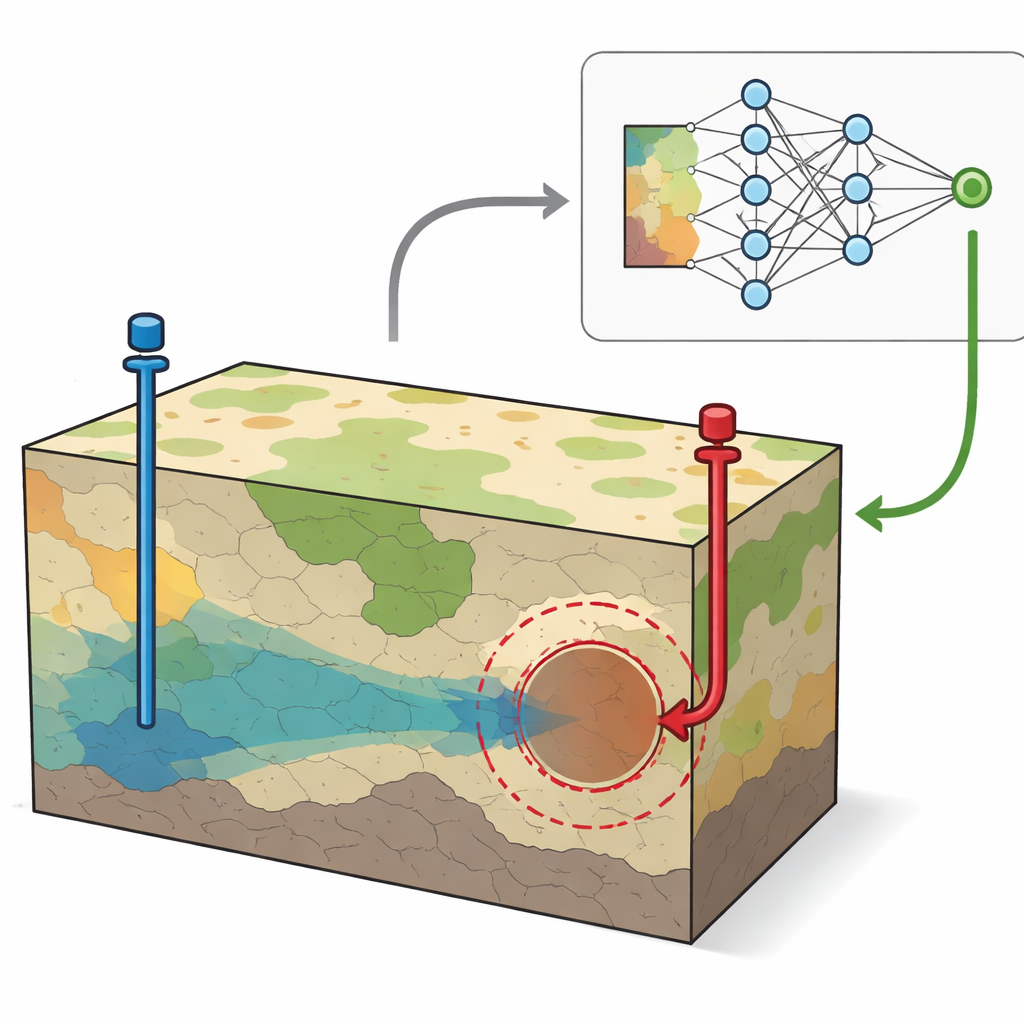
Subsurface reservoirs are anything but uniform. Rock layers vary in how easily fluids move through them, and several fluids can coexist and interact, such as water and gas. Engineers usually rely on detailed computer models to predict how pressure will evolve when they inject or remove fluid. These models must solve complicated equations and, when repeated thousands of times across many possible geological scenarios, they become too slow for practical use. Yet such repetition is exactly what is needed to avoid dangerous pressure build-up and to account for the large uncertainty in real underground formations.
Blending Physics and Machine Learning
The authors propose a physics-informed machine learning workflow that acts as a fast “surrogate” for the full simulator while still respecting the underlying physics. The core idea is to train a convolutional neural network—a type of model that excels at reading images—on two-dimensional maps of rock permeability. Given one such map, the network predicts how much fluid should be extracted at a well to keep the pressure at a nearby critical location within a prescribed limit during injection. Instead of training the network only on past data, the method embeds a full physics simulator directly inside the training loop. Each time the network proposes an extraction rate, the simulator computes the resulting pressure, and the network is adjusted based on how close that pressure is to the target.
From Simple to Complex Physics with Transfer Learning
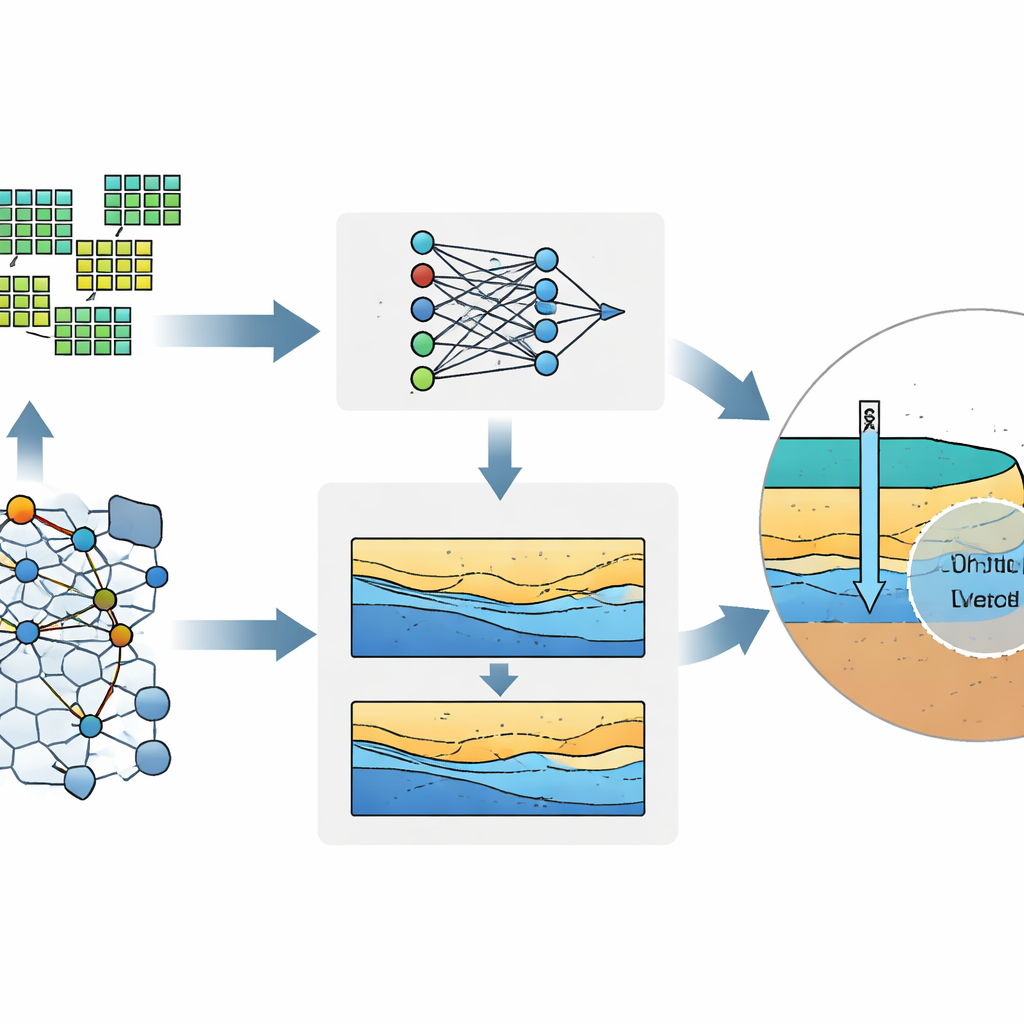
Because realistic underground flow involves multiple fluid phases and changes over time, directly training on full multiphase, time-dependent simulations would require an enormous number of expensive runs. Earlier estimates suggested tens of millions of simulations, which is not feasible. To overcome this, the authors use transfer learning: they first pretrain the neural network on a much simpler problem in which only one fluid phase moves and the system is in steady state. These simulations are cheap and let the model learn broad patterns that link rock properties to pressure control. Once the network has this foundation, it is then fine-tuned using a more realistic two-phase, time-dependent simulator that captures the interaction of injected and resident fluids.
How the New Workflow Performs
With this staged strategy, the authors show that high accuracy can be reached using fewer than three thousand full multiphase simulations—several orders of magnitude fewer than naive approaches would require. During training, they monitor how closely the predicted pressures match the target at the critical location and find that errors shrink smoothly and reach very small values after only a modest number of fine-tuning steps. When they test the trained model on ten thousand randomly generated permeability fields, the network consistently picks extraction rates that keep the pressure at the critical point near the desired level, even though the underlying rock properties vary across several orders of magnitude. The method is also extended to a three-dimensional setting with multiple injection and extraction wells, where it again maintains safe pressures at multiple critical locations.
What This Means for Real-World Operations
The study demonstrates that combining differentiable physics simulators with machine learning can provide a powerful tool for managing subsurface pressure under uncertainty. By learning directly from the governing equations, rather than relying on large historical datasets, the approach can be applied to new storage or extraction sites where data are scarce. It offers a path to faster, yet physically trustworthy, predictions that can support near real-time decision making. In practical terms, this means operators could better tune injection and extraction rates to avoid induced earthquakes and leakage risks while still meeting energy and storage goals.
Citation: Ur Rashid, H., Pachalieva, A. & O’Malley, D. Differentiable multiphase flow model for physics-informed machine learning in reservoir pressure management. Sci Rep 16, 10345 (2026). https://doi.org/10.1038/s41598-026-37063-3
Keywords: reservoir pressure management, physics-informed machine learning, multiphase flow, carbon storage, differentiable simulation