Clear Sky Science · en
Thermal variation associated stress response regulates the growth and reproductive potential of soybean looper
Why temperature matters for crop‑eating caterpillars
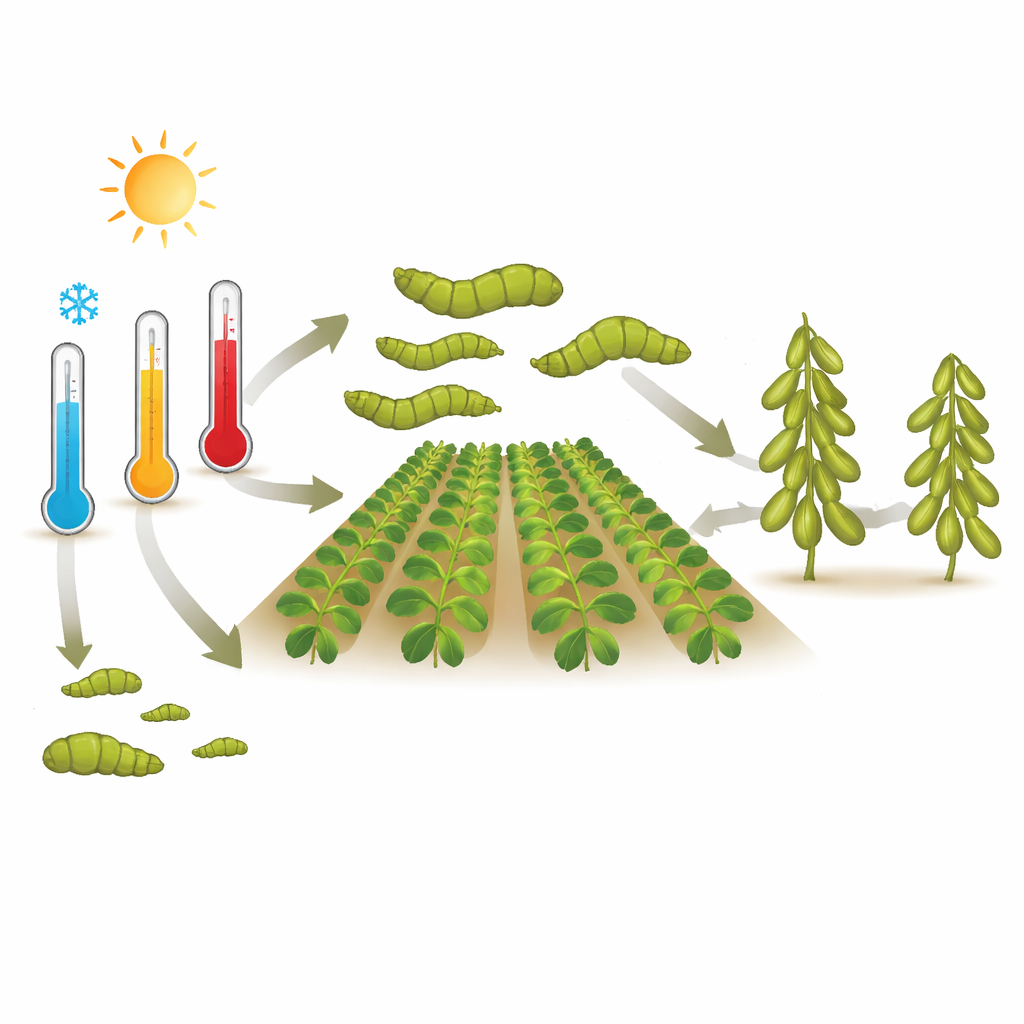
Farmers know that weather can make or break a harvest, but temperature also shapes the lives of crop‑eating insects. This study looks at the soybean looper, a caterpillar that can strip soybean fields bare, and asks a simple question with big consequences: how do unusually cold or hot conditions change its growth, survival, and damage to plants? By following the insect’s entire life cycle and its internal stress responses across a range of temperatures, the researchers show that climate extremes can actually hold this pest back, while moderate warmth lets it thrive.
Following a pest through heat and cold
The team raised soybean loopers from egg to adult under five constant temperatures, ranging from cool (19 °C) to very warm (35 °C), with 27 °C and 31 °C representing more typical warm growing conditions. They carefully tracked how long each life stage took, how many caterpillars survived, how many eggs females laid, how fast larvae gained weight on soybean leaves, and how much damage they caused. At the same time, they examined the caterpillars’ guts to measure key antioxidant enzymes—molecules that help cells cope with stress—and overall protein levels, an indicator of how much building material the insects had for growth and reproduction. Finally, they used population models to project how quickly looper numbers could build up over an 80‑day period at each temperature.
Comfortable warmth fuels growth and reproduction
Moderate warmth turned out to be ideal for the soybean looper. At 27 °C, eggs hatched quickly, caterpillars moved through their stages faster, and adults lived longer than at other temperatures. Females laid the most eggs at this temperature—around 600 per female—and the projected population exploded from 10 eggs to roughly 245,000 insects in 80 days. Larvae feeding on real soybean plants gained weight rapidly at 27 °C and 31 °C, and pupae and adults that developed under these conditions were noticeably heavier. These results mean that under typical warm field conditions, soybean loopers grow quickly, reproduce efficiently, and cause substantial leaf damage, putting soybean yields at risk.
Extreme temperatures trigger internal stress
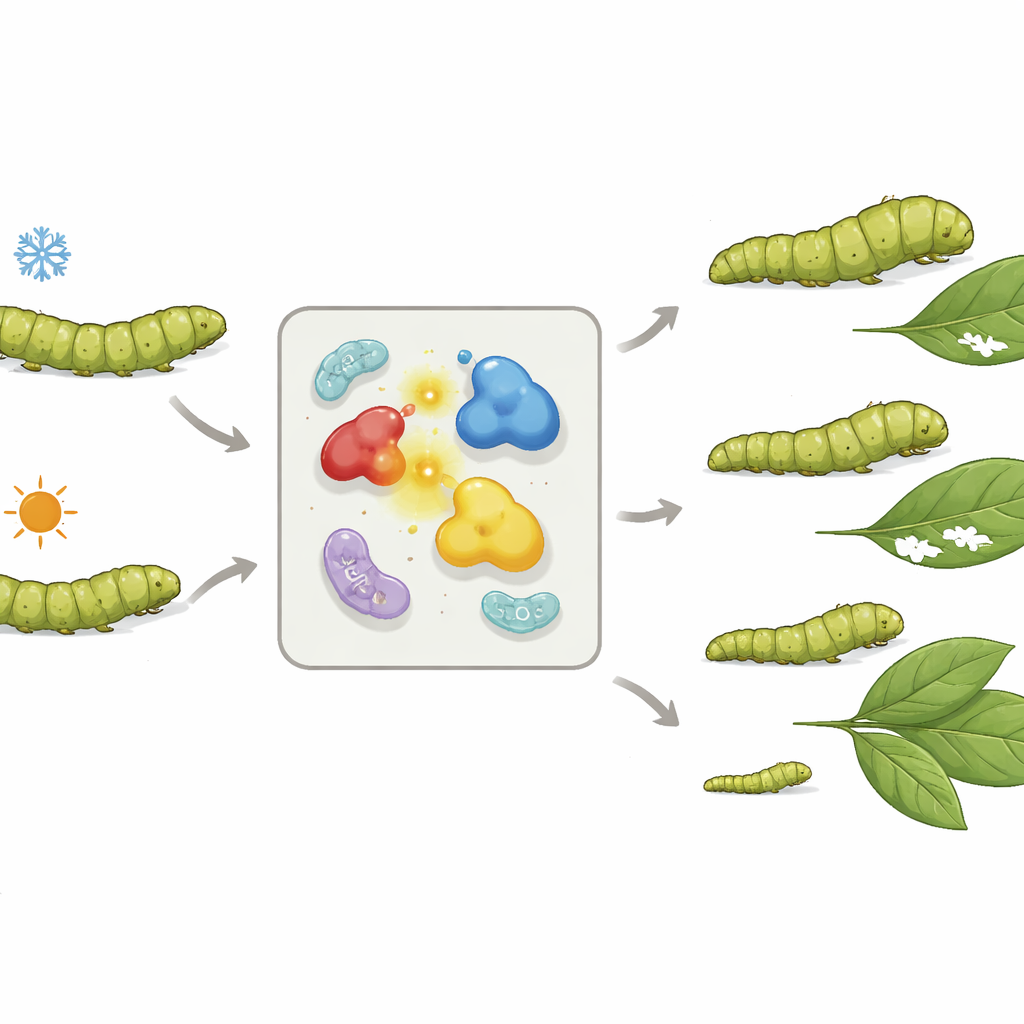
At the cold (19 °C) and hot (35 °C) extremes, the story reversed. Development slowed, with eggs and larval stages lasting much longer, and adults lived shorter lives. Females at these temperatures laid fewer eggs and over a shorter period, and larvae gained much less weight. Population simulations suggested that after 80 days, only about 5,000 insects would be present at 19 °C and about 45,000 at 35 °C—far fewer than at 27 °C. Inside the larvae, cold and heat both triggered sharp increases in antioxidant enzymes, a sign that cells were fighting off damage from reactive oxygen species, the harmful by‑products of stress. At the same time, total protein levels in the larvae dropped, suggesting that energy and resources were being diverted from growth and reproduction toward basic survival.
Linking internal strain to field damage
By comparing all of these measurements, the researchers found strong links between the insects’ internal chemistry and their performance. Higher levels of stress enzymes went hand in hand with slower population growth, fewer offspring, and shorter lifespans. In contrast, higher protein levels in larvae were associated with better survival, higher fecundity, and faster generation turnover. Importantly for farmers, larvae raised in stressful cold or hot conditions not only grew more slowly but also caused noticeably less damage to soybean leaves than those at 27 °C or 31 °C. In practical terms, the same pest species can be far more or less harmful depending on how close the weather is to its comfort zone.
What this means for future pest pressures
The study shows that soybean loopers can survive across a fairly broad temperature range, but their population booms are tightly tied to moderate warm conditions, not extremes. As climate change brings more frequent cold snaps and heat waves alongside overall warming, outbreaks of this pest may become more erratic, with peaks when temperatures hover near the optimum. By revealing how external temperature and internal stress responses work together to limit or promote the looper’s growth, these findings can feed into forecasting tools and management plans. In short, understanding how heat and cold strain these caterpillars helps farmers and scientists better predict when the soybean looper will be a minor nuisance—and when it could become a major threat.
Citation: Debnath, R., George, J., Kariyat, R. et al. Thermal variation associated stress response regulates the growth and reproductive potential of soybean looper. Sci Rep 16, 9976 (2026). https://doi.org/10.1038/s41598-026-36978-1
Keywords: soybean looper, temperature stress, insect pests, crop protection, climate change