Clear Sky Science · en
A novel approach to mural enhancement using MSR CAB and lacuna extraction from ancient mural paintings using random forest
Why fading wall art still matters today
Across historic palaces and temples, wall paintings are quietly flaking away. The missing patches of paint are more than cosmetic flaws: they erase scenes that carry centuries of memory. Yet carefully mapping these losses is slow work typically done by hand, frame by frame. This study presents a computer-based method that can automatically highlight damaged spots in ordinary color photos of murals, helping museums and conservators keep better watch over fragile artworks even when they lack big budgets or large teams.
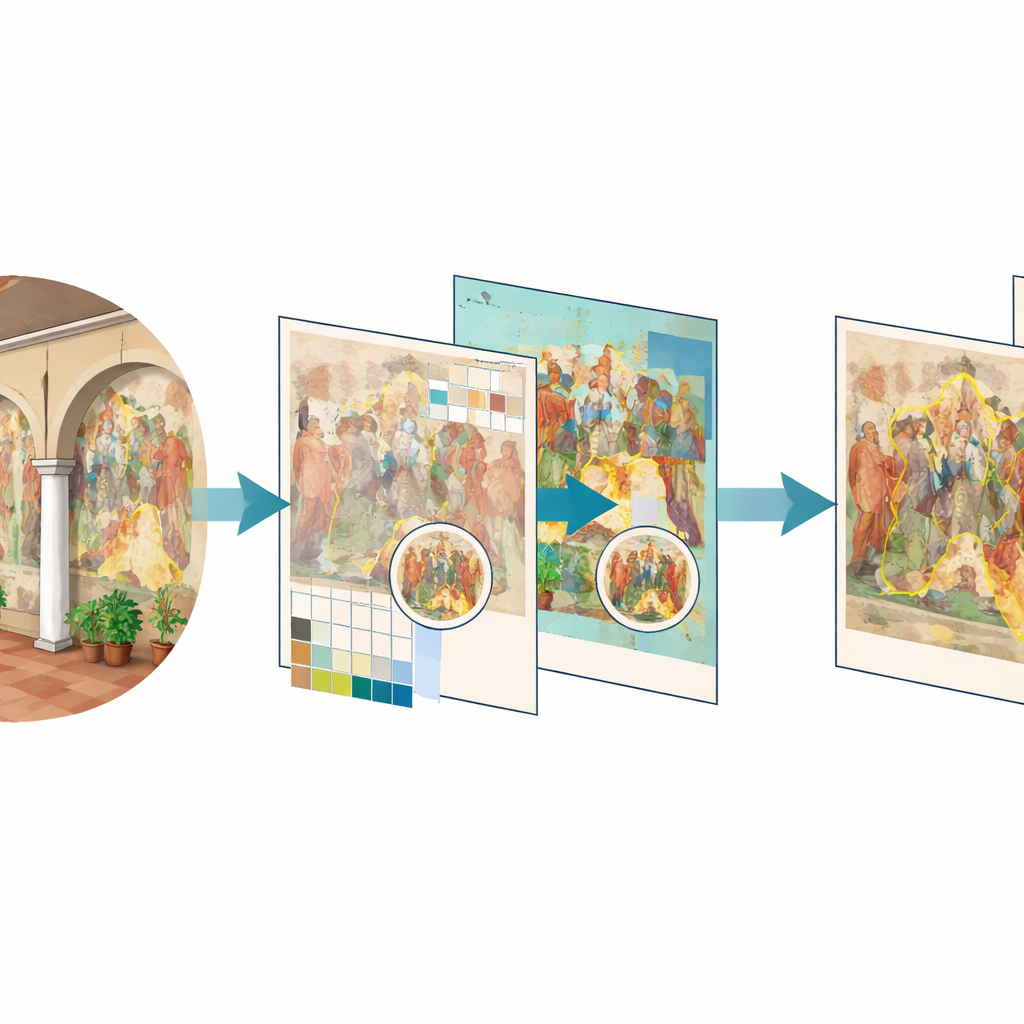
Old palace walls under new scrutiny
The research centers on murals from the 19th‑century Bey’s Palace in Constantine, Algeria, a richly decorated complex whose painted walls document historic battles, travels, and daily life. Over time, heat, humidity changes, dust, and neglect have produced cracks, discoloration, and especially “lacunae” – areas where the paint layer has fallen away, exposing bare plaster. Because these gaps reveal how far decay has progressed, conservators need a reliable map of their size and spread. Manual tracing is slow and subjective, while trendy deep‑learning systems demand thousands of labeled images and powerful computers that most heritage institutions simply do not have.
Making dim, dusty images easier to read
The first half of the new approach focuses on making ordinary photographs of murals easier to interpret, both for humans and for algorithms. The authors designed an image‑cleanup recipe they call MSR‑CAB. It works by first separating lightness from color so brightness can be adjusted without distorting the original hues. Then several stages brighten dark areas, even out shadows, and boost local contrast so fine brushwork and edges stand out. A smart blending step mixes the enhanced view with the original to avoid an artificial look, and a gentle sharpening and noise‑reduction pass brings out detail without blurring important lines. Tests on palace photographs taken under poor lighting show that this sequence makes figures, ornaments, and damaged zones much clearer while keeping the murals’ colors faithful.
Teaching a digital forest to spot lost paint
Once the images are improved, the second half of the method learns to separate missing paint from intact areas, pixel by pixel. Instead of a heavy deep‑learning model, the authors use a Random Forest, an ensemble of many simple decision trees that vote on each pixel’s label. To guide these trees, they feed in five basic clues: the red, green, and blue color values; how much the red channel varies in a tiny neighborhood (a measure of texture); and the strength of local edges. A human expert first marks a few example regions of loss and healthy paint, giving the system ground truth. Because damaged spots are much rarer than intact areas, the method deliberately boosts their weight during training and penalizes missed detections more strongly, so small gaps are not ignored.
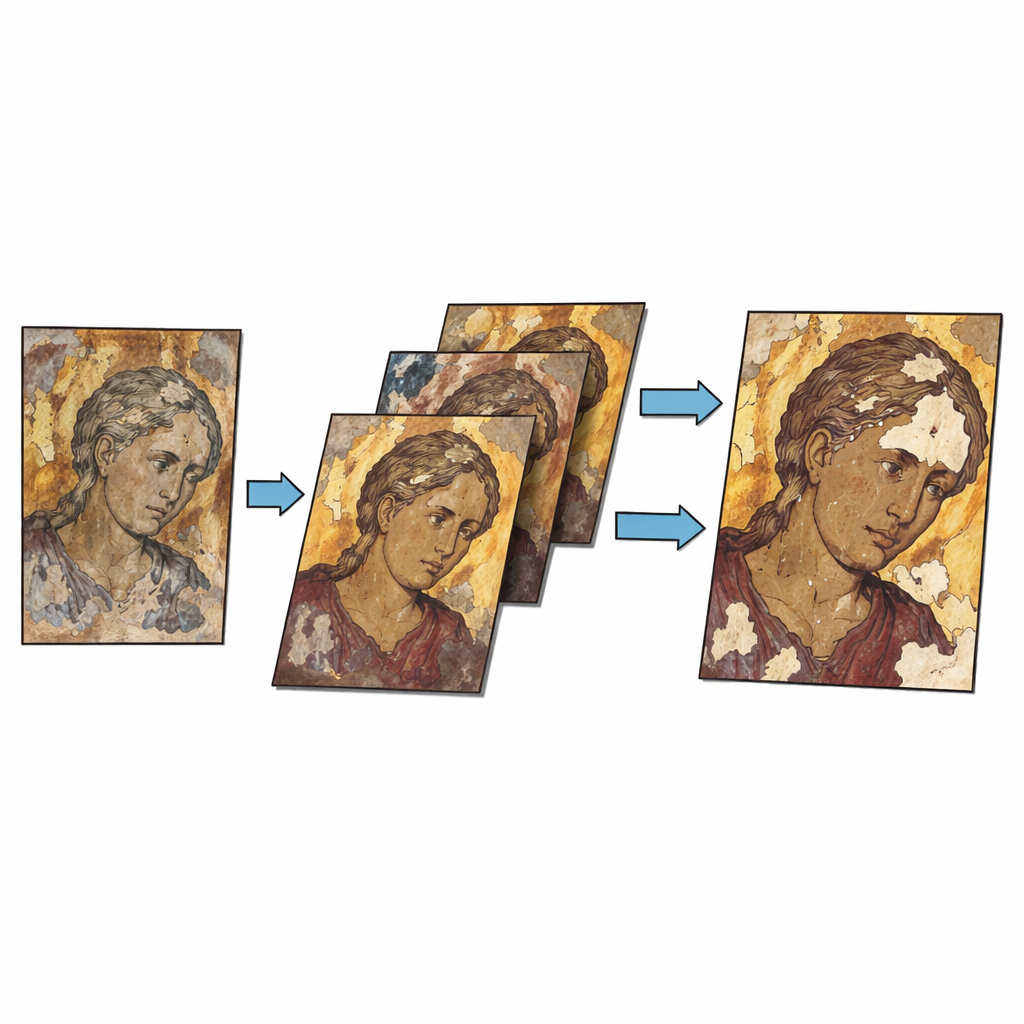
From one palace to many walls and even leaves
On twelve murals from Bey’s Palace, the combined enhancement and Random Forest pipeline correctly classified around 95 percent of pixels on average, with high scores for both how rarely it raised false alarms and how few damaged pixels it overlooked. An ablation study – switching off parts of the enhancement recipe – showed that skipping the cleanup steps sharply reduced performance, especially under uneven lighting, underscoring how vital good imagery is. To test whether the idea works beyond a single site, the authors applied it to murals from China’s Mogao Caves, wall fragments from New York’s Metropolitan Museum of Art, and even a public dataset of diseased plant leaves. In all three cases, the method successfully isolated damaged or diseased regions, with accuracies above 95 percent on the artworks and nearly 99 percent on the leaves, despite small training sets and differing colors and textures.
A practical ally for preserving fragile stories
In essence, this work shows that careful image enhancement, paired with a lightweight learning model, can reliably trace where historic wall paintings are losing their skin. The system does not replace expert judgment, but it can give conservators fast, consistent damage maps from ordinary color photos, even when only a handful of examples are available. By lowering the technical and data barriers to automated analysis, the approach offers heritage institutions a practical tool to monitor decay, plan restorations, and, ultimately, keep more of our painted past from quietly disappearing.
Citation: Nasri, A., Zahra, M., Gao, L. et al. A novel approach to mural enhancement using MSR CAB and lacuna extraction from ancient mural paintings using random forest. Sci Rep 16, 10412 (2026). https://doi.org/10.1038/s41598-026-36973-6
Keywords: mural conservation, paint loss detection, cultural heritage imaging, image enhancement, random forest classification