Clear Sky Science · en
Comprehensive characterization of benzothiazole-hydrazone metal (II) complexes via spectroscopic, biological assignment, electrochemical, DFT, and molecular docking approaches
New Weapons in the Fight Against Microbes
As antibiotic resistance rises, scientists are racing to design smarter molecules that can outmaneuver harmful bacteria and fungi. This study explores a family of tailor‑made metal–organic compounds built around copper, nickel, and cobalt, asking a simple but crucial question: how does changing the metal at the heart of the molecule alter its power to stop microbes in their tracks? By combining modern lab techniques with computer modeling, the researchers map out how structure, electronics, and biological punch are tied together.
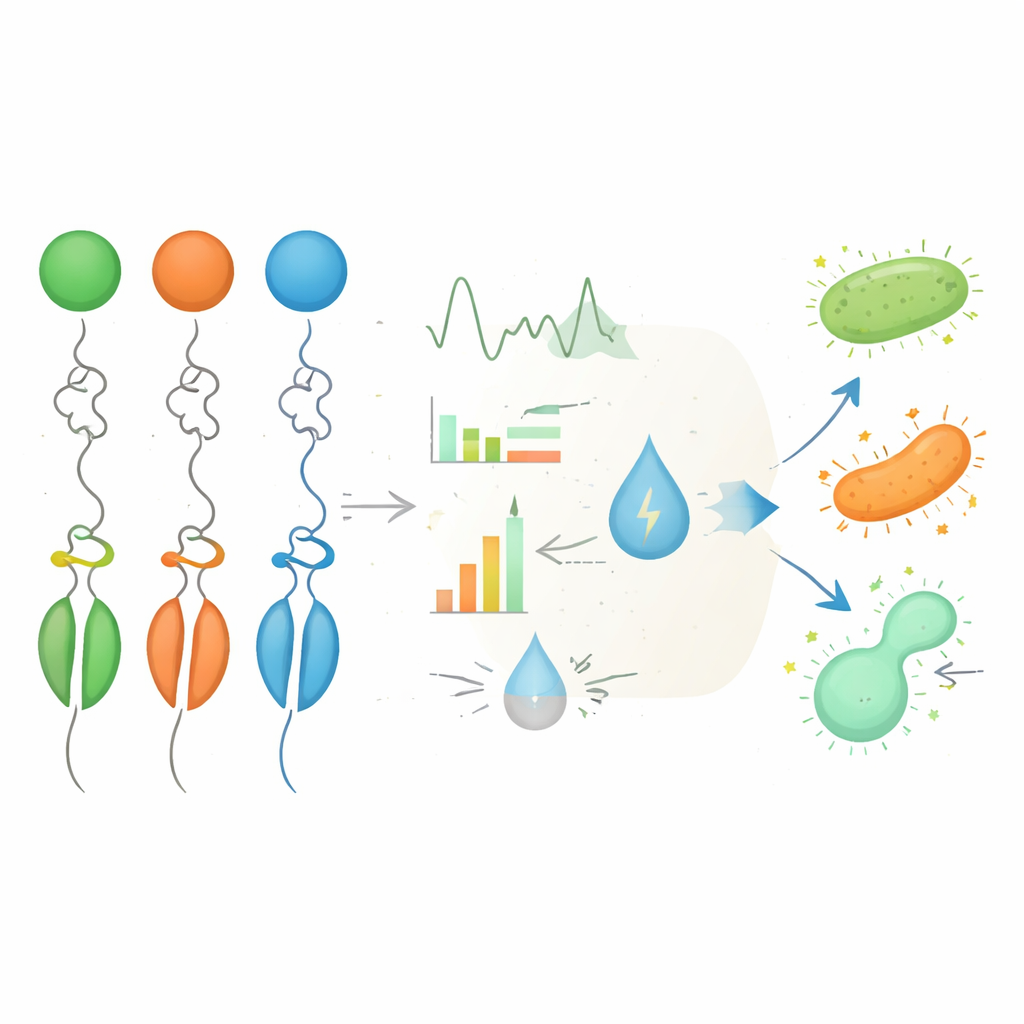
Building Designer Metal–Organic Molecules
The team began by crafting a specific organic scaffold known as a benzothiazole hydrazone ligand. Think of it as a flexible claw that can firmly grip a metal ion. They then attached three different metals—cobalt, nickel, and copper—to this claw in a one‑to‑one ratio, creating three closely related complexes. Standard chemical tests and a broad suite of instruments, including infrared and ultraviolet–visible light measurements, magnetic studies, and mass spectrometry, confirmed that the new compounds had formed cleanly and consistently. These data also revealed that cobalt and nickel favored an almost octahedral arrangement—roughly like a metal sitting inside a six‑pointed cage—while copper settled into a flatter, square‑planar shape.
Peering Into Shape and Charge With Computers
To go beyond what could be seen directly in the lab, the researchers turned to density functional theory, a widely used quantum‑chemical method. Their calculations reproduced the observed bond lengths and infrared fingerprints, strengthening confidence in the proposed shapes. They also examined how electrons are distributed in each molecule by looking at the energy gap between the highest filled and lowest empty molecular levels. The nickel complex showed the smallest gap, meaning its electrons can be stirred more easily, a marker of high reactivity. Maps of electrostatic potential highlighted regions around the metals and certain oxygen and nitrogen atoms as hotspots for interaction, explaining why the ligand grabs the metals so effectively and stabilizes the observed geometries.
From Electronics to Semiconductors and Redox Behavior
Using diffuse reflectance measurements, the team estimated the optical band gaps of the solid complexes, finding values between about 2.1 and 2.3 electron volts—squarely in the semiconducting range. This suggests that, beyond medicine, such materials could be explored in catalysis or light‑driven applications. The copper complex received special attention in an electrochemical cell, where cyclic voltammetry traced how it gains and loses electrons. Its redox signals indicated a quasi‑reversible process and strong interaction between copper and the ligand. These measurements, combined with calculations of thermodynamic stability, showed that the copper species forms a particularly robust complex whose electron‑transfer behavior can be finely tuned by the organic framework.
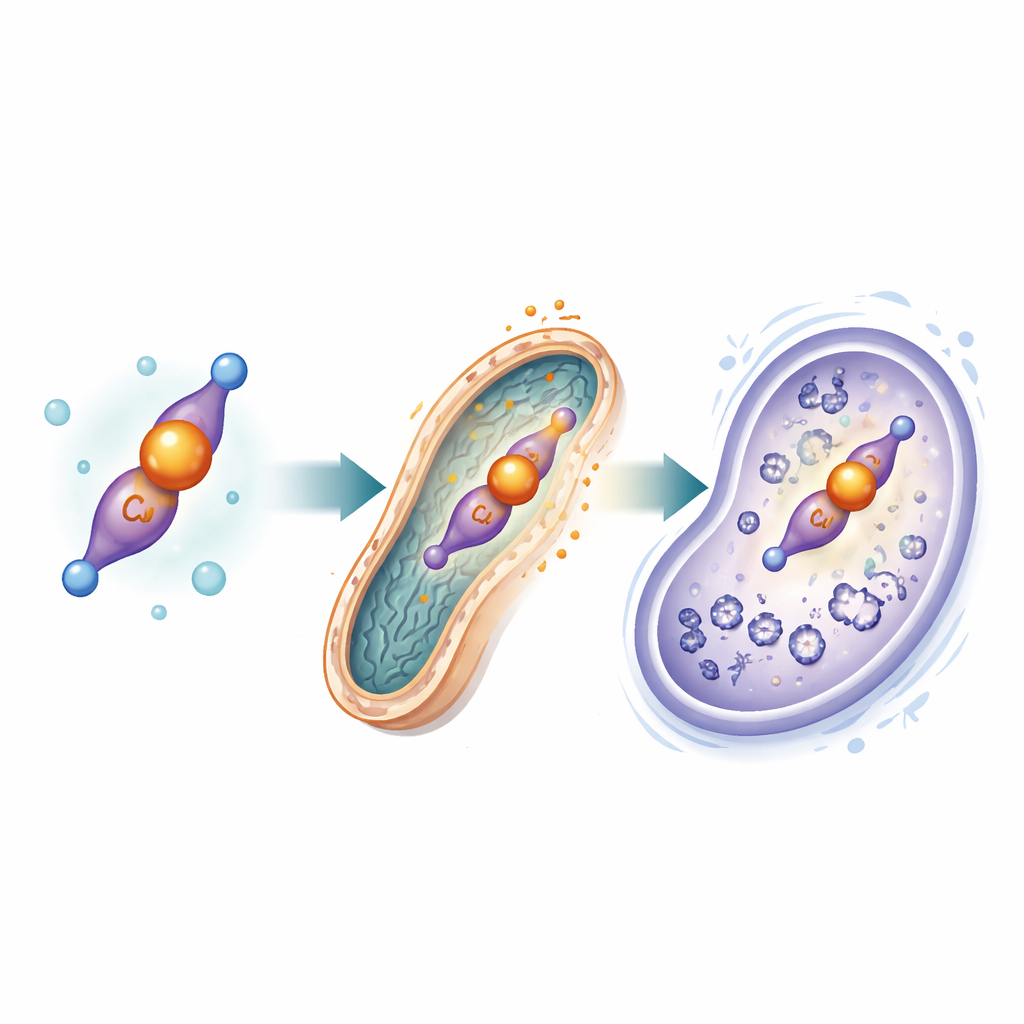
Testing Microbe‑Killing Power and Protein Binding
The real test came when the compounds were challenged against three common pathogens: the bacteria Staphylococcus aureus and Escherichia coli, and the yeast Candida albicans. All of the metal complexes outperformed the free ligand, but the copper complex stood out, giving the largest zones of growth inhibition against the fungus and the Gram‑positive bacterium. To understand why, the researchers used molecular docking simulations, virtually fitting the compounds into the pockets of key microbial proteins. The copper complex formed particularly favorable hydrogen bonds, ionic contacts, and stacking interactions with these targets, mirroring its superior performance in the petri dish and linking its electronic properties to its biological strength.
Why This Matters for Future Medicines and Materials
Overall, the study shows that carefully choosing and arranging a metal within a benzothiazole hydrazone framework can dramatically change how the resulting complex behaves—electronically, chemically, and biologically. Cobalt, nickel, and copper all form stable, semiconducting structures, but copper in a square‑planar environment offers the best combination of strong protein binding and microbe suppression. By tying together synthesis, spectroscopy, computation, electrochemistry, and docking, the work offers a roadmap for designing next‑generation metal–organic compounds that could serve as potent antimicrobial agents and versatile functional materials.
Citation: Ibrahim, F.M., Gomaa, E.A., Zaky, R.R. et al. Comprehensive characterization of benzothiazole-hydrazone metal (II) complexes via spectroscopic, biological assignment, electrochemical, DFT, and molecular docking approaches. Sci Rep 16, 14406 (2026). https://doi.org/10.1038/s41598-026-36955-8
Keywords: metal complexes, antimicrobial agents, copper compounds, molecular docking, semiconductors