Clear Sky Science · en
Adaptive multihazard modeling predicts rainfall-driven dam failure: a case study
Why this matters for people living near dams
Across the world, many large dams are still under construction or being raised higher to store more water. During these unfinished stages, the structures can be surprisingly fragile, especially in seasons of intense rain. This study looks at an Ethiopian dam that suffered serious slope damage before it ever held a full reservoir, and introduces a new way to forecast such problems weeks in advance. The approach could help engineers shift from reacting to cracks and slides after they appear to preventing them before they threaten people and infrastructure downstream.
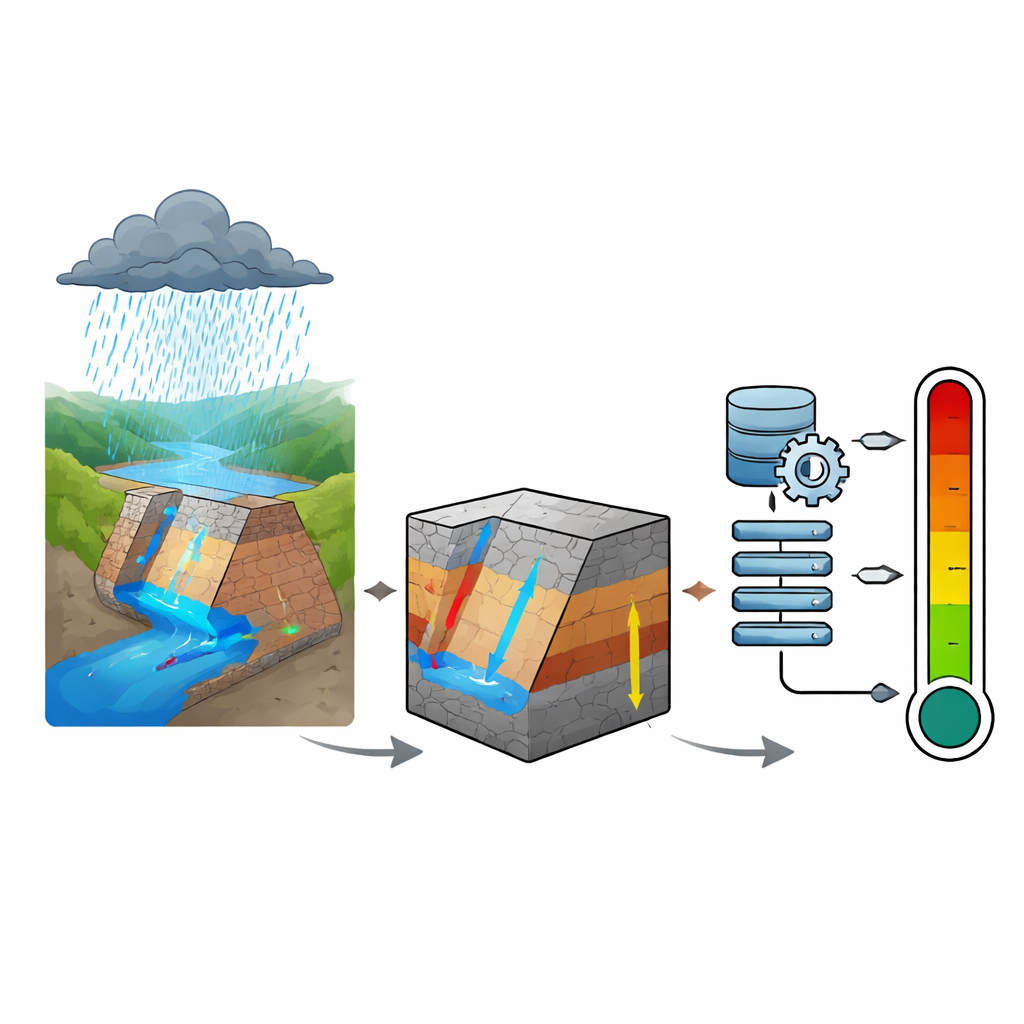
Rain, weak ground, and a vulnerable structure
The Megech Dam in northern Ethiopia is an earth-rockfill dam, built layer by layer from clay and rock rather than solid concrete. Delays in funding and construction left it partially finished for several years, with a large opening still allowing the river to pass. In this state, the dam had exposed slopes, incomplete drainage, and layers of fill that were not yet sheltered by a full reservoir. Exceptionally heavy rains in 2020 and 2021 soaked the structure from above and below, saturating the clay core and foundation. Water pooled in upstream depressions, seeped along cracks, and gradually weakened a band inside the dam, leading to tension cracks, surface slides, and even a 24‑meter-deep block of material shifting downslope.
Looking inside the dam in three dimensions
To understand why these failures occurred, the researchers first rebuilt the dam in the computer in great detail. They combined design drawings, survey points, and field inspections to create a three-dimensional digital terrain of the valley, foundation, and partially completed embankment. Laboratory tests on clay and rock samples revealed how strong, dense, or permeable different zones were. By mapping these properties across the dam, they identified a particularly vulnerable band where high clay content, higher permeability pockets, and strong swelling potential lined up with observed cracks and slides. Advanced numerical models then simulated how rainwater moved through the dam, how pore water pressure built up at depth, and how the internal stresses shifted as the structure became saturated.
Teaching a model to learn from both physics and data
Traditional computer simulations of dams can be very accurate but are too slow and labor-intensive to run every week as new monitoring data arrive. Purely data-driven tools, like standard neural networks, can be faster but often miss the underlying physics and struggle when only a few years of measurements are available. The team therefore built a hybrid system that combines the strengths of both. One part, based on the finite element method, captures the physical behavior of the dam under different water conditions, producing maps of stress, strain, and internal water pressure. A second part, a recurrent neural network designed to track changes over time, learns how pore pressure and movement evolve week by week. A third part, a simpler neural network, learns how the soil’s strength gradually declines as it strains and stays wet. An “attention” mechanism highlights the past weeks that matter most for an upcoming instability, making the predictions more transparent to engineers.

Seeing trouble coming weeks ahead
The hybrid model was trained and tested on two years of weekly monitoring data from Megech Dam—covering rainfall, internal water pressures, and ground movements—along with the physics-based descriptions of the dam’s state. Compared with common machine-learning approaches such as support vector machines, random forests, or a stand‑alone neural network, the new framework predicted the dam’s safety factor more accurately and, crucially, earlier. It could detect the downward trend in stability as heavy rainfall seasons progressed and issued reliable warnings up to about three and a half weeks before critical conditions were reached. The attention component automatically flagged the same periods that engineers later recognized in the field as the most dangerous, confirming that the model had learned meaningful precursors rather than random patterns.
What this means for dam safety
In simple terms, the study shows that blending physics-based simulations with modern learning algorithms can turn scattered monitoring data into an early-warning system for rainfall‑driven failures in earth dams under construction. By capturing how water slowly seeps in, how internal pressures build up, and how soil gradually loses strength, the framework helps engineers see hidden weaknesses before they become visible cracks and slides. Although demonstrated on a single dam, the method is designed to be adaptable to other projects, offering a path toward more proactive, climate‑aware management of dam safety during some of their most vulnerable years.
Citation: Nasser, M., Assefa, E., Assefa, S.M. et al. Adaptive multihazard modeling predicts rainfall-driven dam failure: a case study. Sci Rep 16, 11012 (2026). https://doi.org/10.1038/s41598-026-36927-y
Keywords: dam safety, rainfall-induced landslides, early warning systems, physics-informed AI, earth-rockfill dams