Clear Sky Science · en
Bridging photocatalysis and artificial intelligence to maximize CH4 and CO production from CO2 reduction using synthesized g-C3N4/TNTAs photocatalysts
Turning a Climate Problem into a Fuel Solution
Carbon dioxide, the main greenhouse gas driving climate change, is usually treated as waste. But what if we could turn it into useful fuels using nothing more than sunlight and smart materials? This study explores a promising way to convert carbon dioxide in the air into two valuable gases, methane and carbon monoxide, by combining advanced light‑activated materials with artificial intelligence. The result is a kind of data‑guided solar refinery that could help tackle both energy demand and carbon pollution.
Sunlight, Special Surfaces, and Waste Carbon
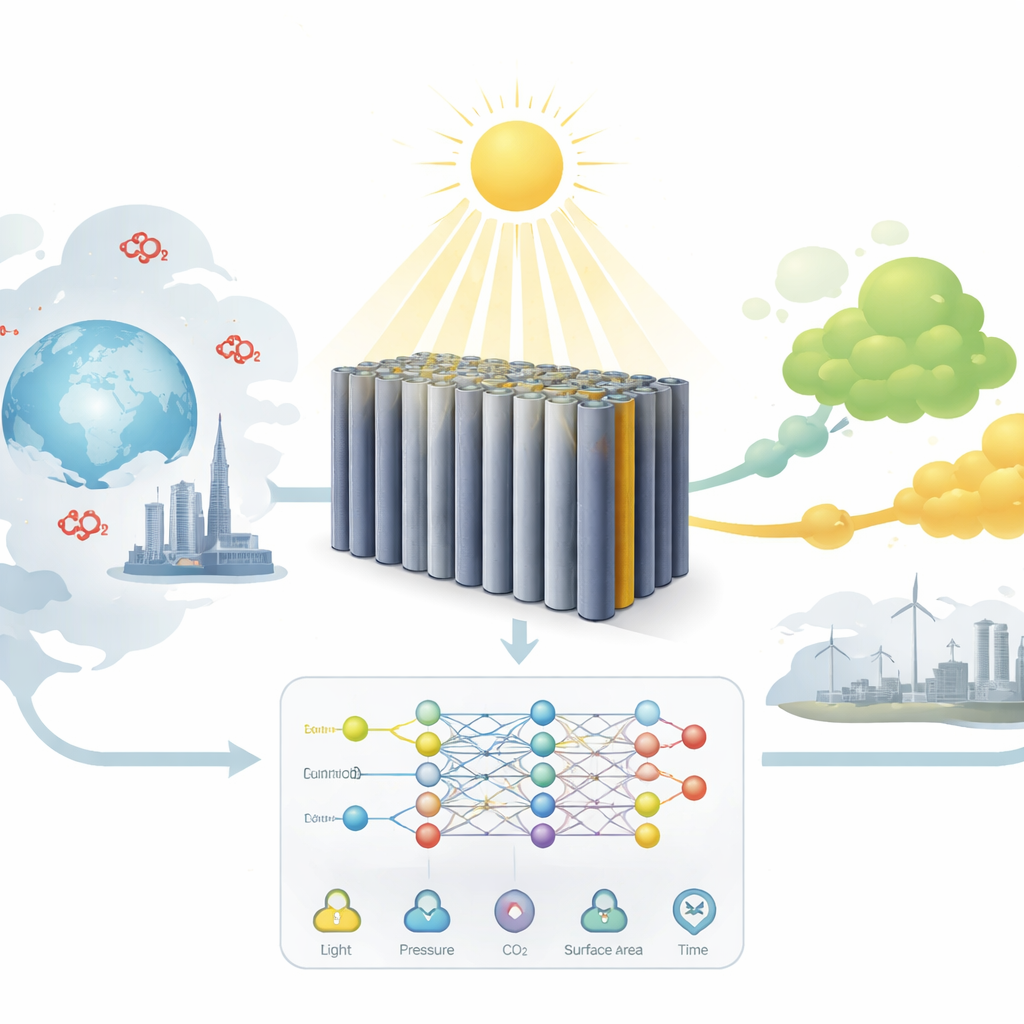
At the heart of this work is a process called photocatalysis, where a solid material absorbs light and uses that energy to drive chemical reactions. The researchers built a carefully engineered surface made from tiny, vertically aligned tubes of titanium dioxide, a stable and widely used material, and coated them with thin sheets of a carbon‑based solid known as g‑C3N4. Together, these two components form a tightly connected structure that captures more of the solar spectrum and keeps the light‑excited charges apart long enough to react with carbon dioxide and water vapor. In a gas‑phase reactor, carbon dioxide and water flow over this illuminated surface, and the system produces methane, a potential fuel, and carbon monoxide, a key building block for many industrial processes.
Why the Surface Design Matters
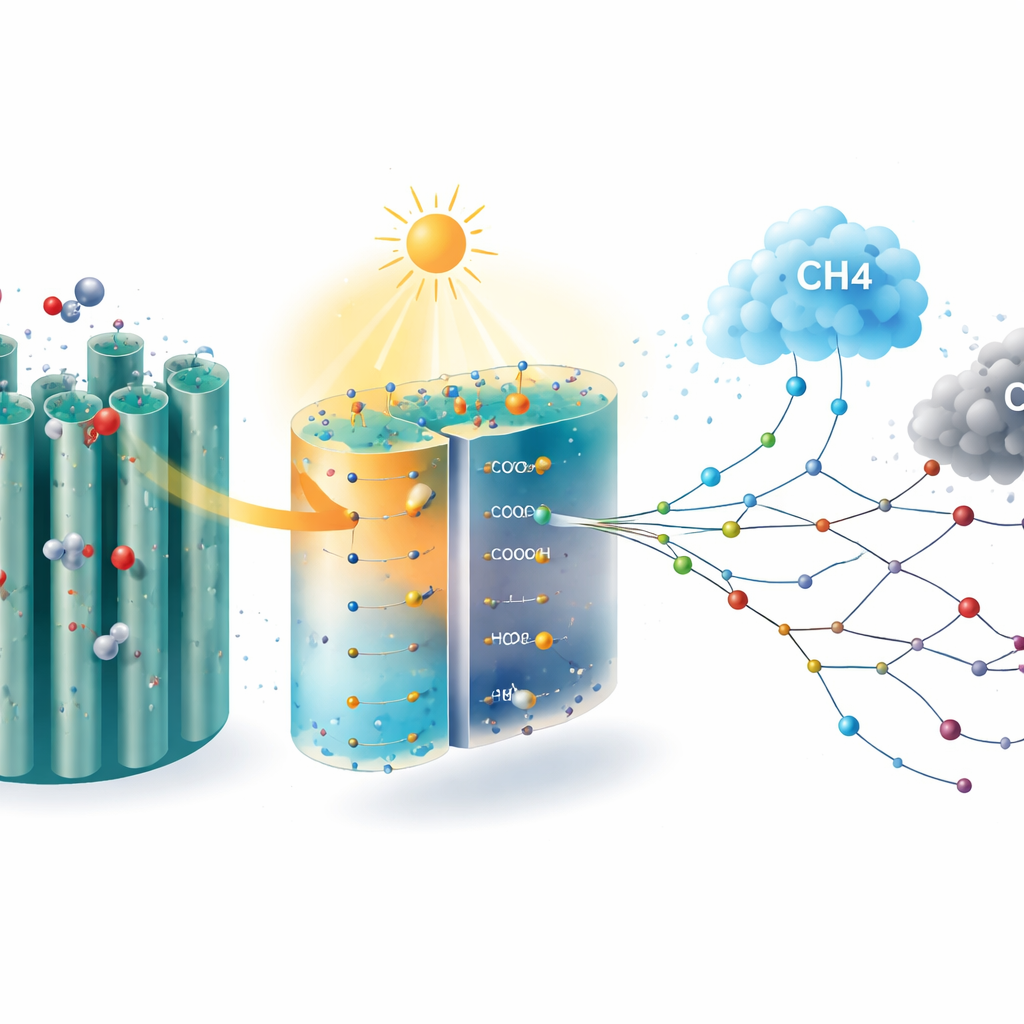
Microscope images show that the titanium dioxide forms long, ordered nanotubes with a large internal area, giving reacting molecules many sites to land on. When the g‑C3N4 sheets are added, they drape over and into these tubes without destroying their shape, effectively creating extra junctions where light‑generated charges can separate. Optical measurements reveal that this hybrid material absorbs visible light better than bare titanium dioxide, and its slightly smaller energy gap means it can make better use of sunlight. Light‑emission tests further indicate that the added carbon nitride suppresses the unwanted recombination of charges, a common loss pathway that normally wastes much of the incoming light energy.
Letting Data Teach the Reactor What Works Best
Even with a good photocatalyst, performance depends strongly on how the system is operated: how large an area of catalyst is exposed, how concentrated the carbon dioxide is, how much pressure and light are applied, and how long the reactor is illuminated. Instead of adjusting these one by one by trial and error, the team generated two large, carefully controlled datasets, each with over a thousand experimental measurements of methane and carbon monoxide output under different conditions. They then trained ten different tree‑based machine‑learning models to learn the hidden patterns linking operating conditions to fuel production, using part of the data for training and the rest for testing. One model, called CatBoost, consistently gave the most accurate predictions, matching measured yields for both gases with better than 98% explanatory power and very low error.
What the Algorithms Reveal About the Reaction
Because tree‑based models can be probed for their decision logic, the researchers could see which knobs matter most. For methane, irradiation time—the length of exposure to light—was the strongest driver of higher output, followed by how much carbon dioxide was present and how much catalyst surface was exposed. For carbon monoxide, the order flipped: the available catalyst area was most important, then irradiation time, while carbon dioxide concentration played only a minor role. Sophisticated analysis tools showed that longer light exposure and larger surfaces almost always push the system toward higher yields, whereas overly high carbon dioxide levels can actually slow things down, likely by blocking access or limiting light penetration. By running an evolutionary optimization algorithm on top of the CatBoost model, the team identified operating points that should maximize each product, and then confirmed in the lab that the predicted and measured yields nearly overlapped.
From Smart Reactors to Smarter Energy Systems
In simple terms, this study shows that it is possible to teach a solar‑driven chemical reactor how to run itself more efficiently. The tailored g‑C3N4/TiO2 nanotube surface already boosts the conversion of carbon dioxide into methane and carbon monoxide, but coupling it with a powerful learning algorithm allows the system to home in on near‑optimal conditions without endless experimentation. The work provides a blueprint for using artificial intelligence to guide the design and operation of future photocatalytic devices, potentially turning waste carbon into useful fuels and chemicals with the help of sunlight and data‑driven insight.
Citation: Hossen, M.A., Prima, M., Aziz, A.A. et al. Bridging photocatalysis and artificial intelligence to maximize CH4 and CO production from CO2 reduction using synthesized g-C3N4/TNTAs photocatalysts. Sci Rep 16, 13003 (2026). https://doi.org/10.1038/s41598-026-36838-y
Keywords: photocatalytic CO2 conversion, solar fuels, machine learning in catalysis, TiO2 nanotube photocatalyst, methane and CO production