Clear Sky Science · en
Vibrational and electronic properties of Np $$_2$$ O $$_5$$ from experimental spectroscopy and first principles calculations
Why this strange crystal matters
As the world leans on nuclear power, we are left with long‑lived radioactive leftovers that must be stored safely for generations. Some of the most troublesome ingredients are elements like neptunium, whose behavior is still not fully understood. This study focuses on a particular neptunium oxide, Np2O5, and shows how carefully measuring how its atoms vibrate and how it conducts electricity can sharpen our understanding of nuclear waste materials and help guide safer handling and storage.
Peering inside an elusive nuclear material
Np2O5 is a crystalline compound that forms when neptunium bonds with oxygen. It is important because it can appear in nuclear fuel cycles and waste streams, yet it has been difficult to make in pure form and hard to study due to its radioactivity. The authors first solved this practical challenge by growing high‑quality single crystals of Np2O5 in a specialized high‑temperature, high‑pressure solution. They then used X‑ray diffraction to confirm that the crystals were structurally clean and matched the known arrangement of neptunium and oxygen atoms. This provided a solid foundation for exploring how the atoms move and how electrons flow through the material. 
Listening to atomic motions with light
To “listen” to the motion of atoms, the team turned to Raman spectroscopy, a technique that shines laser light on a crystal and records the very slight color shifts that occur when the light exchanges energy with vibrations in the lattice. In their single Np2O5 crystals, they observed a rich set of sharp features from low to high vibrational energies, including several that earlier work on mixed, less pure samples had completely missed. The narrow, reproducible peaks show that the vibrations are well defined and not smeared out by disorder, revealing that the crystals are of high quality. Two especially strong peaks stood out, and understanding their origin became a key goal of the study.
Computer models that follow every atom
Because it is impossible to see atomic motions directly, the researchers used advanced quantum‑mechanical calculations to simulate how the atoms in Np2O5 move and how those motions should appear in a Raman experiment. These calculations treat the neptunium electrons, which are famously tricky due to their strong interactions and relativistic effects, with special care. By comparing the simulated spectra with the measurements, the authors could match individual peaks to specific patterns of movement. They found that the strongest peaks come from bending motions of oxygen atoms that sit between planes of neptunium, while the heavy neptunium atoms dominate slower, low‑energy motions. The picture that emerges is of a crystal where oxygen atoms do most of the “dancing,” and neptunium plays a more sluggish, supporting role, revealing directional and partly shared bonding between the two elements.
Measuring how easily electrons can move
Understanding how a nuclear material behaves also requires knowing whether it acts like a metal, an insulator, or something in between. To probe this, the team used scanning tunneling spectroscopy, in which a sharp tip is brought extremely close to the crystal surface and a small current is measured as the voltage is swept. The result for Np2O5 was a clear energy gap of about 1.5 electron volts where no electrons can move, showing that the material is a semiconductor. The same type of quantum calculations used for the vibrations predicted a very similar gap, about 1.7 electron volts, and also showed that the electronic states at the edges of this gap are largely controlled by neptunium’s f‑electrons. 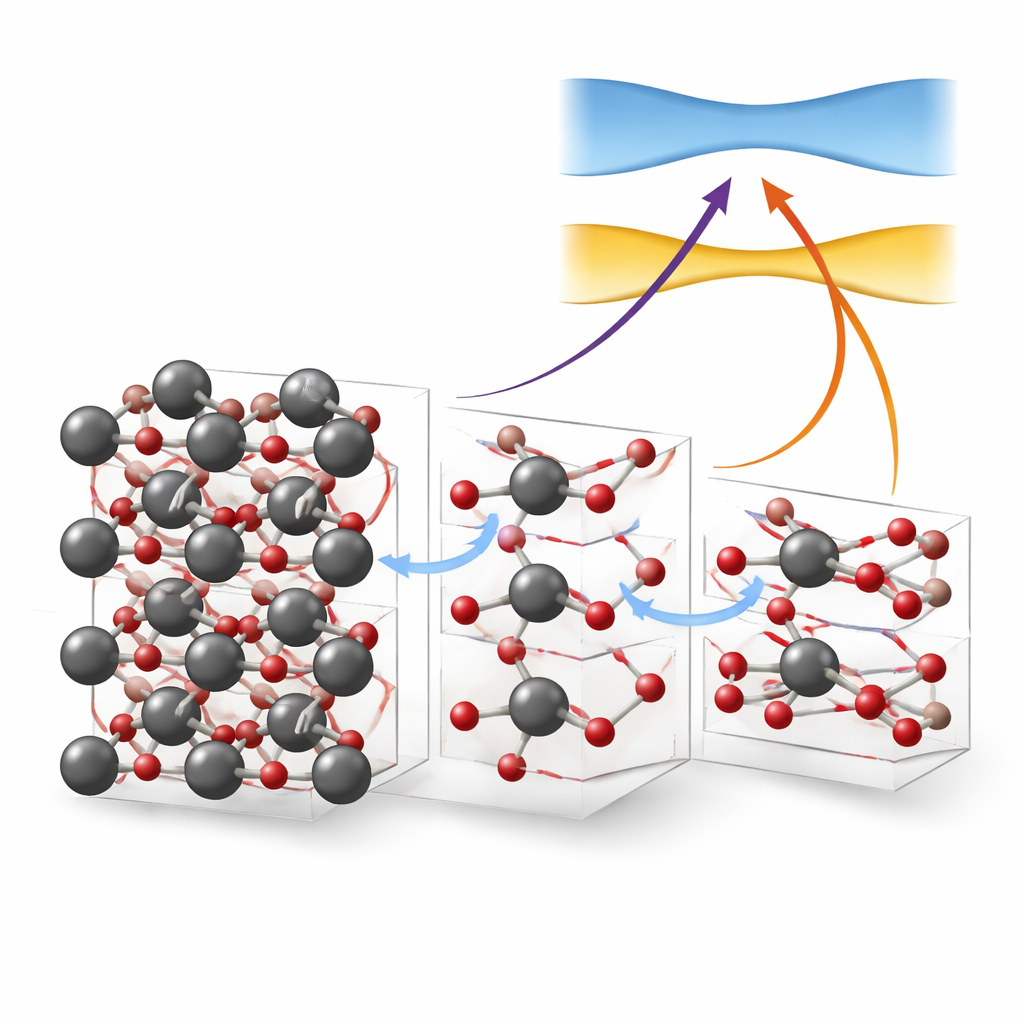
What this means for nuclear science and safety
Taken together, the precise crystal structure, the detailed map of atomic vibrations, and the direct measurement of the electronic gap make this work a benchmark study of Np2O5. For non‑specialists, the key message is that we now have a much clearer, experimentally tested picture of how this challenging nuclear material holds its atoms and electrons in place. That knowledge feeds into better models of how neptunium compounds will behave over long times and under changing conditions in reactors, waste forms, or the environment. The same combination of experiments and calculations showcased here can now be applied to other complex radioactive materials, sharpening the tools we use to design safer nuclear technologies.
Citation: Rai, B.K., Zhou, S., Heiner, B.R. et al. Vibrational and electronic properties of Np\(_2\)O\(_5\) from experimental spectroscopy and first principles calculations. Sci Rep 16, 10883 (2026). https://doi.org/10.1038/s41598-026-36720-x
Keywords: neptunium oxides, nuclear waste materials, vibrational spectroscopy, electronic band gap, actinide semiconductors