Clear Sky Science · en
Simultaneous electrochemical detection of imipenem and meropenem using a Pt–Au bimetallic nanoparticle–decorated 3D graphene oxide modified glassy carbon electrode
Why tracking powerful antibiotics matters
Some of the most important hospital antibiotics, such as imipenem and meropenem, are life‑saving drugs used against stubborn infections. But they are a double‑edged sword: too little in a patient’s bloodstream may let germs survive, while too much can harm the brain, liver, and kidneys and can leak into the environment. This study describes a low‑cost sensor that can quickly and very sensitively measure both of these drugs at the same time in real samples like blood, urine, and medicines, potentially helping doctors fine‑tune treatment and regulators track pollution.
A new way to read tiny chemical signals
The researchers set out to build an electrochemical sensor, a device that translates chemical information into an electrical signal. Instead of relying on large, expensive instruments that require complex sample preparation, they aimed for a small electrode that could be dipped directly into a solution containing imipenem and meropenem. When these drug molecules touch the electrode and undergo an oxidation reaction—essentially losing electrons—the resulting current can be measured. The challenge is to design an electrode surface that makes this reaction efficient and separates the signals of the two drugs clearly, even when their amounts are extremely low.

Building a tiny, porous helper surface
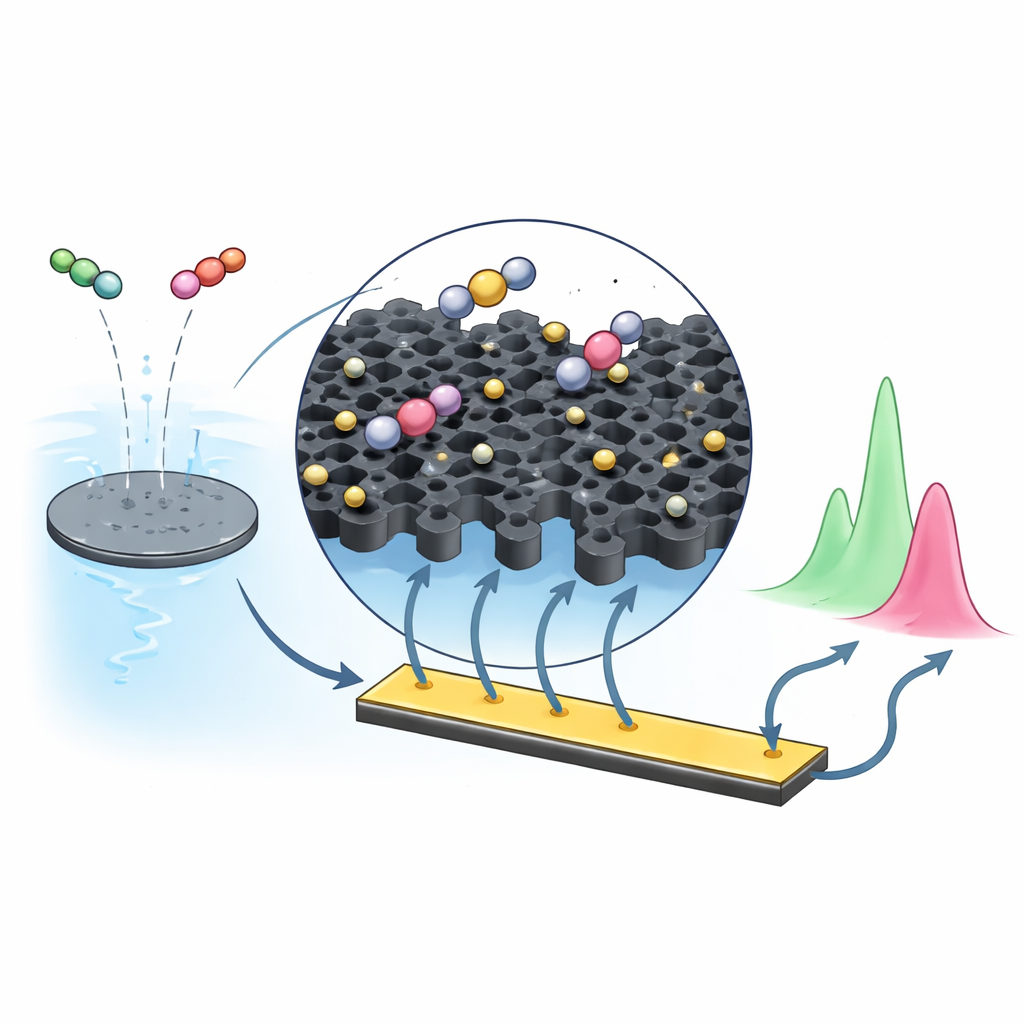
To boost the electrode’s performance, the team engineered a layered nanomaterial. They started with graphene oxide, a form of carbon arranged in atom‑thin sheets. By processing it into a three‑dimensional, sponge‑like network, they created a large, porous surface where many reactions can occur at once. Onto this scaffold they anchored very small particles made from a mix of platinum and gold. These bimetallic nanoparticles act like tiny catalysts, speeding up the transfer of electrons between the drugs and the electrode. Microscopy and X‑ray studies confirmed that the metal particles were well distributed across the graphene framework, forming a stable and highly conductive coating when placed on a glassy carbon base.
Turning drug contact into sharp electrical peaks
Once this coated electrode was prepared, the authors tested how well it responded to imipenem and meropenem. Using voltammetry—sweeping the voltage and recording current—they showed that each drug produced a distinct oxidation peak at a different potential, with a clear gap between them. This separation means the sensor can tell the two drugs apart even when they are present together. The porous, metal‑decorated surface also lowered the resistance to electron flow and greatly increased the active area compared with an unmodified electrode. As a result, the electrical signals grew stronger and more defined, allowing the device to register drug concentrations down to the nanomolar level across a remarkably wide range. Experiments varying solution acidity, material loading, and scan rate helped pinpoint the conditions that give the most reliable and strongest response.
Working in the real world, not just in the lab
Beyond controlled test solutions, the sensor was challenged with real samples: human serum and urine, as well as commercial imipenem tablets and meropenem injections. By adding known amounts of the drugs to these complex mixtures and measuring how much signal increased, the team showed that recoveries hovered very close to 100 percent, with only small variations. The device was also stable over weeks of storage, produced nearly identical results when made in multiple copies, and was not easily fooled by other common drugs or dissolved salts. These traits suggest that the sensor could be used for quality control of medicines and for monitoring how the drugs move through the body.
What this means for patients and the environment
In practical terms, the study delivers a compact and inexpensive electrode that can simultaneously detect two major last‑line antibiotics at extremely low levels. For healthcare, such a sensor could support therapeutic drug monitoring, helping clinicians adjust dosing so that drug levels stay high enough to kill bacteria but low enough to avoid harmful side effects. For environmental and food safety, the same platform could help track antibiotic residues in water, agricultural products, or hospital waste. While further development would be needed before bedside or field use, this work shows how carefully designed nanomaterials can turn subtle chemical footprints into clear electrical readouts that are easy to measure.
Citation: Paghaleh, H.J., Jahani, S., Moradalizadeh, M. et al. Simultaneous electrochemical detection of imipenem and meropenem using a Pt–Au bimetallic nanoparticle–decorated 3D graphene oxide modified glassy carbon electrode. Sci Rep 16, 9876 (2026). https://doi.org/10.1038/s41598-026-36658-0
Keywords: electrochemical sensor, imipenem, meropenem, graphene nanomaterials, antibiotic monitoring