Clear Sky Science · en
Artificial intelligence-driven optimal charging strategy for EV with integrated power quality enhancement in electric power grids
Why Smarter Charging Matters
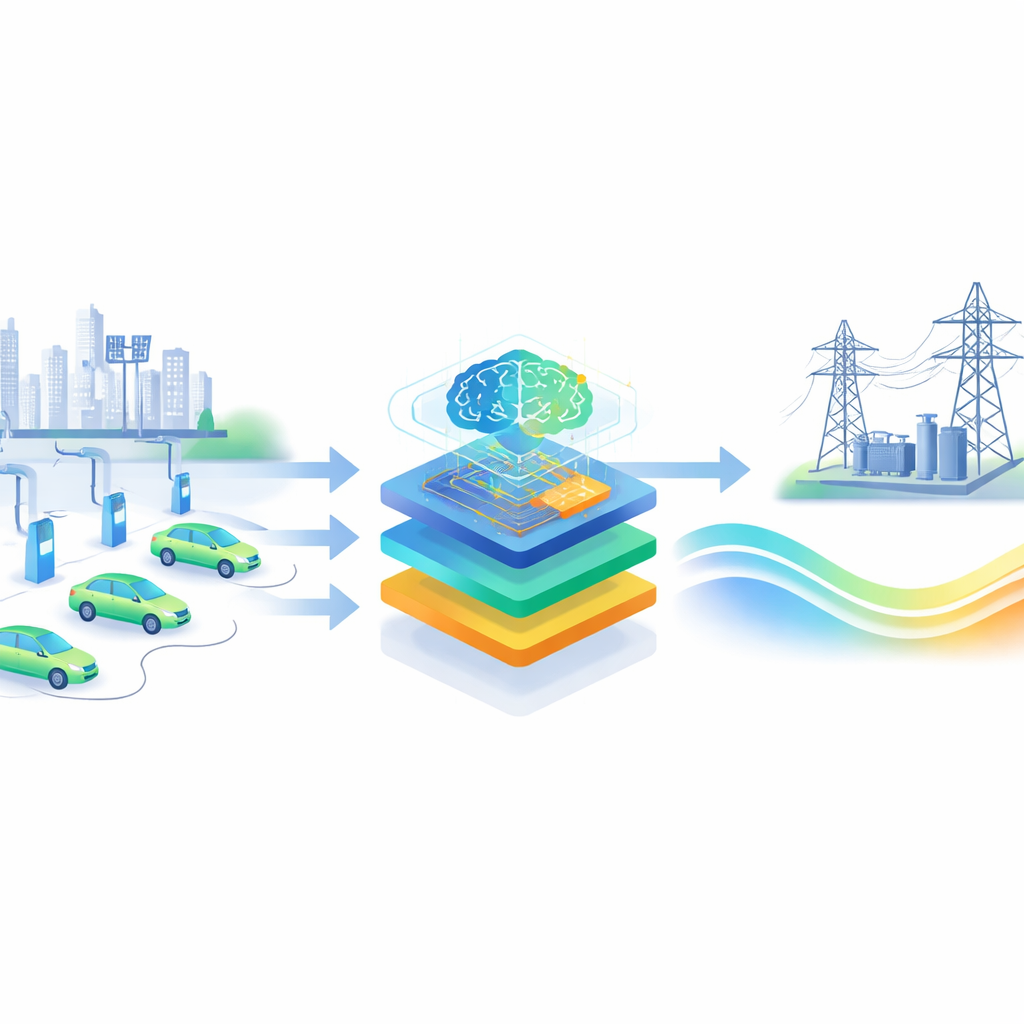
As electric vehicles move from novelty to normal, our plugs are starting to matter as much as our tailpipes. Millions of cars charging at once can quietly strain the same wires and transformers that power homes, hospitals, and factories. This paper explores how artificial intelligence can turn EV charging from a blind power grab into a coordinated, almost invisible dance with the grid—keeping lights steady, equipment safe, and costs under control while drivers still get the range they need.
The Hidden Strain on the Wires
Today, most electric cars charge whenever they are plugged in, with only simple time-of-day pricing to guide behavior. When many drivers charge at the same time, the combined demand can push neighborhood lines and transformers beyond what they were built for. Fast chargers, which rely on power electronics, add another complication: they can distort the smooth sinusoidal shape of grid voltage, leading to flicker, extra heating, and premature wear in sensitive devices. The study shows that in a realistic feeder with 20 mixed chargers, uncontrolled charging pushed voltage swings beyond recommended limits and raised harmonic distortion well above industry standards.
Teaching the Grid to Look Ahead
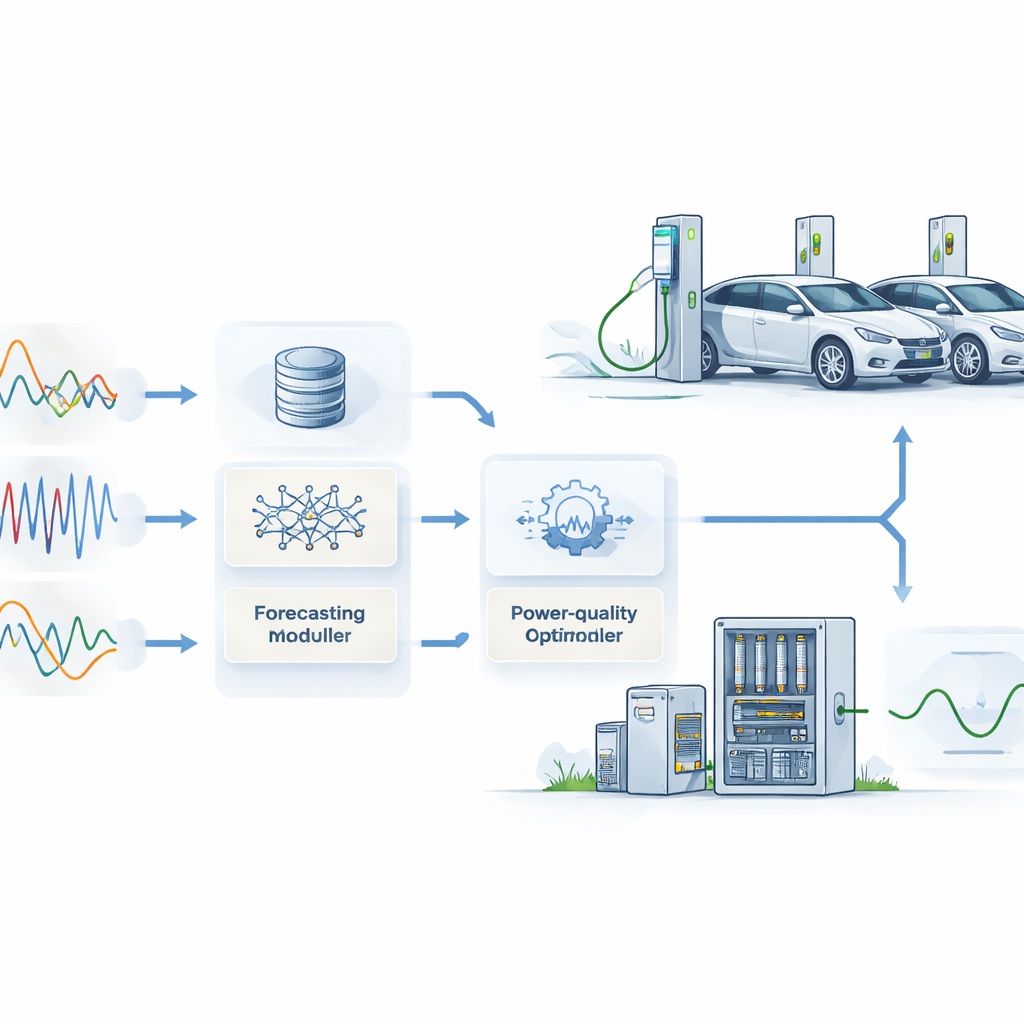
To handle this challenge, the authors first give the grid a form of foresight. They use a modern machine-learning model called a Temporal Fusion Transformer to study past charging patterns, grid measurements, and charger types. From this, the system predicts, in fine time steps, not only how much power will be needed but also how that demand is likely to disturb voltage and waveforms. Instead of just forecasting total load, it anticipates stress indicators—like how far voltage may drift and how distorted the current might become—so that corrective actions can be prepared before problems appear.
Letting an AI Coach Coordinate the Charging
Forecasts alone do not protect the grid; decisions do. The second piece of the framework is a learning-based controller that treats every control interval as a new move in a long game. This controller, trained with a method known as deep reinforcement learning, experiments in simulation with different ways of slowing, speeding, or shifting charging among vehicles. It receives rewards when it keeps voltages near their ideal value, reduces waveform distortion, holds down electricity costs, and still fills batteries on time. Over thousands of episodes, it discovers charging patterns that balance driver needs against grid health, avoiding sharp peaks and spreading demand more smoothly through the day and night.
Cleaning Up the Power as It Flows
Even with careful scheduling, some moments still push the grid close to its limits. For those times, the framework adds a final layer: a power-quality optimizer tied to devices that can inject or absorb reactive power and filter out electrical noise. This optimizer fine-tunes the controller’s charging plan so that voltages stay within narrow safety bands and harmonic distortion respects strict standards. It decides when to activate a distribution compensator and harmonic filters, choosing settings that keep power clean while minimizing extra energy losses and operating costs.
What the Simulations Reveal
Using a detailed computer model of an 11 kV distribution line feeding 20 different EV chargers, the authors compare uncontrolled charging with their AI-guided approach. With the smart system active, average harmonic distortion drops by nearly a third, and the worst spikes fall by more than two-thirds, bringing the network back under recommended limits. Voltage swings shrink, and the time the system spends outside the safe band is cut by roughly three-quarters. The average power factor—a measure of how efficiently the grid delivers useful power—rises from a borderline value to comfortably above the typical requirement. At the same time, the framework trims overall operating cost, largely by avoiding wasteful peaks and unnecessary losses.
Balancing Drivers and the Grid
For non-specialists, the key takeaway is that the problem is not electric cars themselves but how and when they draw power. This study shows that with the right mix of prediction, adaptive control, and targeted cleanup hardware, large numbers of EVs can be woven into existing grids without dimming lights or damaging equipment. The proposed AI-based system effectively acts as a traffic controller for electrons, steering charging sessions so that batteries are filled on time, the grid stays within its comfort zone, and the overall cost of operation falls. If scaled up, this kind of smart coordination could make widespread EV adoption far easier and cheaper than simply overbuilding the grid.
Citation: K, S., C, M. Artificial intelligence-driven optimal charging strategy for EV with integrated power quality enhancement in electric power grids. Sci Rep 16, 10884 (2026). https://doi.org/10.1038/s41598-026-36546-7
Keywords: electric vehicle charging, smart grid, artificial intelligence, power quality, renewable transport