Clear Sky Science · en
Delivery from the sky: investigating visual cues to communicate robot intentions in simulated public spaces
Packages from Above
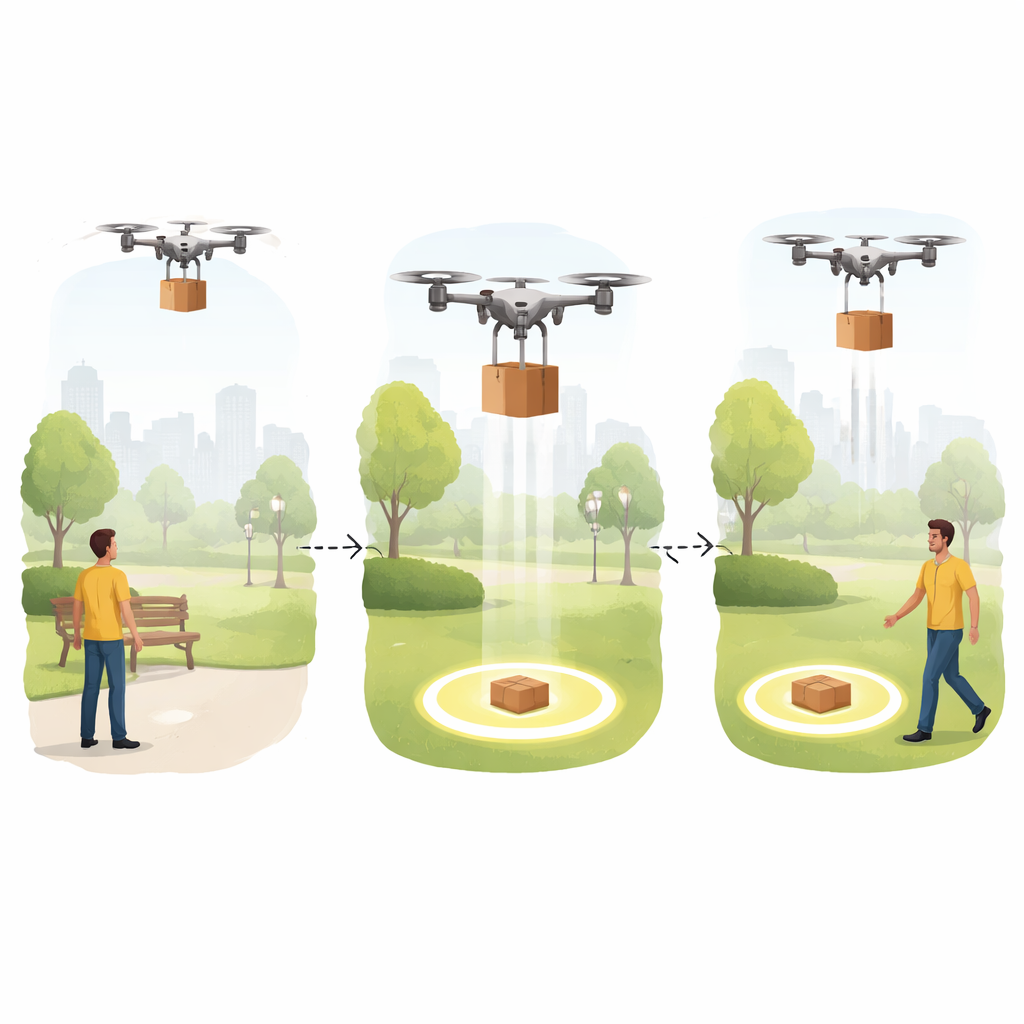
Imagine ordering medicine or groceries and, instead of a van pulling up, a small flying robot appears overhead. As drones begin to share our parks and streets, people need to quickly understand what these machines are doing and when it is safe to step closer. This study explores how simple visual signals on delivery drones can calm uncertainty, build trust, and guide everyday people through a safe handover of packages from the sky.
Why Drone Signals Matter
Many of us still find drones unfamiliar and even a bit unsettling. When a loud machine suddenly appears above you, it may be unclear whether it plans to land, hover, or drop something nearby. That confusion—called uncertainty in the study—can make people hesitate, back away, or mistrust the technology. The researchers asked a basic question: can carefully designed visual cues on drones, such as lights, a simple display, or a glow on the ground, make their intentions easier to read and interactions feel safer?
A Park, Eight Drone Behaviors, and 150 Viewers
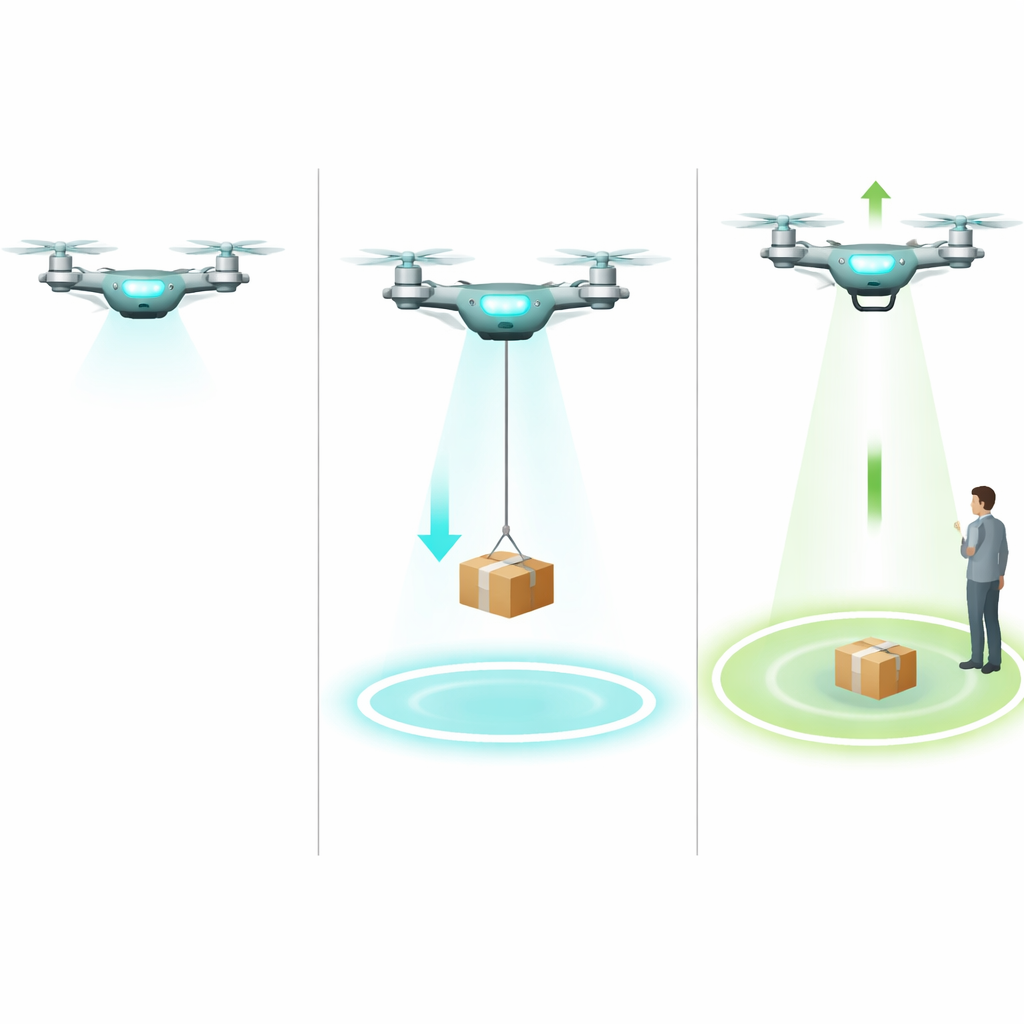
To investigate, the team created realistic computer videos of a delivery drone arriving in a public park. One hundred fifty online participants watched eight different scenarios. In each, the drone either landed on the ground or stayed above head height and lowered a package by cable. At the same time, the drone might show no extra cues at all (the baseline), or use one of three visual aids: a pair of blinking lights on its front, an animated display on its “face,” or a bright projection on the ground that marked the delivery spot and a surrounding safety ring. After each video, viewers rated how uncertain they felt, how understandable and predictable the drone’s actions were, how much they trusted the cues, and how confident they would be about stepping in to collect the package.
What Helped People Feel Sure
The results were clear: any visual interface was better than none, and ground projection worked best of all. When the drone used projection, people reported the lowest uncertainty and the highest levels of understanding, predictability, trust, and confidence about approaching the drop-off area. The projection’s glowing circle on the ground helped locate the package spot and hinted at a “do not cross” boundary. The display, which used simple directional animations, also worked well by making the drone’s up-and-down motion easy to follow. Plain blinking lights helped somewhat but were often harder to interpret, especially when the drone hovered high above people, making it difficult to see which light was blinking.
Safety, Comfort, and Preferred Delivery Styles
Participants were divided on whether they preferred the drone to land or to hover and use a cable. Some felt the cable method was safer because spinning propellers stayed far overhead; others worried about cables swinging in bad weather or being grabbed by children or pets. Interestingly, once interfaces were added, the differences between the two delivery styles became small. What mattered more was how clearly the drone signaled its intentions. With good visual cues, many people felt confident enough to approach the package before the drone fully left the scene—a sign of growing trust, but also a reminder that cues must be designed to keep people from stepping into unsafe zones too early.
From Study to Real Streets and Skies
For a general audience, the key takeaway is that drones can become much more understandable neighbors with the help of simple, well-placed lights, displays, and projected markings on the ground. These cues turned a mysterious flying machine into a more readable partner, reducing confusion and making people feel safer about walking up to collect a package. The authors recommend using displays to show motion and projections to make landing or drop-off spots—and their safety boundaries—obvious at a glance. While this work was done in a simulated park, it offers a roadmap for designing future delivery drones and other flying robots, such as those used in emergencies or public services, so that their intentions are clear long before they touch down near us.
Citation: Lingam, S.N., Petermeijer, S.M., Obaid, M. et al. Delivery from the sky: investigating visual cues to communicate robot intentions in simulated public spaces. Sci Rep 16, 12094 (2026). https://doi.org/10.1038/s41598-026-36451-z
Keywords: drone delivery, human-drone interaction, robot communication, public space robotics, visual cues