Clear Sky Science · en
Visual perception of longitudinal waves: theory and observations
Why moving ripples of dots matter
Sound moves through air as ripples of pressure, but we almost never see this kind of motion. This study turns those invisible ripples into visible patterns of moving dots so we can watch how our eyes and brain interpret them. The authors find that what we "see" in these waves is not a simple copy of the underlying motion. Instead, our brains carve the wave into two opposite streams of movement that do not exist in the physical dots themselves, revealing hidden rules for how we interpret complex motion.
Turning sound-like waves into something we can see
The authors focus on longitudinal waves, the kind where particles move back and forth along the same line that the wave travels, as in sound or some earthquakes. They build a mathematical description of how idealized particles in a gas should move when driven by a sinusoidal vibration. When they compute how densely packed the particles become along space, they find that the pattern is only gently wavy at tiny amplitudes. As the shaking grows stronger, the dense regions sharpen into narrow spikes while the gaps become broad, and at still higher amplitudes each cycle splits into two peaks. These strong distortions, largely ignored in standard physics treatments, arise even though the underlying vibration remains perfectly regular. The team then renders these waves as movies of hundreds of dots that oscillate in place with a progressive phase shift, so a visible wave seems to travel around a ring-shaped band. 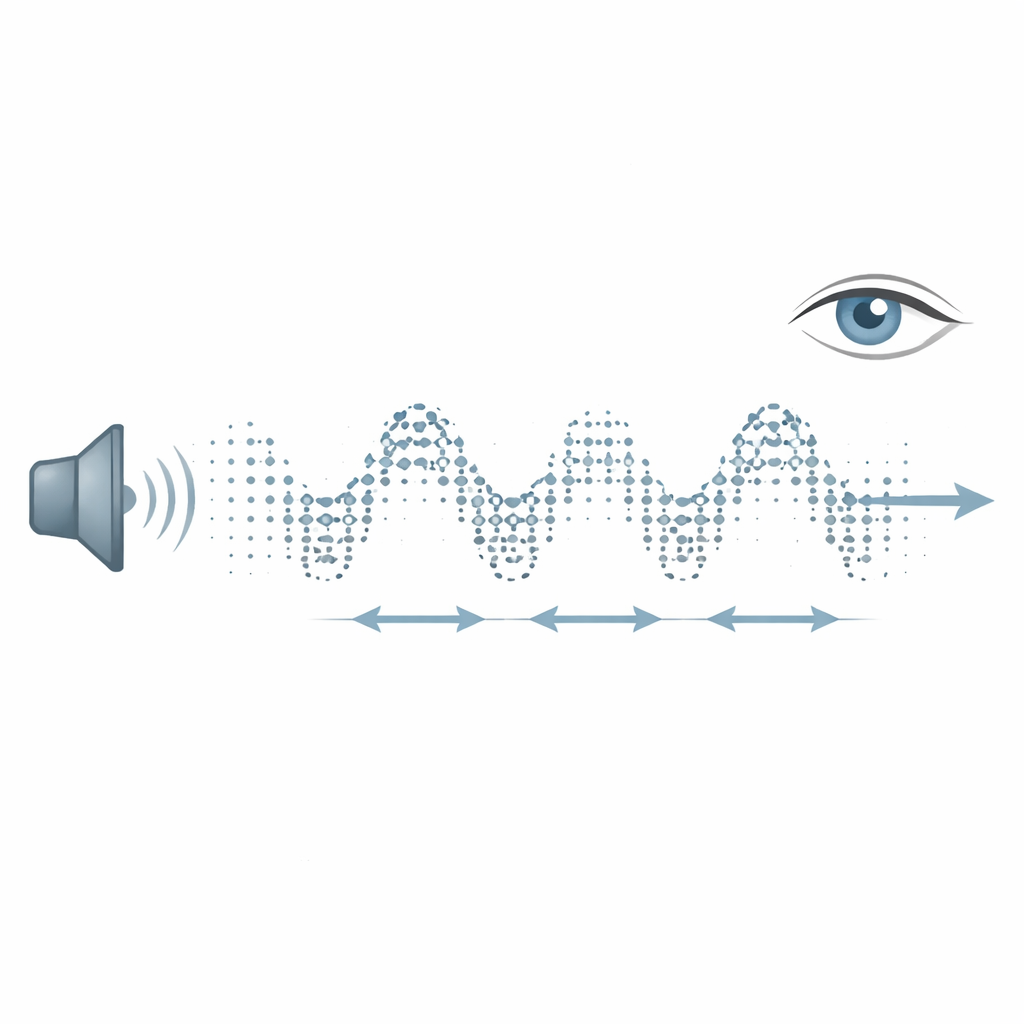
What the brain sees in a ring of moving dots
When observers fixate the center of a dot-filled ring, they find it surprisingly hard to notice that each dot simply rocks back and forth without drifting around the ring. Instead, the eye latches onto regions where dots bunch together (crests) and where they spread out (troughs). The crests appear to sweep around the ring in the same direction as the underlying phase propagation, while the troughs seem to drift as a broad texture in the opposite direction. At medium wave strengths, many viewers also report that the dense crests pop forward in depth, as if they were closer in 3D space. Careful timing shows that the perceived speed of both crests and troughs seems to increase with amplitude, even though, physically, each crest always takes the same time to circle the ring: the speed change is an illusion created by nonlinear changes in density.
Testing brightness, contrast, and pure density
Because bunching the dots makes those regions darker on average, the authors ask whether ordinary motion mechanisms that track luminance are responsible for the effect. They therefore create versions where dot brightness is adjusted to cancel out the natural darkening of dense crests, and other versions where each dot is randomly black or white so that average brightness stays uniform. In both cases, observers still see forward-moving crests and backward-moving troughs, and the sense of depth remains. Next, the team carefully balances the local contrast so that dense regions no longer carry extra contrast energy, a cue thought to drive a separate "second-order" motion system. This reduces the clarity of both motions but does not abolish them; at high amplitudes, the forward motion of crests fades while the backward motion of troughs dominates. When the authors scramble the dots’ positions from frame to frame so that only waves of density remain, the moving structure becomes almost invisible. Together, these tests suggest that neither simple brightness nor contrast energy, nor density alone, can fully explain the perceived bidirectional motion; instead, the precise trajectories of individual dots, integrated over space, play a key role. 
Probing hidden motion signals and aftereffects
To understand how our motion system converts local dot oscillations into global flows, the authors add a uniform rotation to all dots, like spinning the whole ring rigidly. By adjusting this added spin until the forward-moving crests or backward-moving troughs appear to stand still, they estimate how fast each perceptual stream is moving. The required cancellations do not match the average speed of the dot motions, nor simply their maximum speed, but fall in between—and they differ for crests and troughs, especially at higher amplitudes. This implies that separate mechanisms pool local motion within dense and sparse regions differently. The team then asks whether these strange waves trigger a motion aftereffect, the illusory motion seen after staring at a moving pattern and then switching to a static one. Rigidly rotating textures of dots produce strong aftereffects, but the same dots arranged as a longitudinal wave do not, unless contrast is adjusted to favor one direction. The authors argue that local motion detectors tuned to opposite directions adapt equally and cancel out, so the net aftereffect vanishes even though strong global motion is clearly experienced.
What this means for how we see motion
This work shows that when we look at a sound-like longitudinal wave, the brain does not simply follow the back-and-forth path of each dot. Instead, it builds a higher-level picture in which moving bands of compression and rarefaction become two transparent sheets sliding past each other in opposite directions. These emergent motions depend on nonlinear changes in particle density and on how local motion signals are pooled over large areas, yet they can remain invisible to classic tests like the motion aftereffect. By exposing this gap between physical motion and perceived motion, the study highlights that our experience of moving patterns is a constructed interpretation, shaped by specialized neural mechanisms that detect and integrate motion in ways that go beyond straightforward tracking of brightness or contrast.
Citation: Tyler, C.W., Solomon, J.A. & Anstis, S.M. Visual perception of longitudinal waves: theory and observations. Sci Rep 16, 11392 (2026). https://doi.org/10.1038/s41598-026-36204-y
Keywords: visual motion perception, longitudinal waves, random-dot patterns, nonlinear wave dynamics, motion aftereffect