Clear Sky Science · en
Neural correlates of adversity-overcoming pup rescue behavior in female mice
Why rescuing babies matters
Most of us instinctively rush to help a baby in trouble, even if the child is not our own. This sense of urgency to protect vulnerable young is a cornerstone of human society, and scientists want to understand where it comes from in the brain. In this study, researchers used mice to explore how females decide whether to brave a threatening situation—crossing water they dislike—to rescue helpless pups, and which brain areas help them push through fear or discomfort to do so.
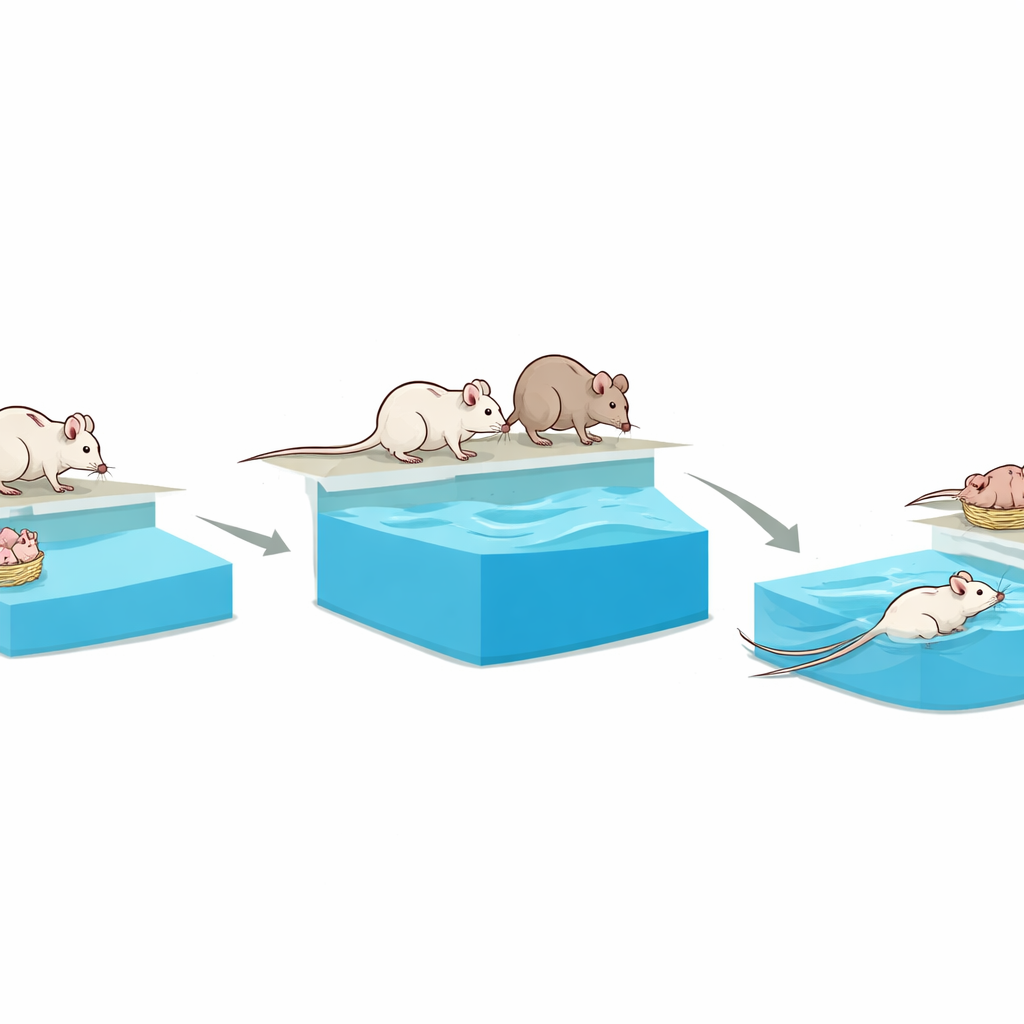
A simple but demanding rescue test
The team created a new “rescue arena” that let them dial up or down the level of challenge. A nest was placed on one side of a rectangular cage, and a shallow pool on the other side separated the adult females from the pups. By changing the water depth from dry floor, to a thin film, to ankle-deep water, the researchers could tune how unpleasant the crossing felt. Mice naturally avoid standing water, so deeper water represents greater adversity: crossing it costs more effort, comfort, and possibly body heat.
Water aversion and who dares to cross
First, the scientists confirmed that both mother mice and non‑maternal virgin females dislike the water, and that deeper water is more strongly avoided. Using both hand scoring and an automated motion‑tracking system, they found that as the pool grew deeper, mice waited longer before stepping in, made fewer crossings, and spent less time in the water. Mothers were especially cautious, treating the water as more threatening than virgins did, even though both groups lived with pups and had experience with infant care.
Surprising rescuers: non‑mothers step up
When pups were placed beyond the pool, both mothers and virgins tried to rescue them by crossing the water, picking them up, and bringing them back to the nest. As expected, pup presence reduced water avoidance: mice crossed more readily when babies needed help. Unexpectedly, however, virgin females outperformed mothers as the water got deeper. At the highest depth, virgins were more likely to reach and retrieve all pups and did so more quickly. Mothers showed better technical skill—needing fewer trips and dropping pups less often—but their stronger reluctance to enter deep water limited how much care they could provide. This suggests that rescue depends on a balance between attraction to the pups and perception of danger, and that this balance differs between mothers and non‑mothers.
Trapped pups and the helping brain
To probe the brain machinery behind this adversity‑overcoming rescue, the researchers used a tougher version of the task with only virgin females. Now, pups were confined inside small tubes beyond a shallow pool, so rescuers had to cross the water and then learn to open the tubes before carrying pups back. Some mice consistently did this, while others never managed to open the tubes. The team then examined brain tissue for c‑Fos, a marker of recent neural activity, to see which regions were more active in successful rescuers.
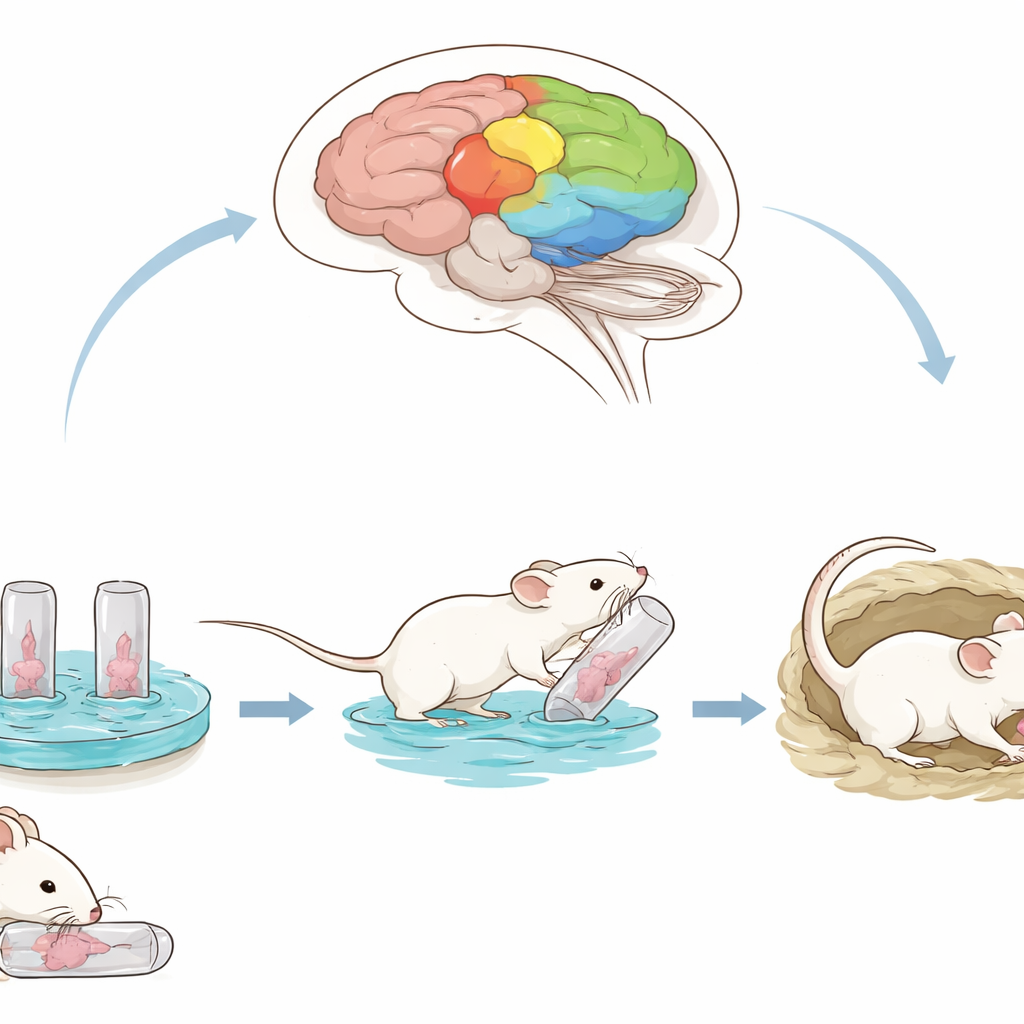
Key brain hubs for pushing through discomfort
Rescuing virgins showed stronger activity in several interconnected areas linked to parental care, emotion, and sensitivity to others’ distress. These included parts of the preoptic area previously tied to nurturing behavior, regions such as the anterior cingulate cortex, lateral septum, and basolateral amygdala that help process negative feelings and social signals, and brainstem centers involved in arousal and responses to uncomfortable bodily states. Across animals, higher activity in these regions was related to shorter delays in crossing the pool and opening the tubes, suggesting they help transform concern for pups into swift, determined action despite the unpleasant water.
What this means for understanding altruism
Because the rescuing virgins were not related to the pups they helped, their behavior resembles a simple form of altruism: taking a personal cost to benefit another. This study shows that such costly helping in mice can be measured and linked to specific brain circuits. It also highlights that caregiving motivation is shaped not just by hormones of motherhood, but by how the brain weighs danger against the urge to protect young. By mapping these circuits in a controlled animal model, the work lays groundwork for understanding how caring for infants, cooperation, and altruistic behavior might have arisen and are supported in mammalian brains, including our own.
Citation: Prokofeva, K., Shibamiya, M., Kawata, R. et al. Neural correlates of adversity-overcoming pup rescue behavior in female mice. Sci Rep 16, 11844 (2026). https://doi.org/10.1038/s41598-026-35639-7
Keywords: altruism, parental care, prosocial behavior, mouse behavior, brain circuits