Clear Sky Science · en
Cluster based WSN routing with MOGA and LSA optimization
Smarter Networks for a Connected World
From environmental monitoring to smart factories and cities, tiny wireless sensors quietly collect and relay data all around us. Yet these battery-powered devices have a hard limit: once their energy runs out, the entire network can fail. This paper explores a new way to organize and route information in such wireless sensor networks so they last longer, waste less energy, and deliver data more reliably—key needs for the future Internet of Things and smart environments.
Why Tiny Sensors Face a Big Energy Problem
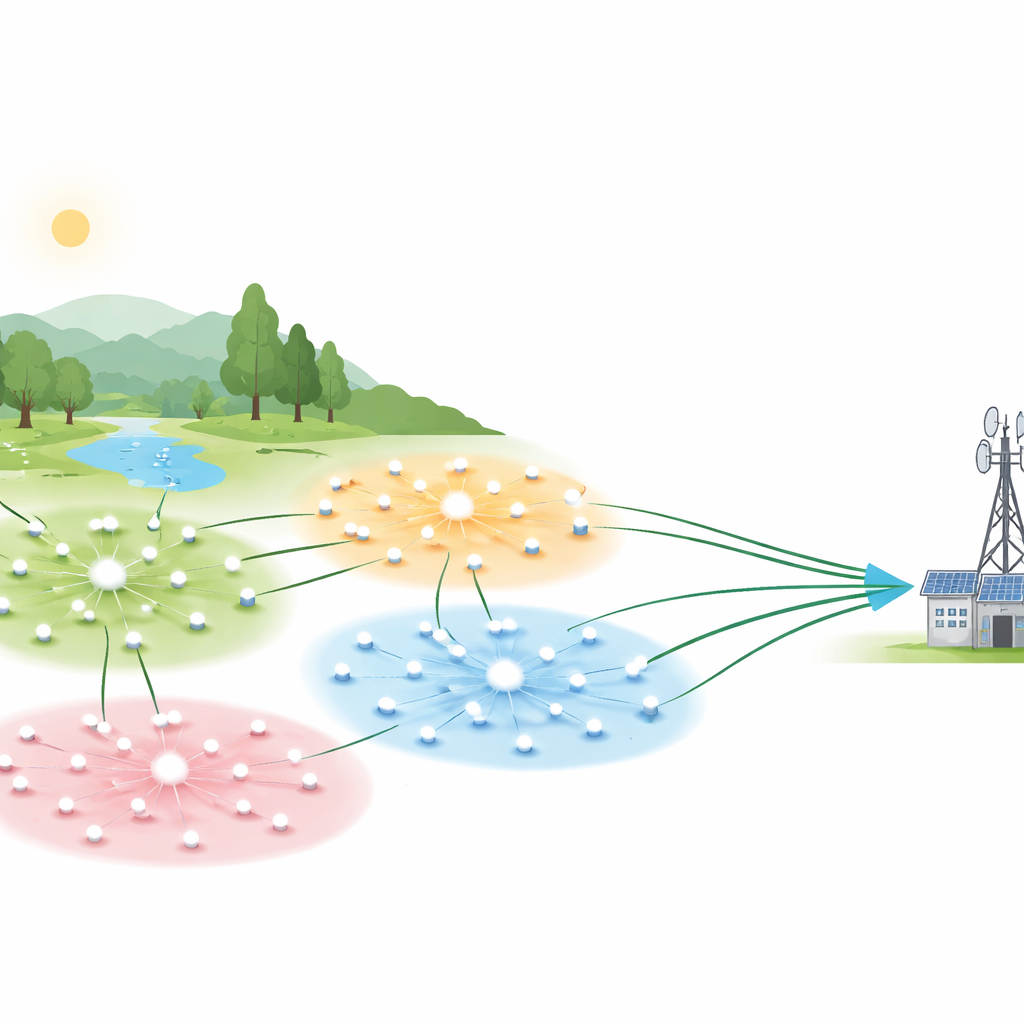
Wireless sensor networks consist of many small devices scattered across an area, each measuring temperature, motion, pollution, or other signals. Sending data wirelessly, especially over long distances, consumes far more energy than sensing. If every sensor talked directly to a central base station, the devices far away would quickly drain their batteries, creating gaps in coverage and shortening the life of the whole system. To slow this drain, engineers group sensors into clusters. Within each cluster, a single sensor acts as a “leader” that gathers data from its neighbors and forwards it to the base station. Choosing which sensors should become leaders, and how data should travel between them, turns out to be a complex puzzle with many competing goals.
Blending Two Digital "Evolution" Strategies
The authors propose a hybrid optimization method that combines two nature-inspired algorithms: a Multi-Objective Genetic Algorithm (MOGA) and the Lightning Search Algorithm (LSA). MOGA mimics evolution by treating possible choices of cluster leaders as chromosomes that can be selected, crossed, and mutated. It evaluates each configuration on several fronts at once: keeping the average distance between sensors and their leader short, keeping leaders close to the base station, and favoring leaders with plenty of remaining battery energy. Over many generations, MOGA converges on a set of leader choices that balance these trade-offs, so no single area of the network is overworked or drains too fast.
Finding the Best Paths Through the Network
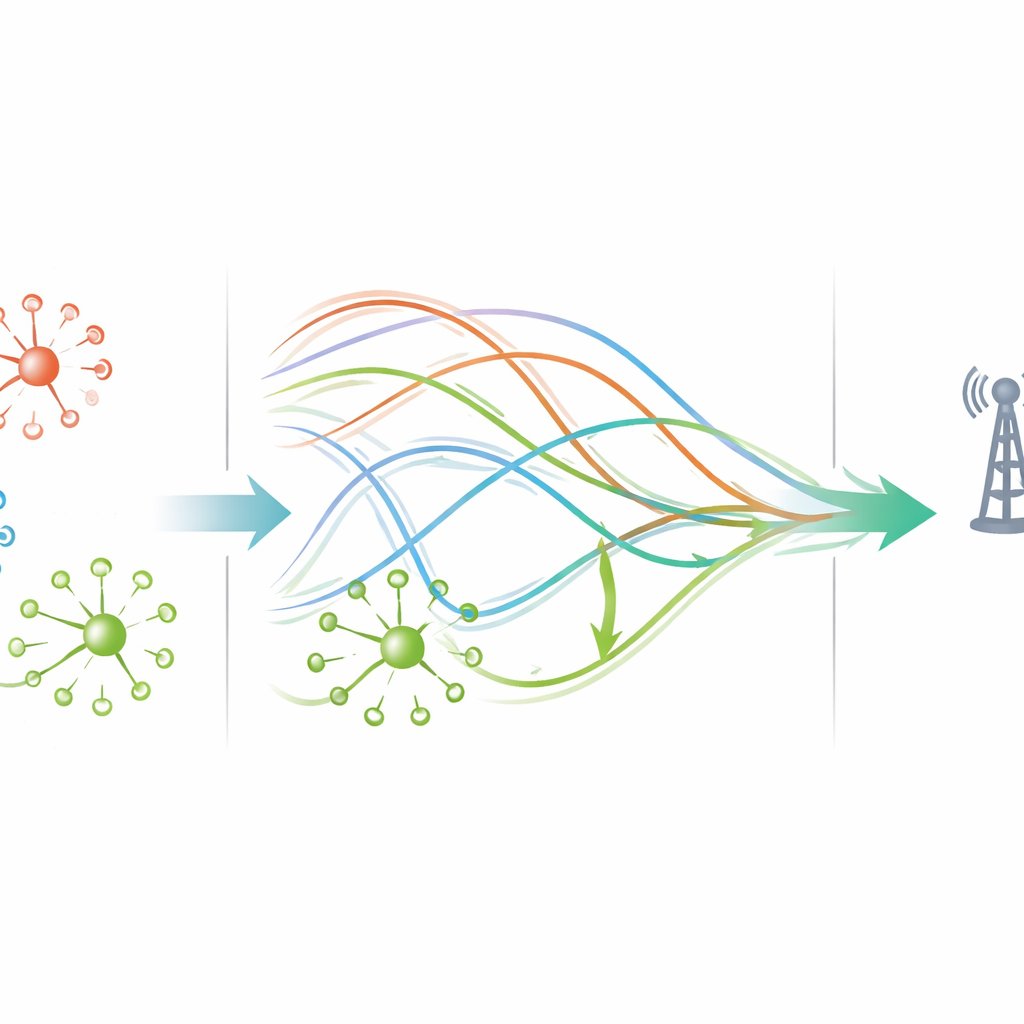
Once good leaders have been chosen, the next challenge is how data should hop from leader to leader on its way to the base station. There are many possible multi-hop routes, and picking the best one is again a multi-faceted problem. Here the Lightning Search Algorithm comes into play. Inspired by the branching and convergence of lightning strikes, LSA starts from the candidate routes implied by MOGA’s cluster layout and then explores alternative paths. For each possible route it weighs how much total energy it consumes, how long data takes to travel from source to sink, and how reliably packets are delivered. By iteratively improving paths and escaping local dead-ends, LSA homes in on global routes that jointly minimize energy use and delay while maximizing successful delivery.
How the New Method Performs in Practice
To test their approach, the researchers simulated sensor networks with 100 nodes using standard tools and compared their hybrid MOGA–LSA framework against several well-known methods, including LEACH, PSO-based schemes, and other hybrid metaheuristic designs. Across thousands of simulated data rounds, the new method reduced overall energy consumption by about 48 percent, kept the energy drain much more balanced across nodes, and significantly extended the time until the first sensor died and the network broke down. At the same time, it achieved very high data delivery rates—above 99 percent—while keeping the delay from one end of the network to the other low. Statistical tests confirmed that these gains were not due to chance but reflected a consistent advantage of the hybrid design.
Limits and Next Steps for Real-World Use
While the method works well for static or slowly changing sensor setups, the authors note that highly dynamic conditions—such as moving nodes or rapidly shifting wireless channels—may reduce its effectiveness. In such cases, the cluster structure and optimal routes may need to be recalculated more often, adding overhead and possibly offsetting energy savings. The paper suggests that future work could explore other combinations of search algorithms, extend the design to three-dimensional layouts (for example, in buildings or underwater), and adapt the approach to networks where nodes move more frequently.
What This Means for Everyday Technology
In simple terms, the study shows that carefully coordinating how sensors group themselves and how they pass data along can greatly extend the life and reliability of wireless sensor networks. By letting two complementary optimization strategies work together—one to pick the right local leaders and another to find the best global routes—the system uses battery power far more wisely. For everyday technologies built on the Internet of Things, from smart homes to precision agriculture, approaches like this could mean fewer battery replacements, more stable monitoring, and more sustainable large-scale deployments.
Citation: Tan, W., Wang, F. Cluster based WSN routing with MOGA and LSA optimization. Sci Rep 16, 9953 (2026). https://doi.org/10.1038/s41598-026-35584-5
Keywords: wireless sensor networks, energy-efficient routing, cluster-based networking, metaheuristic optimization, internet of things