Clear Sky Science · en
EVA-centric QUBO optimization for active and reactive power coordination in DLMP-driven distribution systems
Why your car could help keep the lights on
As electric cars spread across neighborhoods, they are quietly turning into one of the grid’s most powerful tools. Instead of being just another device that plugs in at night, a parked car’s battery and charger can help smooth demand, support local voltage and even earn money for its owner. This paper explores how thousands of electric vehicles, acting together through an aggregator, can be scheduled so that they charge cheaply, steady the grid and prepare for a future where new forms of computing tackle problems too complex for today’s methods.
From lone cars to coordinated swarms
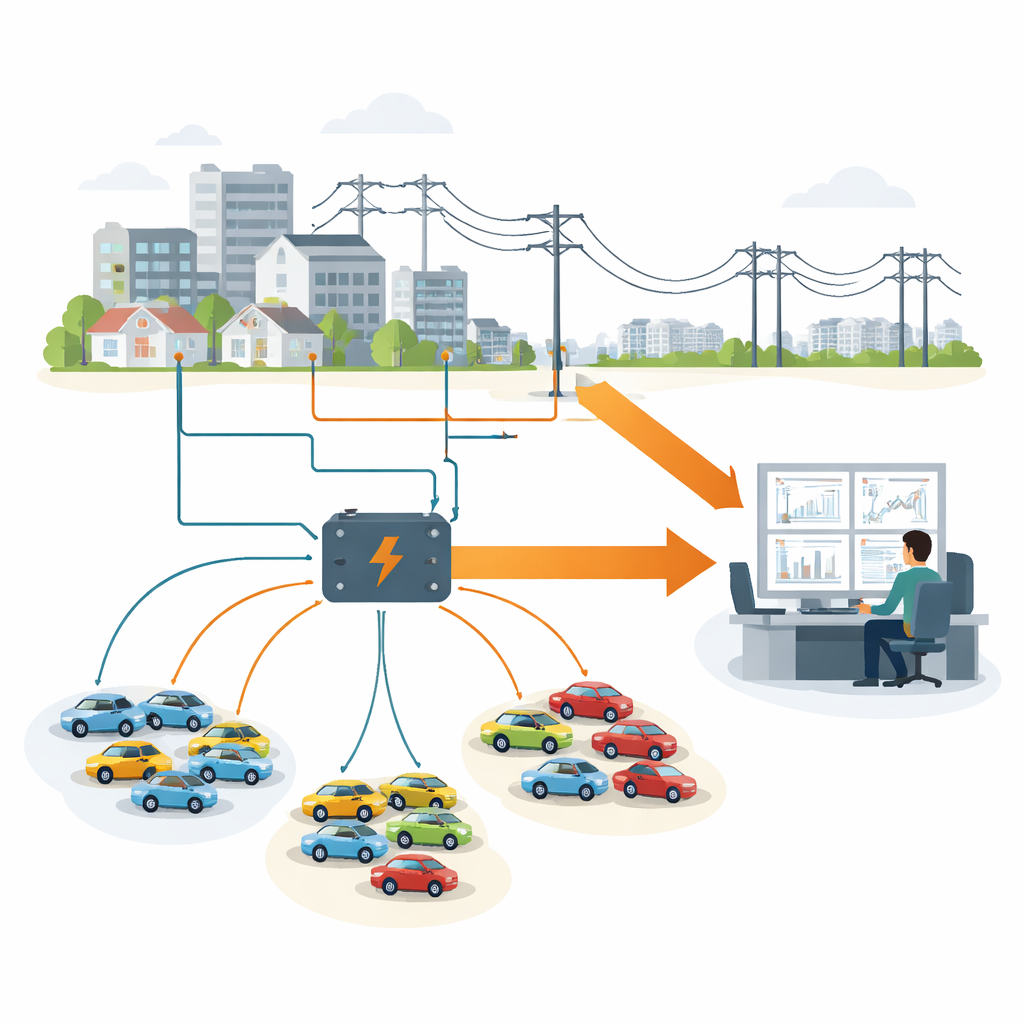
The study focuses on electric vehicle aggregators—companies or platforms that manage charging for large fleets of cars on behalf of drivers. Rather than treating each car as an isolated load, the aggregator groups vehicles with similar arrival times, energy needs and charger sizes into a few clusters. This makes a sprawling problem with 1,000 cars manageable while still respecting when each driver arrives home, how far they must drive tomorrow and how fast their car can charge. These clusters then act like controllable blocks of demand that can be shifted in time or adjusted up and down to help the grid.
A flipped power hierarchy that favors flexibility
Traditionally, the local grid operator tells everyone else what to do: it sets prices and generators and consumers respond. Here, that hierarchy is flipped. The electric vehicle aggregator is treated as the leader in a two-level game, deciding how much charging and voltage support each cluster will provide over the day. The distribution system operator follows, adjusting local generation and network settings in response. Prices known as distribution locational marginal prices capture the true cost of supplying power, including losses and congestion on specific feeders. The aggregator predicts these prices, schedules its fleet accordingly, and then updates its plan as the operator reacts, repeating the process until neither side has an incentive to change.
Turning physics into a puzzle of on–off choices
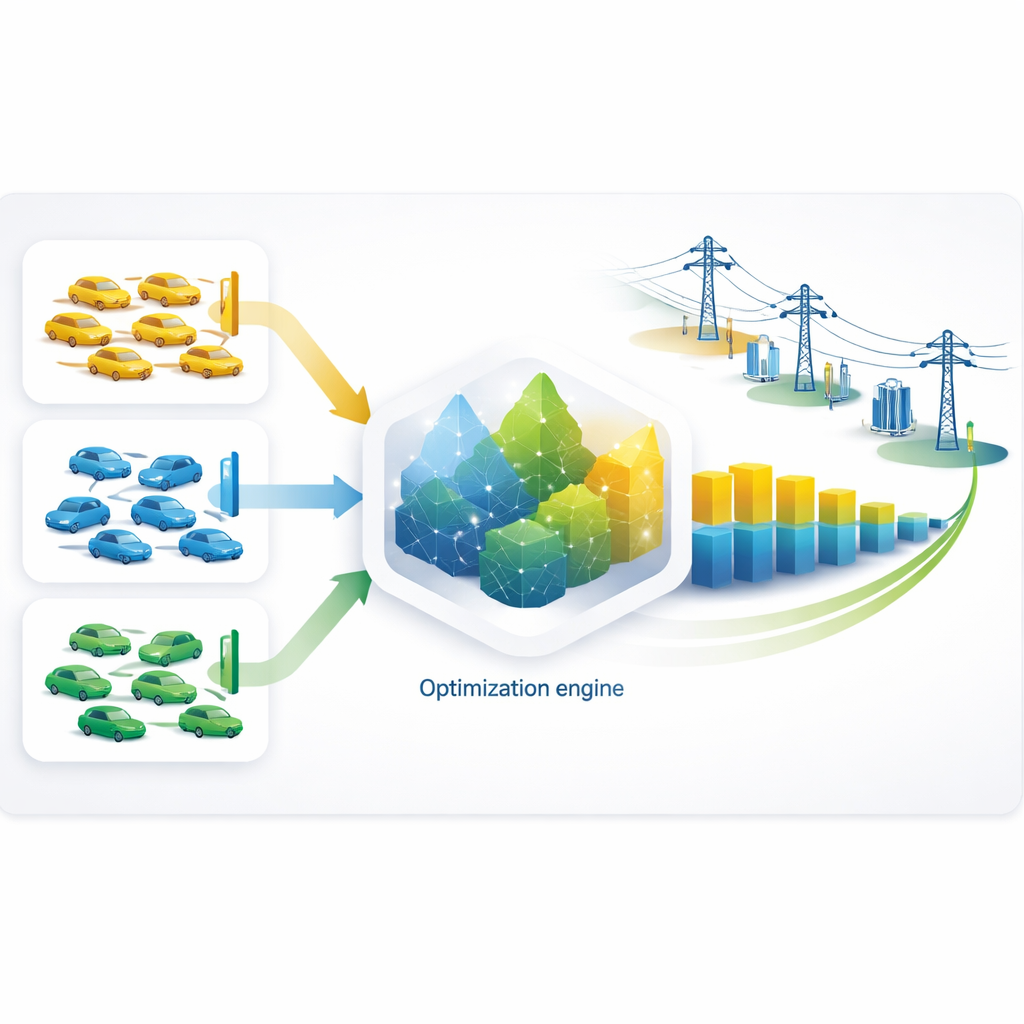
Coordinating thousands of cars over many time steps is a combinatorial nightmare. The authors recast this challenge as a quadratic unconstrained binary optimization problem, or QUBO, in which continuous decisions—such as power levels and voltages—are discretized into a grid of on–off choices. Clever penalties in the mathematical formulation ensure that physical limits, like charger ratings, energy needs and voltage bounds, are respected. A spectral clustering method, also written in QUBO form, automatically finds well-balanced clusters of vehicles. The resulting binary problems are solved with an enhanced simulated annealing algorithm, a search strategy inspired by how materials cool and settle into low-energy states and well suited to future quantum hardware.
What happens when 1,000 cars play along
The framework is tested on a standard 33-bus distribution network with 1,000 cars divided into four clusters. When the cars respond only with their active charging power, the grid already benefits from shifted demand. When they also use their chargers to provide reactive power—an invisible but crucial ingredient for holding voltages steady—the gains become striking. Compared with more conventional coordination schemes, total system costs drop by nearly 40 percent, the grid operator’s own costs fall by about a quarter and the aggregator’s energy bill shrinks by three quarters. Power losses on the lines fall by almost 5 percent, voltage deviations improve by roughly 10 percent and minimum voltages at the end of the feeder rise above common quality thresholds.
New earnings for cars and new tools for engineers
Beyond technical gains, the scheme opens a fresh revenue stream: by selling voltage support, the fleet earns over $47 per day in reactive power payments, while still meeting 100 percent of drivers’ energy needs and maintaining a customer satisfaction index near 99 percent. Compared with popular search methods such as particle swarm and genetic algorithms, the QUBO approach is slower but scales more gracefully to very large problems and works efficiently with modern commercial solvers. Because QUBO is also the native language of many emerging quantum computers, the authors argue that their framework can reap immediate benefits on today’s machines while being ready to exploit tomorrow’s quantum speedups as grid electrification and renewable deployment continue to grow.
Citation: Suri, V., Nagpal, N., Siano, P. et al. EVA-centric QUBO optimization for active and reactive power coordination in DLMP-driven distribution systems. Sci Rep 16, 12513 (2026). https://doi.org/10.1038/s41598-026-35457-x
Keywords: electric vehicle aggregation, smart distribution grids, demand response, reactive power support, quantum-inspired optimization