Clear Sky Science · en
Mechanical, half-metallic ferro-magnetic and thermoelectric properties double perovskites Li2W(Cl/Br)6 for spintronic and energy devices: DFT-calculations
New materials for faster gadgets and greener power
Modern electronics are pushing against limits in speed, energy use, and how much data they can store. One promising way forward is to use not just the electric charge of electrons, but also their tiny built‑in magnets, called spins, and at the same time harvest waste heat as useful electricity. This study explores a new family of crystal materials, Li2WCl6 and Li2WBr6, that could help build both ultra‑efficient spin‑based electronics and solid‑state heat‑to‑power devices, pointing toward faster gadgets that also waste less energy.
Building blocks with a tidy crystal framework
The authors focus on “double perovskites,” a class of crystals known for their highly ordered, Lego‑like atomic frameworks that can be tuned by swapping in different elements. Here, lithium (Li), tungsten (W), and either chlorine (Cl) or bromine (Br) combine into Li2W(Cl/Br)6, forming a stable cubic structure where tungsten atoms sit at the center of octahedra surrounded by six halogen atoms. Using advanced computer simulations based on quantum mechanics, they first check whether these compounds are structurally sound. Negative formation energies and satisfaction of standard mechanical stability rules show that both versions should be thermodynamically and mechanically robust, with Li2WBr6 coming out slightly more rigid. The calculations also predict melting temperatures well above 1000 K, suggesting these crystals could withstand demanding device conditions. 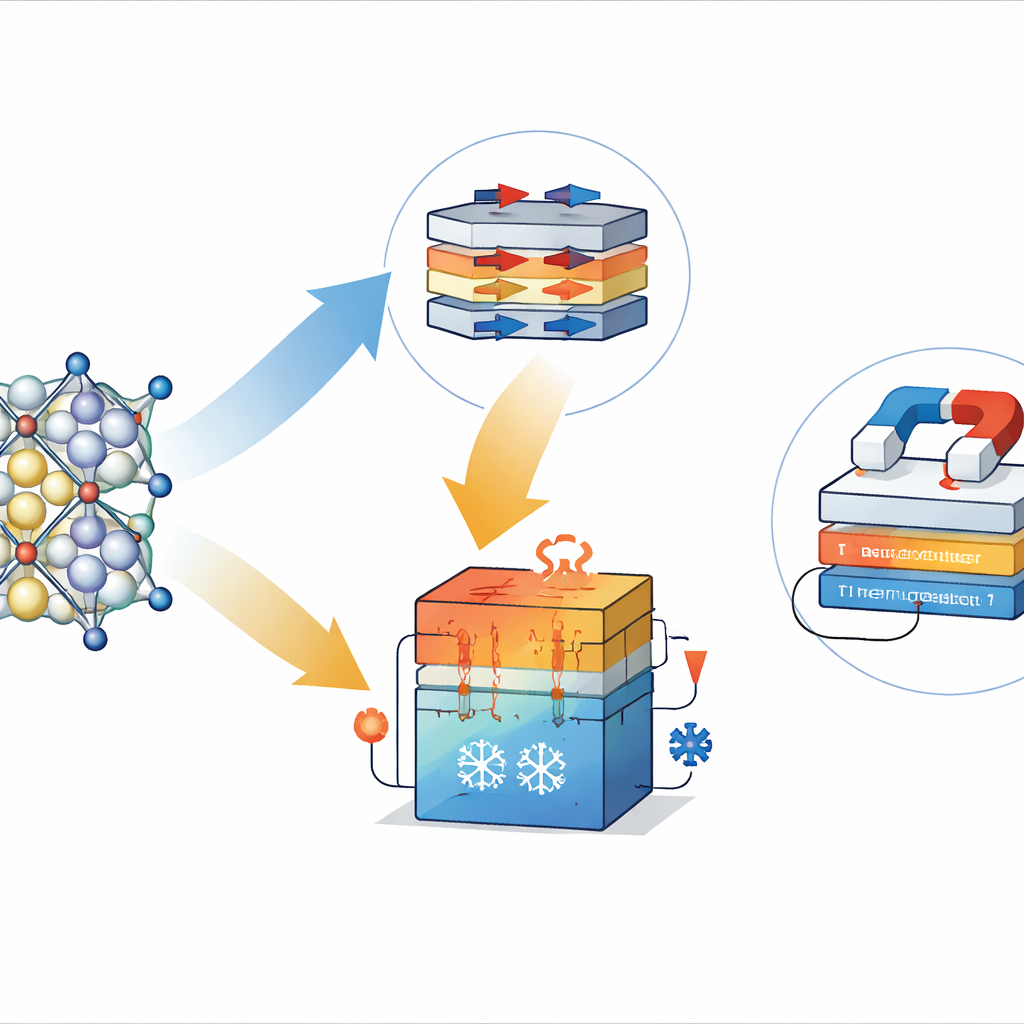
Magnetic behavior that filters spins
What makes these crystals especially interesting is their magnetic personality. The study finds that both Li2WCl6 and Li2WBr6 favor a ferromagnetic arrangement, where many tiny atomic magnets align in the same direction, and that this order should persist far above room temperature, with predicted Curie temperatures around 400 K. Even more importantly, their electronic band structures reveal “half‑metallic” behavior: electrons with one spin direction find a metallic, easy‑to‑travel path, while those with the opposite spin see a gap and are blocked, as in an insulator. This near‑perfect spin filtering arises from the way tungsten’s d‑orbitals mix with the surrounding halogen orbitals, helped by strong spin‑orbit effects from the heavy W and Br atoms. As a result, the crystals provide almost completely spin‑polarized currents, a key requirement for practical spintronic devices such as magnetic memory and spin‑based logic.
Mechanical strength that suits real devices
Having a promising electronic and magnetic profile is not enough; a useful material also needs to survive the stresses of growth, packaging, and operation. By calculating elastic constants, the authors show that both compounds are mechanically stable and, importantly, ductile rather than brittle. Indicators such as Pugh’s ratio and Poisson’s ratio suggest these materials can deform slightly without shattering, which is helpful for thin films and layered device stacks. The crystals are also anisotropic, meaning their stiffness and related properties vary with direction. While this sounds like a complication, it can in fact be an advantage, allowing engineers to align crystals in ways that optimize both spin transport and heat flow in working devices.
Turning heat into useful electrical power
Beyond spin control, Li2WCl6 and Li2WBr6 show promise as thermoelectric materials that convert temperature differences into voltage. Using a transport code that connects the band structure to carrier motion, the team evaluates how electrical conductivity, Seebeck coefficient (which measures how strongly temperature drives voltage), and thermal conductivity change from 200 to 800 K. Both compounds show increasing Seebeck coefficients with temperature and reasonable electrical conductivities, while their lattice thermal conductivities drop as phonons—vibrations of the crystal—scatter more at higher temperatures. Li2WBr6, with slightly better electrical performance and lower electronic heat conduction, achieves a higher dimensionless figure of merit (ZT), indicating more efficient heat‑to‑power conversion. 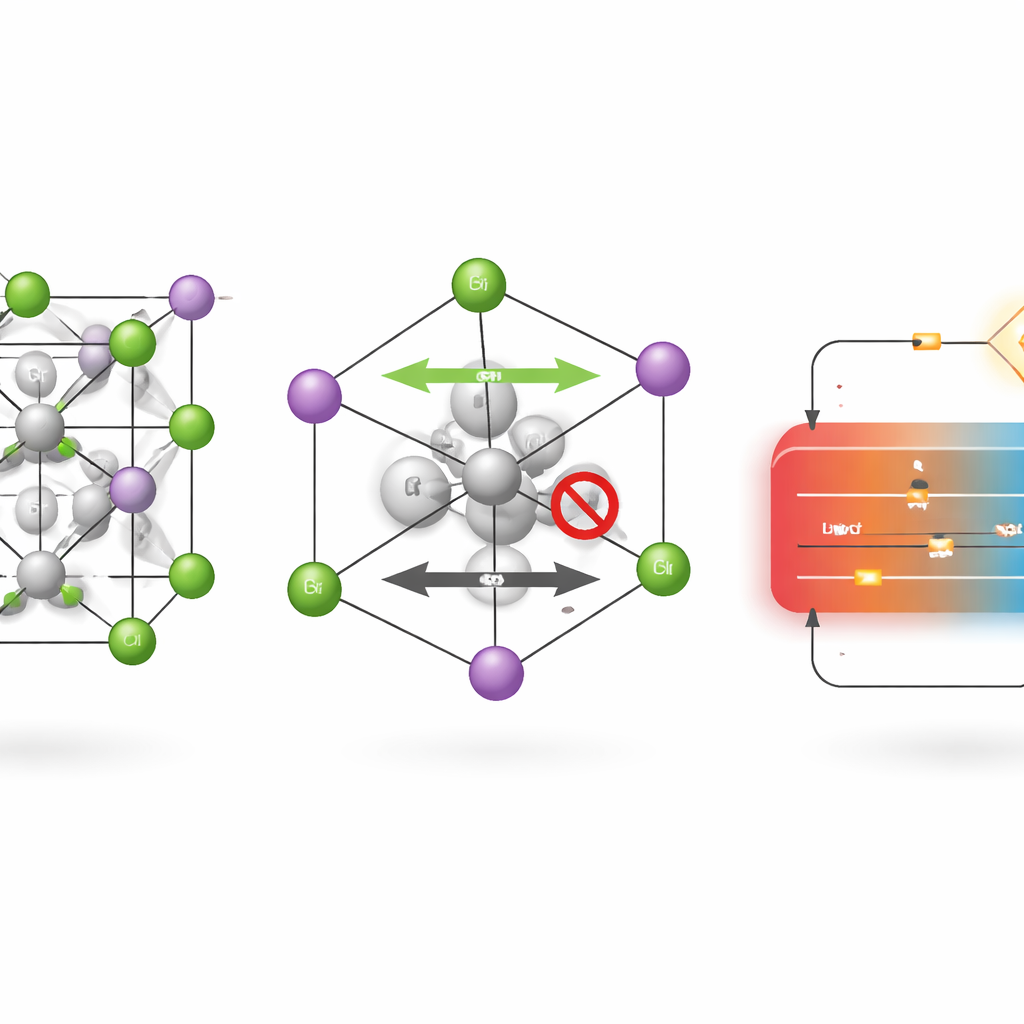
Why these crystals matter for future technology
In plain terms, this work identifies two closely related crystals that can both act as powerful spin filters and make useful electricity from heat, all while remaining strong and stable. Their ability to pass electrons of only one spin direction, maintain magnetism at everyday temperatures, and handle heat gradients efficiently makes them attractive candidates for next‑generation spintronic memory, sensors, and on‑chip energy harvesters. If synthesized as thin films and integrated into devices, Li2WCl6 and Li2WBr6 could help electronics become faster, more compact, and less wasteful of energy.
Citation: Ahmad, M., Khan, R., Sohaib, M.U. et al. Mechanical, half-metallic ferro-magnetic and thermoelectric properties double perovskites Li2W(Cl/Br)6 for spintronic and energy devices: DFT-calculations. Sci Rep 16, 11095 (2026). https://doi.org/10.1038/s41598-026-35445-1
Keywords: spintronics, half-metallic perovskites, thermoelectric materials, ferromagnetism, energy conversion