Clear Sky Science · en
A hybrid AI framework for identification of power quality disturbances in electrical network
Why the health of your electricity matters
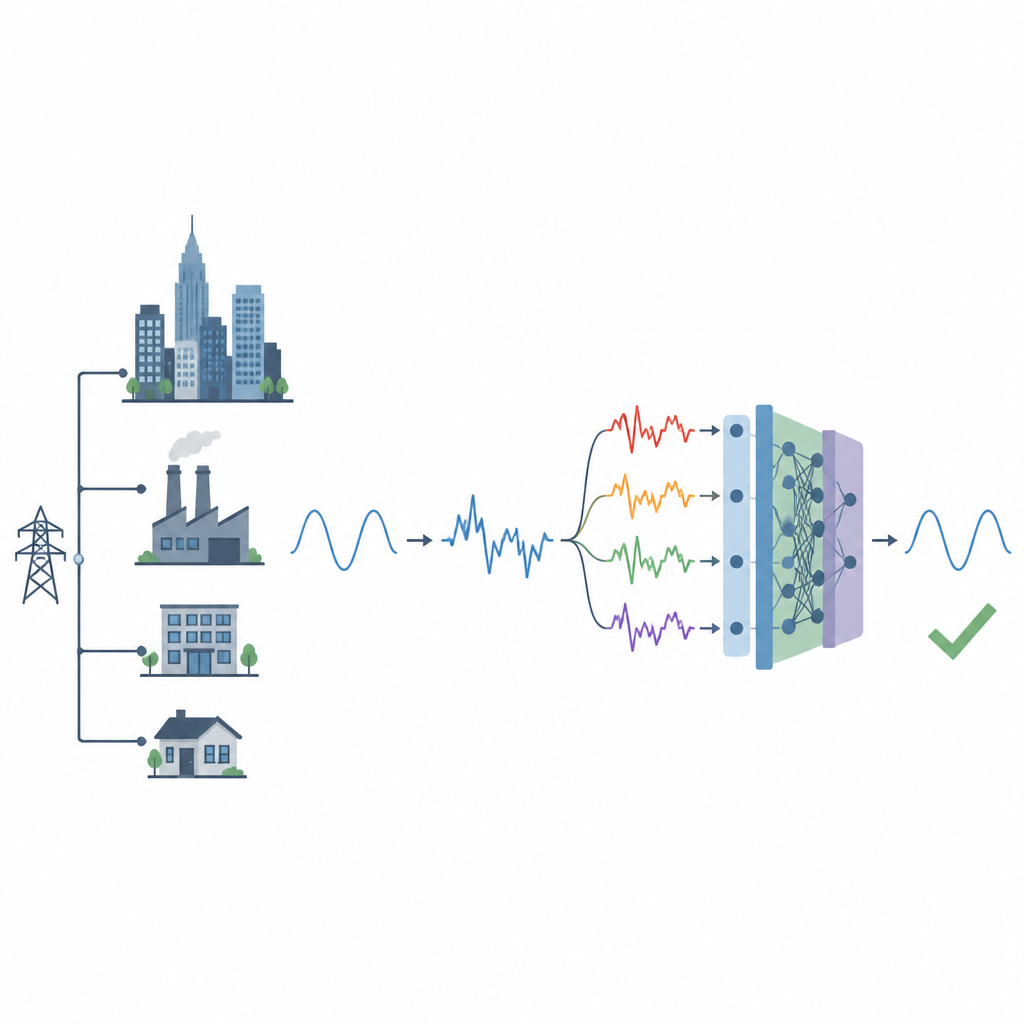
Most of us expect the electricity from the wall socket to be smooth and steady, quietly powering everything from phone chargers to factory robots. In reality, the voltage and current on modern grids often wobble, dip, and spike as solar panels, electronics, and heavy machinery connect and disconnect. These small but frequent glitches, known as power quality disturbances, can overheat equipment, confuse digital controls, and shorten the life of sensitive devices. This study explains how a hybrid artificial intelligence tool can quickly spot and sort these disturbances, even when several happen at once, helping keep lights on and electronics safe.
Hidden hiccups in everyday electricity
Electric power is supposed to follow a smooth, sinusoidal waveform at a fixed frequency. In practice, it is constantly nudged off course by non linear devices like variable speed drives, phone chargers, and power electronics in renewable energy systems. These cause different kinds of disturbances, such as sags where voltage briefly drops, swells where it rises, flicker that makes lights shimmer, sharp transients, and added harmonics that roughen the waveform. When these events overlap, for example a sag mixed with harmonics or several types occurring together, traditional monitoring tools struggle to tell them apart. Yet identifying the exact combination is crucial for deciding whether the source is a faulty appliance, a grid fault, or a design issue.
Turning messy signals into useful fingerprints
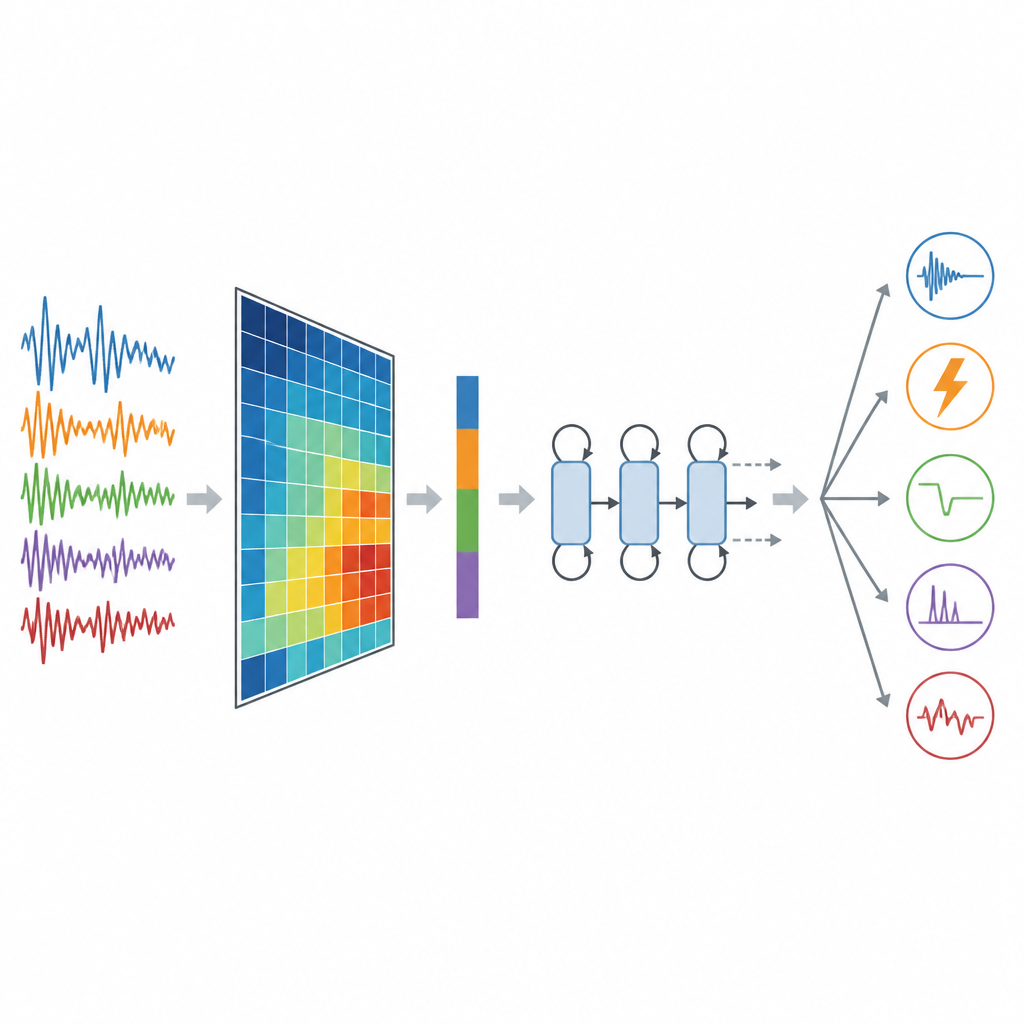
The authors build their system in stages so that each step distills the raw signal into clearer information. First, they apply a mathematical lens called the Stockwell Transform, which shows how the frequency content of a voltage signal changes over time. This creates a time frequency map that highlights, for instance, short bursts of high frequency noise from a transient or repeating bands from harmonics. From these maps they calculate simple numerical descriptors such as average power, peak values, and shape measures. To avoid drowning the learning algorithm in unnecessary data, they then apply a chi square test, a statistical filter that keeps only the features most strongly linked to differences between disturbance types.
Teaching a memory based AI to recognize patterns
These selected features become the input to a Long Short Term Memory network, a type of recurrent neural network that is good at handling sequences. Unlike simpler models that look at each moment in isolation, this network maintains an internal memory that captures how a disturbance evolves over time. The researchers train it on 18 classes of signals, including normal operation, six single disturbance types, and many double, triple, and even quadruple combinations. They generate 18,000 example signals using standard formulas and detailed simulations of two benchmark power systems known as IEEE 9 bus and 33 bus networks. To make the test realistic, they also add different levels of random noise, mimicking the messy conditions of real grids.
Putting the method to work in virtual and real time grids
After training, the hybrid system is challenged in several ways. On synthetic signals it correctly classifies most cases, with accuracy above 99 percent for single disturbances and still above 96 percent when four different problems occur at once and noise is present. The authors then move beyond pure simulation by creating disturbances in detailed software models and in a hardware in the loop platform called OPAL RT, which runs grid models in real time. In these more demanding tests the method still achieves about 99 percent average accuracy, outperforming a traditional neural network and a range of earlier techniques reported in the literature. Crucially, it remains robust when measurement noise is introduced.
What this means for everyday power users
For the average person, the work points toward smarter monitoring devices that can quietly watch the grid and quickly flag not just that a problem exists, but exactly what kind it is, even when several are tangled together. Utility operators and large energy users could use such tools to track the growing mix of renewables and electronic loads without being overwhelmed by data. While the method still relies on large training sets and will need to adapt to new disturbance types as grids evolve, it shows that combining advanced signal analysis with memory based AI can give a clearer and more reliable picture of the health of our electricity in real time.
Citation: Debnath, R., Majumder, A., Jain, A.K. et al. A hybrid AI framework for identification of power quality disturbances in electrical network. Sci Rep 16, 15758 (2026). https://doi.org/10.1038/s41598-026-35376-x
Keywords: power quality, electrical grid, artificial intelligence, signal analysis, disturbance detection