Clear Sky Science · en
Fuel cell PV fed hybrid energy sources for 3 phase matrix converter using 3D Space Vector Modulation
Power without Pause
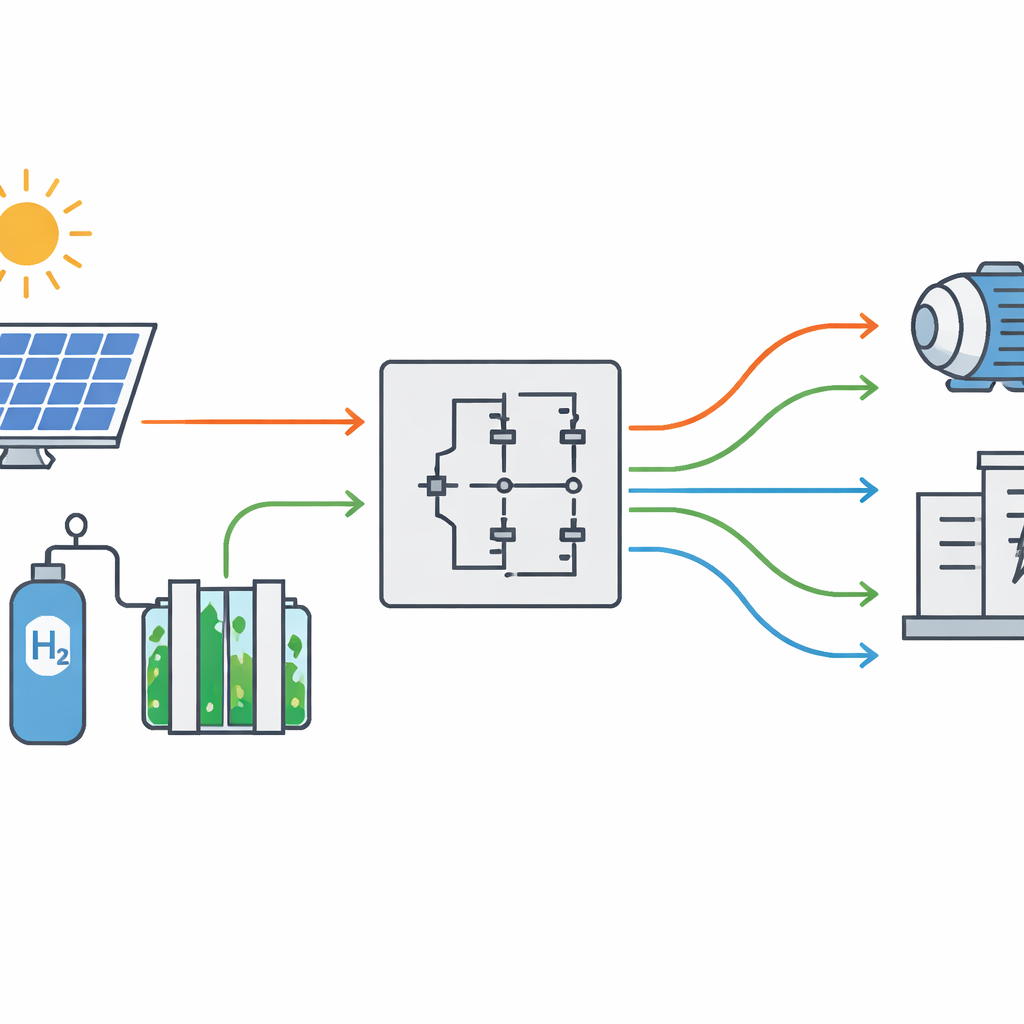
Keeping the lights on with clean energy is harder than it sounds. Solar panels only work when the sun shines, and many low‑carbon technologies struggle to deliver the smooth, reliable power that homes, factories, and data centers expect. This paper explores a smart way to combine solar power with hydrogen fuel cells and an advanced type of electronic converter so that, together, they behave like a calm, steady power plant rather than a flickering set of gadgets.
Two Clean Sources, One Steady Supply
The researchers start with a simple idea: use two renewables whose strengths and weaknesses balance each other. Solar panels provide cheap, emission‑free electricity whenever sunlight is available, but their output jumps around with clouds and time of day. Proton exchange membrane fuel cells, by contrast, sip hydrogen to produce electricity and water with very low pollution, and they can run continuously, but they are slower to react to sudden changes in demand. By wiring these two sources together in a hybrid arrangement, the system lets solar do most of the work when sunshine is good, while the fuel cell quietly fills in the gaps so the overall output stays stable.
Smarter Harvesting from Sun and Hydrogen
To squeeze as much energy as possible from the solar side, the team uses a control method called fuzzy logic to guide a DC–DC converter that conditions the panel output. Instead of relying on a rigid mathematical formula, the controller follows a set of simple, rule‑of‑thumb statements—much like a human operator saying “increase voltage a little” or “back off quickly”—based on how power and voltage are changing. This allows the solar array to stay very close to its best operating point even when clouds move fast or parts of the array are shaded. The fuel cell is modeled in detail, including losses inside the stack, to ensure it delivers a reliable baseline voltage and current when the solar contribution drops.
A Direct Path from Sources to AC Loads
Most renewable systems convert electricity in several stages, often storing energy briefly in large capacitors. That adds cost, bulk, and potential failure points. Here, the authors instead use a three‑phase matrix converter, a grid of nine bidirectional switches that directly reshapes incoming power into the form needed by motors or other AC equipment. Each output line can be connected on the fly to any input line, so the converter can change both voltage and frequency without an intermediate energy store. This compact design is especially attractive where space and efficiency matter, such as in electric drives, microgrids, or onboard power systems.
Guiding the Switches in Three Dimensions
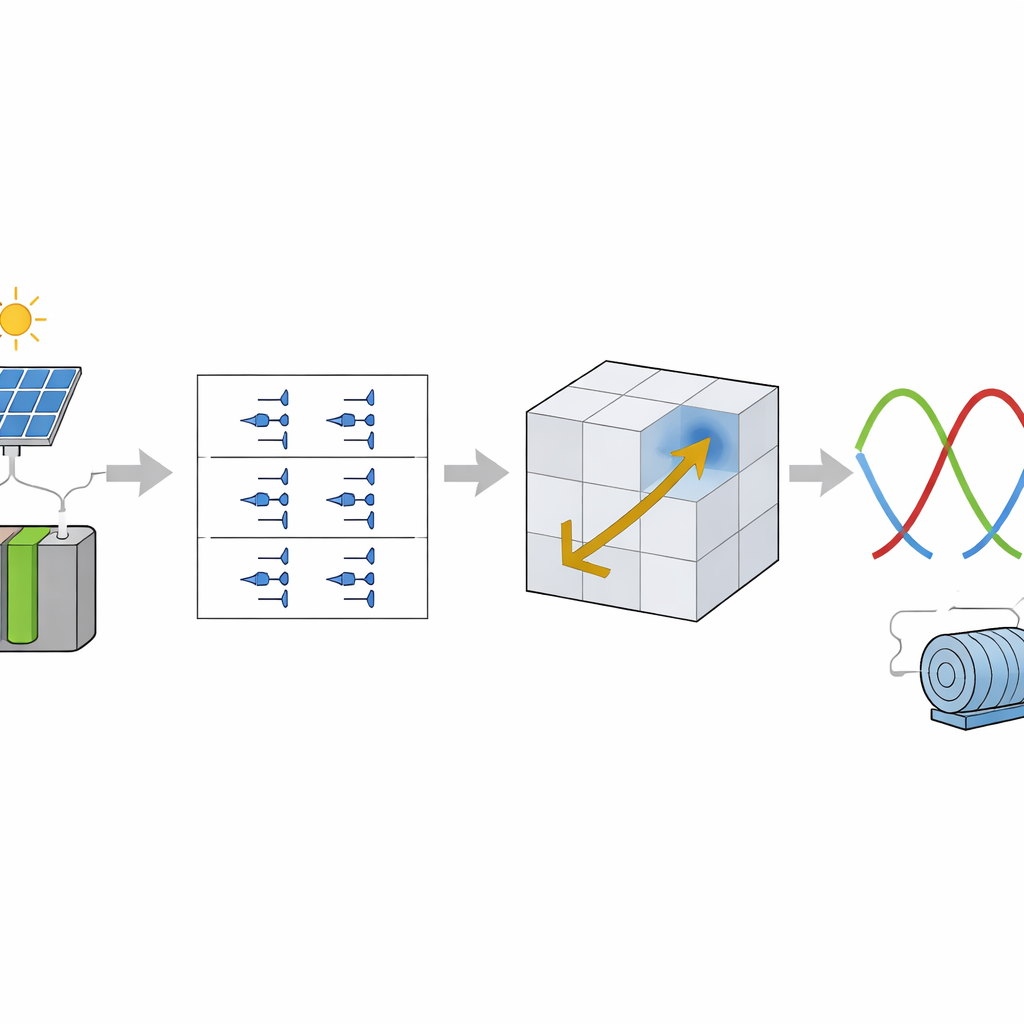
The heart of the work is a new way to coordinate those nine switches using a method called three‑dimensional space vector modulation. Instead of thinking about each phase separately, the controller treats the three‑phase voltages as a single point moving inside a cube of possible values. The cube is divided into smaller regions, and at each instant the algorithm finds which region the target point lies in and chooses a small set of switch combinations that, when averaged over a brief time, closely reproduce the desired voltage. This geometric approach lets the converter use the input voltage more efficiently, reduce unwanted ripples and spikes, and keep neutral and common‑mode currents—troublesome side‑effects that can stress equipment and create interference—extremely low.
From Computer Model to Laboratory Bench
The team validates the concept through detailed simulations and a laboratory prototype with emulated solar panels and fuel cells. In both settings, the hybrid system delivers almost perfectly smooth three‑phase outputs while sharing power sensibly between the two sources. The measured distortion in the output voltage is about a tenth of a percent, and in the current about a quarter of a percent—far better than many conventional designs. Neutral currents and stray voltages relative to ground are also sharply reduced compared with standard modulation techniques, which helps protect motors and sensitive electronics connected downstream.
What This Means for Everyday Power
In plain terms, the study shows that mixing solar panels and hydrogen fuel cells with an intelligently controlled matrix converter can turn variable, fragile renewables into a robust AC supply that looks and behaves like that from the traditional grid—only much cleaner. By improving how power is harvested, blended, and shaped, the approach cuts waste and electrical “noise,” making it easier to plug renewables directly into demanding applications such as industrial drives or local microgrids. While future work will need to test larger systems, add small storage devices, and refine long‑term control, this research outlines a practical path toward compact, high‑quality, always‑on green power.
Citation: Palanisamy, R., Thentral, T.M.T., Usha, S. et al. Fuel cell PV fed hybrid energy sources for 3 phase matrix converter using 3D Space Vector Modulation. Sci Rep 16, 10469 (2026). https://doi.org/10.1038/s41598-026-35349-0
Keywords: hybrid renewable energy, solar fuel cell systems, matrix power converters, power quality improvement, advanced modulation control