Clear Sky Science · en
p-STAT3 expression associates with prognosis and inflammatory indexes in gastric cancer patients
Why this study matters
Stomach cancer remains one of the deadliest cancers worldwide, especially when found at an advanced stage. Doctors know that some tumors behave far more aggressively than others, but today’s tests cannot always predict which patients are at highest risk. This study looks at a key molecular "switch" inside cells, called p-STAT3, and asks a practical question: can measuring this switch in tumor samples help identify patients who are more likely to have inflammation, more dangerous disease, and shorter survival?
A hidden switch inside stomach tumors
STAT3 is a protein that normally helps cells respond to signals from the immune system. When it is turned on by chemical tags, it becomes p-STAT3 and can drive cells to grow, survive, and even escape immune attack. The researchers examined stomach cancer tissue and nearby normal tissue from 68 patients who had surgery in Vietnam. Using a staining method that makes p-STAT3 visible under the microscope, they counted how many samples showed this activated switch and how strongly it was turned on. They found that cancer tissue was much more likely to show p-STAT3 than the neighboring normal stomach lining, and the staining in tumors was often more intense, especially in the cell nuclei where genetic programs are controlled. 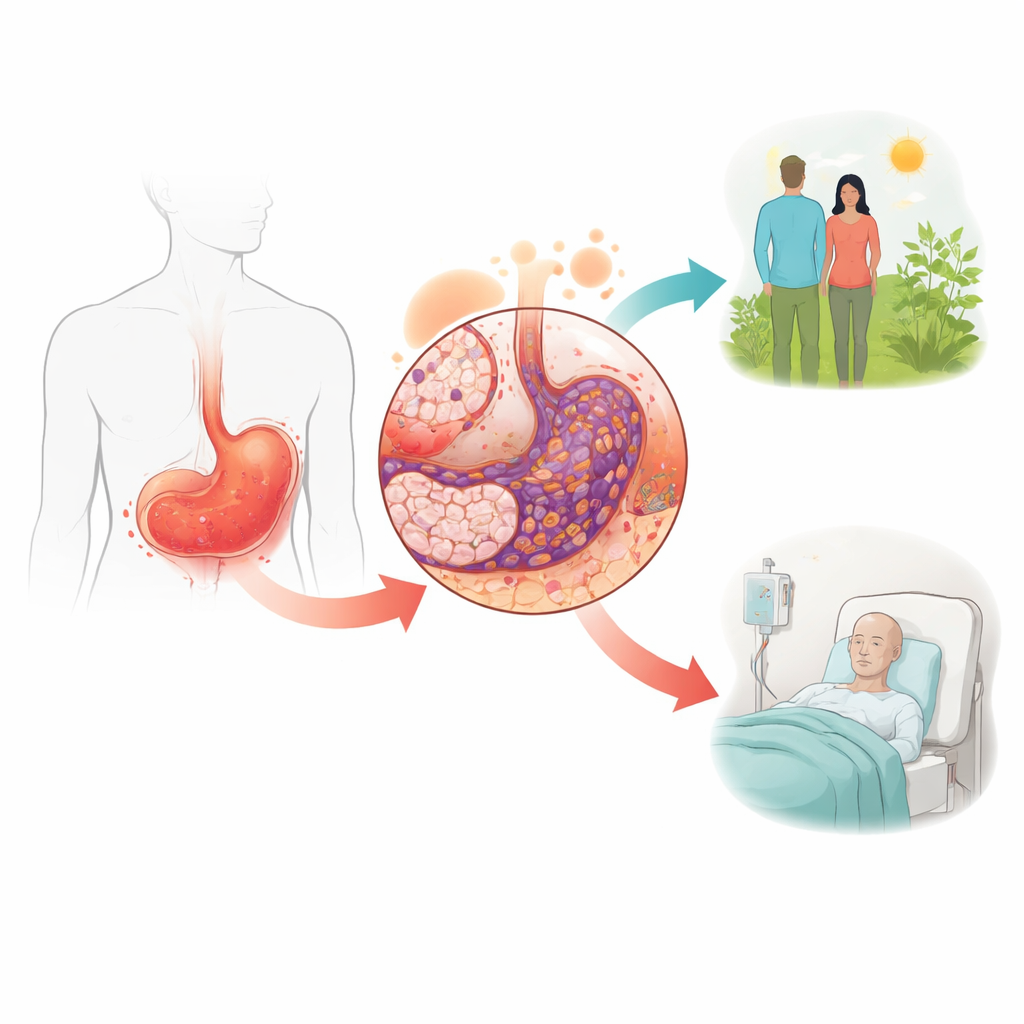
Linking tumor signals to inflammation in the blood
Because STAT3 is closely tied to inflammation, the team also looked at simple blood tests taken just before surgery. They focused on ratios that compare different types of blood cells: the neutrophil-to-lymphocyte ratio (NLR) and the platelet-to-lymphocyte ratio (PLR). High values for these ratios are widely viewed as signs of a body under inflammatory stress. Patients whose tumors were positive for p-STAT3 had clearly higher NLR and PLR values, and lower lymphocyte (a key immune cell) counts than those whose tumors lacked p-STAT3. Importantly, this shift came mainly from fewer lymphocytes rather than more neutrophils or platelets, hinting that tumors with active p-STAT3 may help suppress protective immune cells.
Tumor features and where they fall short
The investigators then asked whether p-STAT3 was tied to traditional tumor features: size, depth of invasion into the stomach wall, spread to nearby lymph nodes, and overall stage. There were trends toward more p-STAT3 in larger tumors, in those that had grown deeper, and in those with lymph node spread or more advanced stage, but none of these patterns reached statistical significance in this relatively small group of 68 patients. A slightly higher proportion of tumors near the upper part of the stomach showed p-STAT3, but the number of such cases was too small to draw firm conclusions. Overall, p-STAT3 did not simply mirror what doctors can already see under the microscope or on scans.
Predicting who lives longer after surgery
Where p-STAT3 truly stood out was survival. The researchers followed patients for a median of 18 months after surgery and compared outcomes between those with p-STAT3-positive and p-STAT3-negative tumors. Only about half of the patients with p-STAT3-positive cancers were still alive at the end of follow-up, compared with more than 90% of those without p-STAT3. When the team used statistical models that adjusted for age, tumor size, and blood markers such as CA19-9 and CA72-4, p-STAT3 remained the strongest single predictor of death. Patients whose tumors expressed p-STAT3 had an estimated risk of dying several times higher than those whose tumors did not. 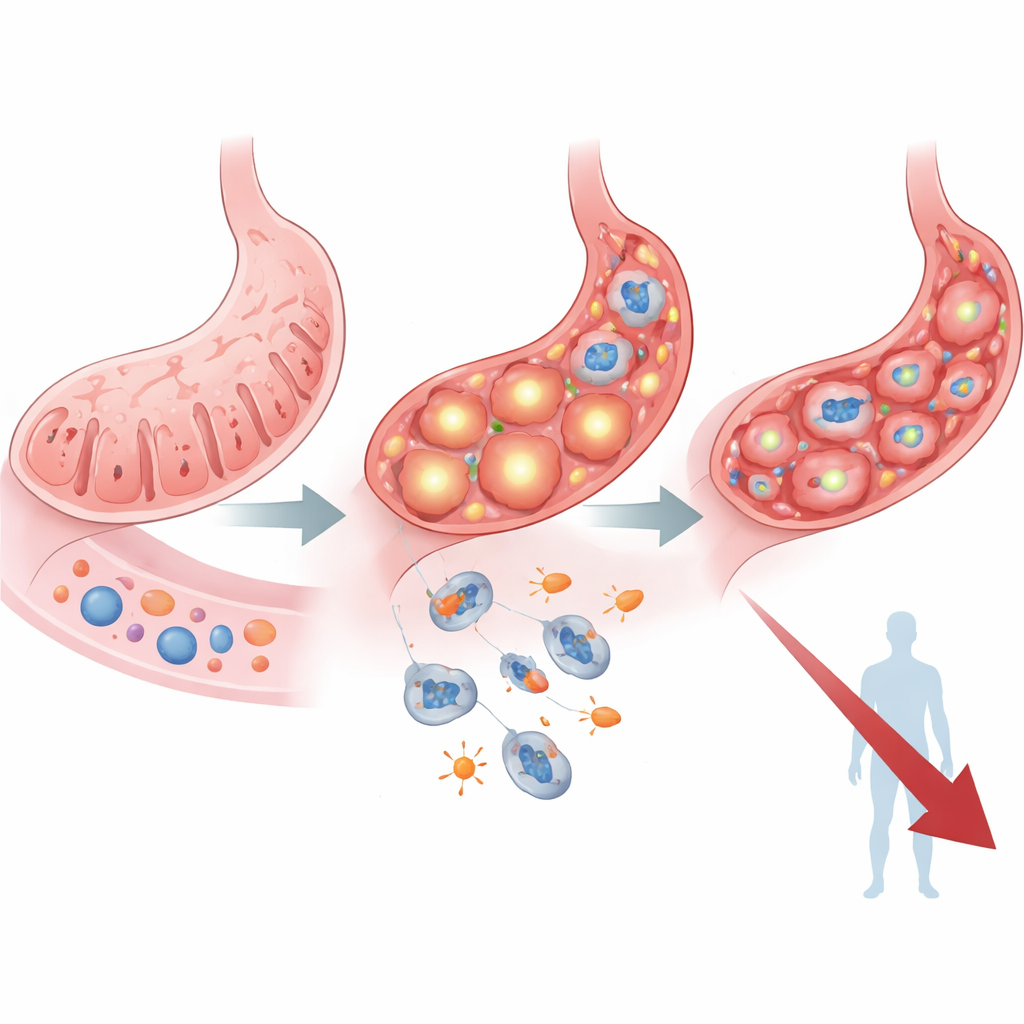
What this could mean for patients
To a lay reader, the message is straightforward: a chemical switch called p-STAT3, when active in stomach cancer cells, goes hand-in-hand with a more inflamed body, fewer protective immune cells, and a much poorer chance of long-term survival after surgery. Although this study is limited by its modest size and single-center design, it suggests that testing tumors for p-STAT3 could help doctors sort patients into different risk groups and perhaps guide closer follow-up or additional treatment. Because p-STAT3 is not just a marker but also a driver of harmful behavior in cancer cells, it may also be a promising target for future drugs aimed at calming inflammation, restoring immune defenses, and improving outcomes for people with gastric cancer.
Citation: Tran, D., Le, T., Nguyen, T. et al. p-STAT3 expression associates with prognosis and inflammatory indexes in gastric cancer patients. Sci Rep 16, 6574 (2026). https://doi.org/10.1038/s41598-026-35070-y
Keywords: gastric cancer, STAT3, tumor inflammation, prognostic biomarker, immune response