Clear Sky Science · en
Investigation of optical, structural, and radiation shielding properties of novel polyvinyl alcohol and cesium dichromate Cs2Cr2O7 nanocomposite films
Why smarter plastic shields matter
From medical X‑ray rooms to spacecraft and nuclear facilities, we rely on heavy materials like lead and concrete to keep harmful radiation at bay. At the same time, modern electronics and solar cells increasingly use lightweight plastic components that must handle both light and radiation. This study explores a new kind of thin plastic film that not only manages light more efficiently, but also helps block dangerous gamma rays—offering a lighter, more versatile alternative for future protective coatings and optoelectronic devices.
Building a new kind of plastic film
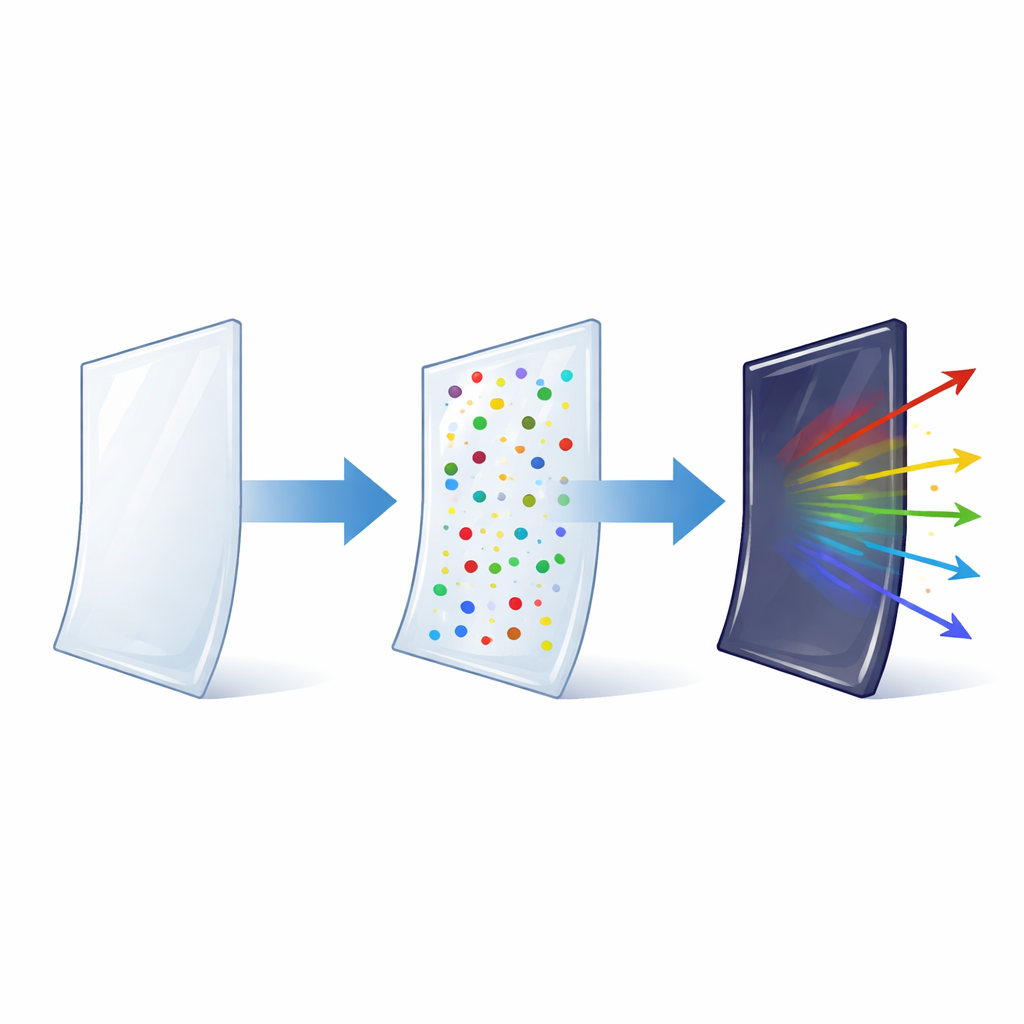
The researchers started with polyvinyl alcohol (PVA), a common, water‑soluble plastic known for being cheap, flexible, and environmentally friendly. They mixed it with tiny particles of a compound called cesium dichromate, creating what scientists call a nanocomposite film. By adjusting how much of these nanoparticles they added—ranging from none to 8 percent by weight—they produced a series of films with gradually changing color and transparency. This simple solution‑casting process, which involves dissolving, mixing, and drying on glass plates, is already compatible with industrial manufacturing, making the approach practical as well as scientific.
Looking inside the films
To see how the added particles changed the plastic, the team used several standard lab tools. X‑ray diffraction measurements showed that as more cesium dichromate was introduced, the internal structure of PVA became less ordered and more amorphous, a shift that often improves certain optical and electrical properties. Infrared spectroscopy revealed new bonding features associated with chromium and oxygen, and subtle shifts in existing PVA signals. These changes indicated that the nanoparticles were not just sitting loosely in the plastic, but were strongly interacting with and binding to the polymer chains, creating a more integrated and stable material.
Tuning how the film handles light
One of the most striking effects of adding cesium dichromate was on how the films absorb light. Measurements in the ultraviolet and visible range showed that the originally clear PVA developed strong absorption extending into the visible, and characteristic peaks associated with the chromium ions. As nanoparticle content increased, the sharp edge where the film begins to absorb light shifted toward longer wavelengths, meaning the material’s energy “gap” for electrons became smaller. Numerically, both the indirect and direct bandgap values dropped to near typical semiconductor levels for the film with 8 percent additive. In practical terms, this turns a simple insulating plastic into a material that can participate more actively in light‑based processes, making it attractive for UV filters, solar energy conversion, and other optoelectronic applications.
Stopping harmful radiation in a thin layer
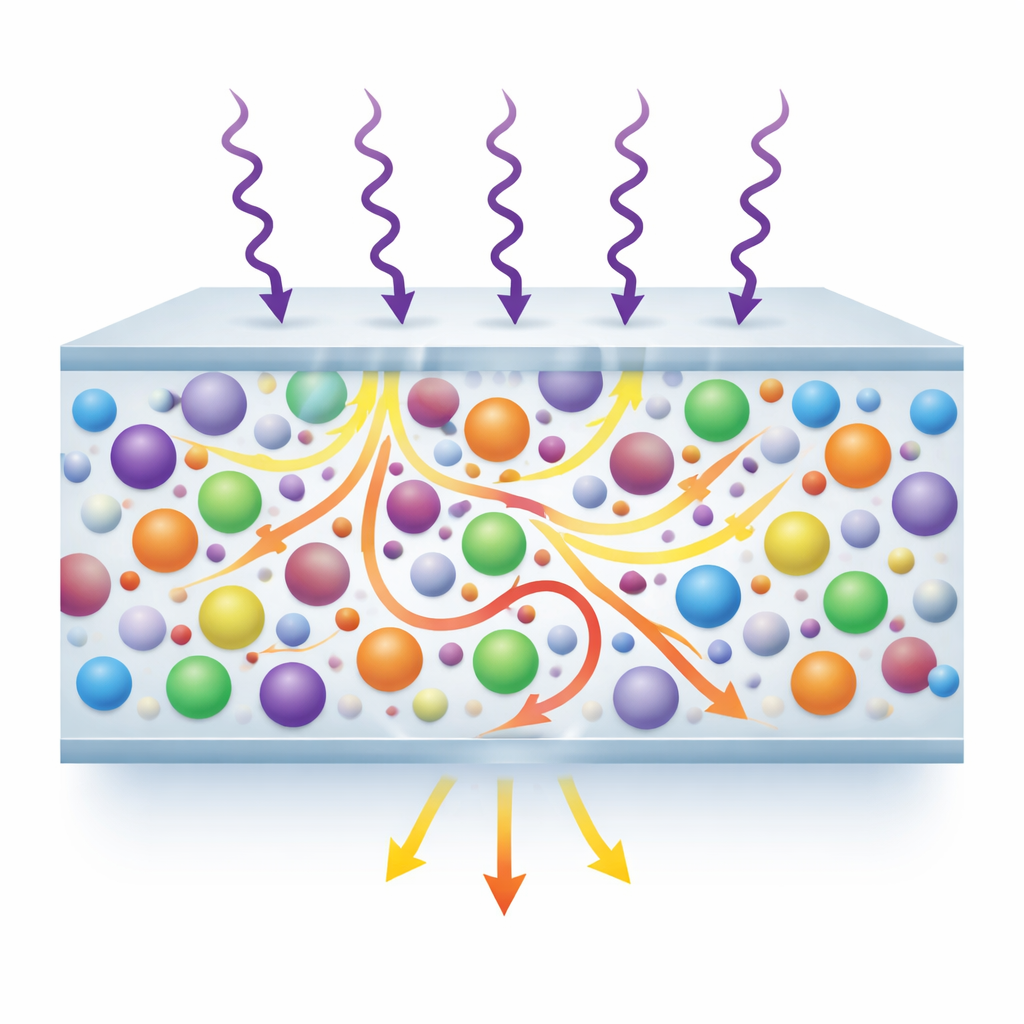
Beyond light management, the team also examined how well these films could slow or block gamma rays, the highly energetic photons that pose radiation hazards. Using a specialized calculation program and measured material data, they determined how likely gamma rays are to interact inside each film, how far the rays tend to travel before being absorbed or scattered, and what thickness is needed to cut the radiation in half. Films with more cesium dichromate consistently performed better. At a representative energy of 0.1 mega‑electron‑volts, the film with the highest nanoparticle loading showed a mass attenuation value about 42 percent higher than pure PVA, and the distance needed to halve the radiation intensity shrank from 2.6 centimeters to 1.5 centimeters. Other calculated factors, such as effective atomic number and build‑up behavior, also confirmed that nanoparticle‑rich films are more efficient shields across a broad energy range.
What this means for real‑world uses
Taken together, the results show that carefully dispersing cesium dichromate nanoparticles in a common plastic can transform it into a multifunctional material: it becomes better at controlling light, shifts from an electrical insulator toward a semiconductor, and offers notably improved protection against gamma radiation. For a layperson, the key idea is that a thin, flexible, and potentially transparent film can be engineered to both help electronic and optical devices work better and help guard people and equipment from harmful rays. Because the fabrication method is simple and scalable, these nanocomposite films could realistically be used as protective coatings on walls, windows, instruments, or wearable gear in settings ranging from hospital imaging suites to nuclear plants and spacecraft, all while also serving in advanced optical and solar technologies.
Citation: Soliman, T.S., Zakaly, H.M.H. Investigation of optical, structural, and radiation shielding properties of novel polyvinyl alcohol and cesium dichromate Cs2Cr2O7 nanocomposite films. Sci Rep 16, 12352 (2026). https://doi.org/10.1038/s41598-025-98412-2
Keywords: radiation shielding, nanocomposite films, polyvinyl alcohol, gamma rays, optoelectronic materials