Clear Sky Science · en
Targeted supplementation with bioactive plants sustainably improves goat health and decreases antiparasitic drug use on smallholder farms
Why healthy goats matter for rural families
In many dry parts of Africa, goats are more than just animals—they are family savings accounts, sources of meat and milk, and a buffer when crops fail. Yet these goats are constantly threatened by tiny worms living in their guts, which sap their strength, stunt growth, and can even kill them. Treating these parasites with drugs is getting harder and more expensive as the worms evolve resistance. This study asked a simple but powerful question: can carefully timed feeding of local medicinal plants keep goats healthier, cut the need for deworming drugs, and still be practical for small, low-income farms?
Everyday challenges on dryland goat farms
Smallholder farmers in semi-arid Botswana manage goats in tough conditions: scorching summers, long dry spells, and limited pasture. Goats roam freely for several hours a day, mostly eating shrubs, grasses and crop leftovers, which often lack enough protein—especially in the dry season. Under these stressful conditions, gut worms, particularly a blood-sucking species called the barber’s pole worm, flourish. They cause anemia, weight loss and poor milk and meat production. Conventional control relies on giving deworming drugs to whole herds, but this is costly, drugs are often hard to obtain, and overuse has already led to drug-resistant worms in many regions.
Using simple checks to target help
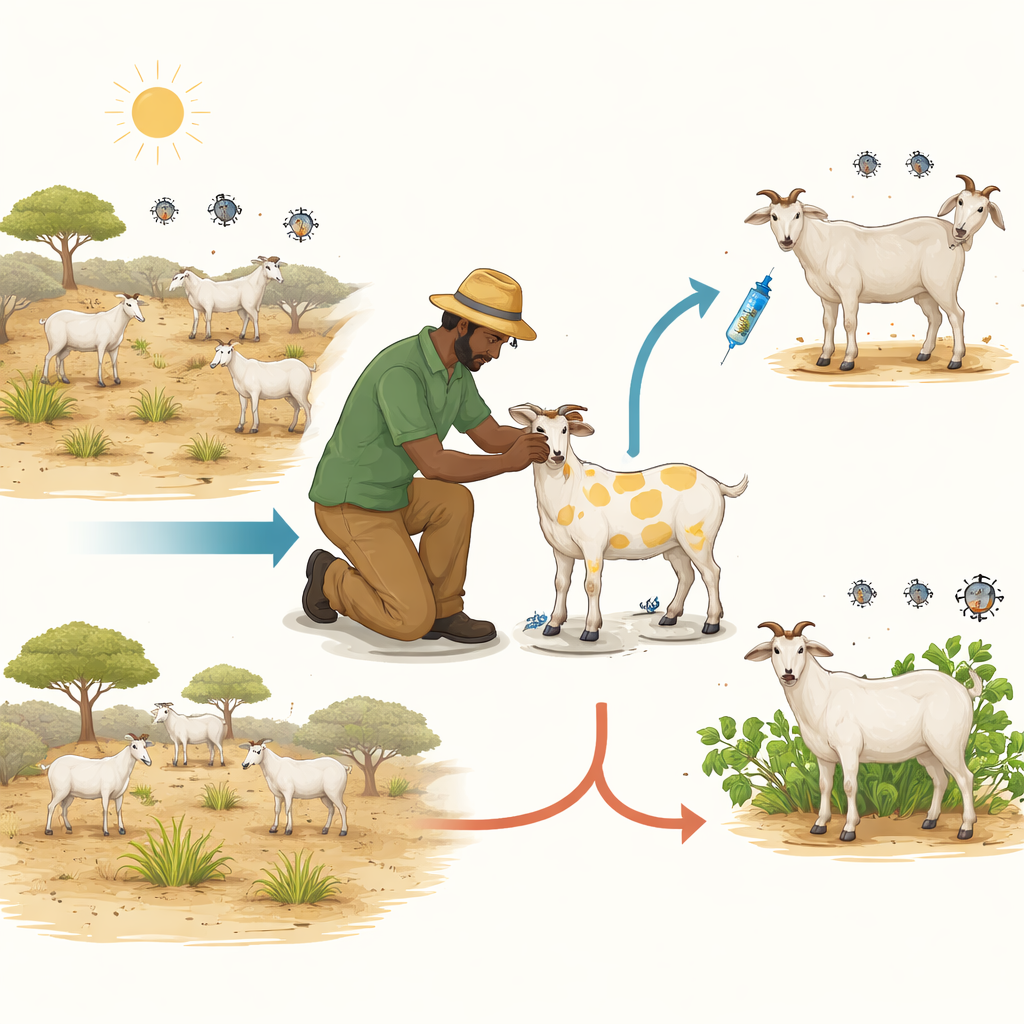
Instead of treating every goat, the researchers worked with farmers to apply a “Five Point Check”: looking at the goat’s nose, eyes, jaw, back and tail for signs such as pale eyelids (anemia), swelling under the jaw, poor body condition, or diarrhea. This quick, visual system helped classify goats as healthy, borderline, or sick. Two treatment strategies were compared over 17 months. In the drug-only Targeted Selective Treatment (TST) group, only sick goats—those with clearly poor scores—received deworming medicine. In the plant-TST group, sick goats still got medicine, but goats in borderline condition were first given extra feed in the form of local bioactive plants, mainly the tree Terminalia sericea and the mistletoe Viscum rotundifolium, which farmers already knew and used informally.
Plants that feed goats and fight worms
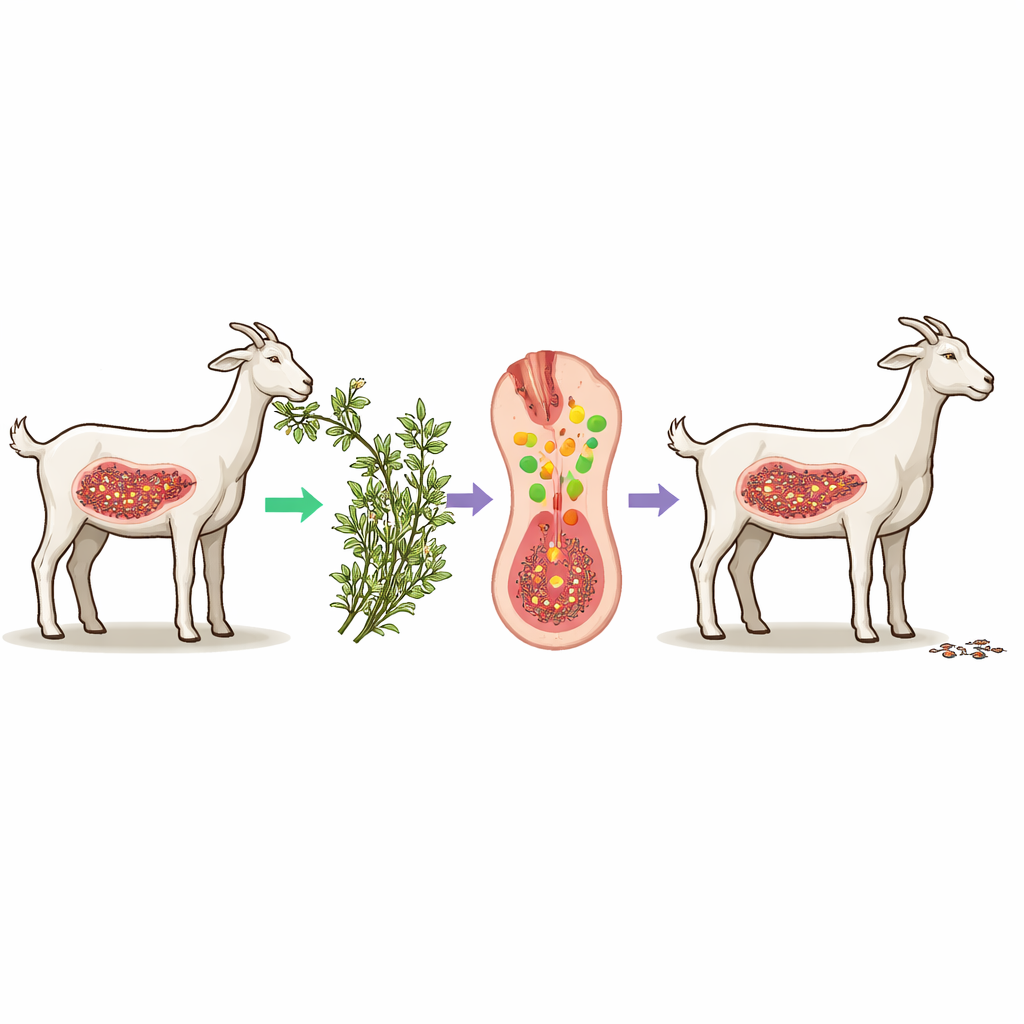
The selected plants are rich in protein and natural compounds such as condensed tannins, which past research suggests can damage worms or reduce their ability to reproduce. Farmers cut about 250 grams of fresh leaves per goat per day and fed them for 8–12 days whenever an animal slipped into borderline health. Across more than a year and through wet and dry seasons, both treatment strategies lowered worm egg counts in manure, showing that targeted treatment itself is effective. But plant-TST went further. Goats given plant supplements were generally heavier, had better eye color scores (less anemia), and a higher proportion stayed in the healthy category. In this group, nearly half of the goats never needed any deworming drug at all, and many that became sick returned to borderline or healthy status more quickly.
Less medicine, smarter use of local resources
Careful tracking revealed that plant-TST farms used substantially fewer drug treatments than would be required under traditional whole-herd dosing, and even fewer than the drug-only TST farms. At the same time, targeted plant feeding cut plant use by more than half compared to a hypothetical strategy of feeding these plants to every goat all the time. Survival-style analyses showed that goats receiving repeated plant supplements could go much longer before ever needing a drug treatment, especially when fed T. sericea. Seasonal patterns in worm eggs followed rainfall and humidity—peaking in wetter months—yet the combined strategy of simple health checks and plant supplements helped buffer goats against these peaks, sustaining better condition through the year.
What this means for farmers and food security
For smallholder farmers with few resources, this approach offers a practical way to keep goats productive and reduce losses without relying solely on expensive or increasingly ineffective drugs. By watching for early signs of trouble and reserving medicines for the truly sick, while giving borderline animals short pulses of locally collected leaves, farmers can improve goat weight and resilience, hold down worm burdens, and slow the spread of drug resistance. The study suggests that targeted plant supplementation, combined with selective drug use guided by a simple five-point check, is a promising step toward affordable, sustainable parasite control that protects both livelihoods and the environment.
Citation: Machekano, H., Ventura-Cordero, J., Airs, P.M. et al. Targeted supplementation with bioactive plants sustainably improves goat health and decreases antiparasitic drug use on smallholder farms. Sci Rep 16, 11805 (2026). https://doi.org/10.1038/s41598-025-34862-y
Keywords: goat health, parasite control, bioactive plants, smallholder farming, anthelmintic resistance