Clear Sky Science · en
Optimizing 5G NR link layer parameters for eMBB and URLLC applications under dynamic channel and transmission configurations
Why smarter 5G settings matter
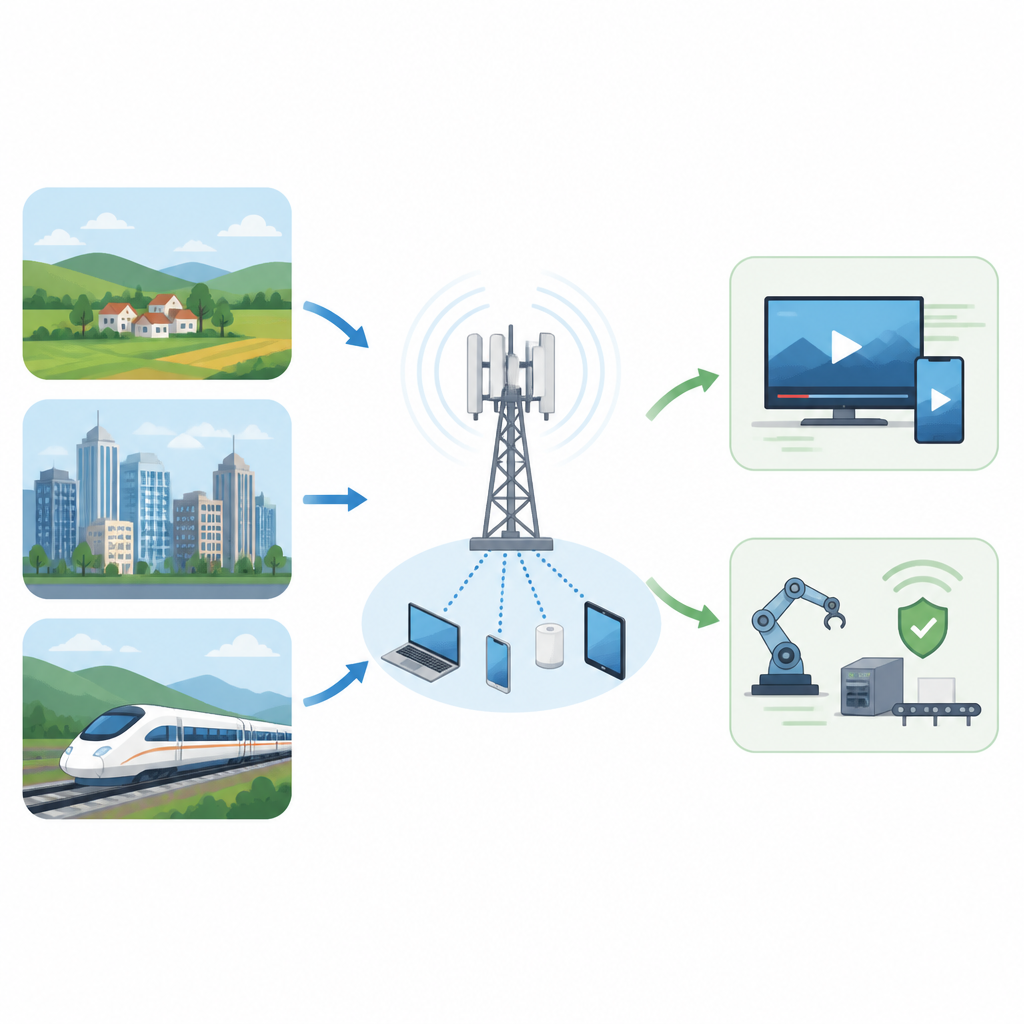
When you stream a movie on your phone or a robot arm in a factory reacts in a split second, they both rely on the same 5G network. Yet these tasks pull in opposite directions: one wants raw speed, the other demands near‑perfect reliability with very little delay. This study asks a simple question with big consequences for everyday users: how should the “dials” inside 5G’s radio links be tuned so that both fast broadband and ultra‑reliable control signals work well in the messy, changing conditions of the real world?
How 5G carries bits through the air
Inside 5G, several building blocks work together to move information between phones and base stations. Some channels carry user data, while others carry vital control signals that keep the connection stable and confirm that data arrived correctly. On top of them sits a safety net that requests a repeat whenever a packet is corrupted. The authors focus on how these pieces behave when the radio path is affected by reflections from buildings, moving users, and shifting interference. They use detailed industry‑standard models that mimic city streets, rural areas, and even high‑speed movement to see how often errors occur and how much useful data gets through.
Putting 5G through realistic stress tests
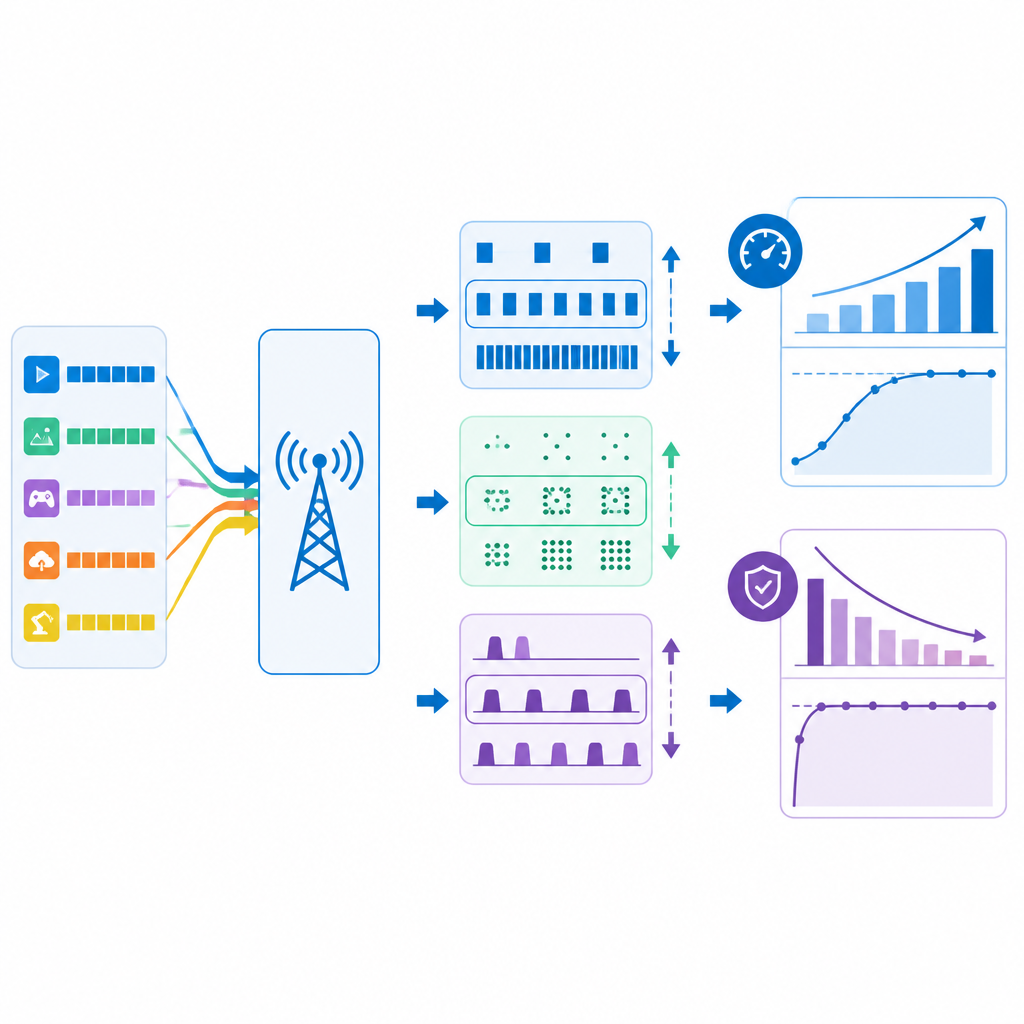
Many earlier studies looked at only a few short bursts of data or assumed overly tidy conditions. Here, the team runs long computer simulations covering 1000 frames of transmission so that rare but important glitches have a chance to appear. They vary three main knobs: how tightly radio tones are packed together, how complex the signal patterns are, and how the control channel jumps between different frequencies. By sweeping signal strength from very weak to strong and by swapping in different types of propagation, they build a map of which settings work best for different situations, rather than searching for a single “one‑size‑fits‑all” configuration.
Finding the sweet spot between speed and reliability
The results reveal clear trade‑offs. When the signal is weak or echoes are strong, using wider spacing between tones hurts reliability, because the shorter symbols are more easily distorted by delayed reflections. In those cases, tighter spacing gives lower error rates, even though it is not the fastest option. Simple signal patterns prove more forgiving in noisy conditions, keeping error rates low when the receiver struggles. At high signal strength, however, more complex patterns shine, packing more bits into each transmission and pushing throughput to its maximum. For the key uplink control channel, jumping across different frequency bands and using certain spacing values greatly cuts error rates, especially in environments with heavy fading.
Lessons for future 5G services
By comparing many combinations of settings, the study shows that no single choice is best everywhere. Rural and low‑mobility areas benefit from conservative spacing that favors robustness, while crowded cities and very fast links, such as those serving trains or millimeter‑wave cells, gain from wider spacing that reduces delay. For applications that cannot tolerate failure, such as industrial control or safety‑critical links, specific control‑channel settings and frequency‑hopping schemes stand out as especially reliable. For video streaming and other data‑hungry uses, high‑order signal patterns deliver the highest speeds when the radio link is clean.
What this means for everyday connectivity
In simple terms, the authors conclude that 5G networks should not fix their radio settings once and for all. Instead, they should constantly adapt how tightly they pack tones, how complex the signals are, and how they hop across frequencies based on current channel conditions and service needs. Doing so makes better use of the available spectrum while keeping connections stable where it matters most. These insights give engineers a practical guide for tuning real‑world 5G systems so that both enhanced mobile broadband and ultra‑reliable low‑latency services can share the same airwaves without getting in each other’s way.
Citation: Pateriya, S., Bandopadhaya, S., Bairwa, A.K. et al. Optimizing 5G NR link layer parameters for eMBB and URLLC applications under dynamic channel and transmission configurations. Sci Rep 16, 15770 (2026). https://doi.org/10.1038/s41598-025-34674-0
Keywords: 5G New Radio, link layer, URLLC, mobile broadband, wireless channel