Clear Sky Science · en
Cellulose with urethan crosslinks decorated with ionic functionality for wastewater purification including design, synthesis, and theoretical studies
Turning plant waste into clean water tools
Access to safe water is vital for health, yet many communities struggle with wastewater contaminated by toxic metals. This study explores how leftovers from the olive oil industry can be transformed into soft, sponge-like filters that pull dangerous metals such as lead and uranium out of water, offering a low-cost and eco-friendly option for cleanup.
Why dirty water is hard to fix
Industrial, household, and farm activities release a stew of pollutants into waterways, including metal ions like lead, cadmium, and mercury. These metals do not break down and can build up in the body over time, causing serious health problems. Many current treatment methods are expensive or complex. A popular alternative is adsorption, where contaminants stick to the surface of a solid material. Natural materials such as cellulose from plants are attractive for this purpose because they are abundant, renewable, and generally safe, but ordinary cellulose has limited sites where metals can attach and does not easily expose those sites to flowing water.
Building a better sponge from olive waste
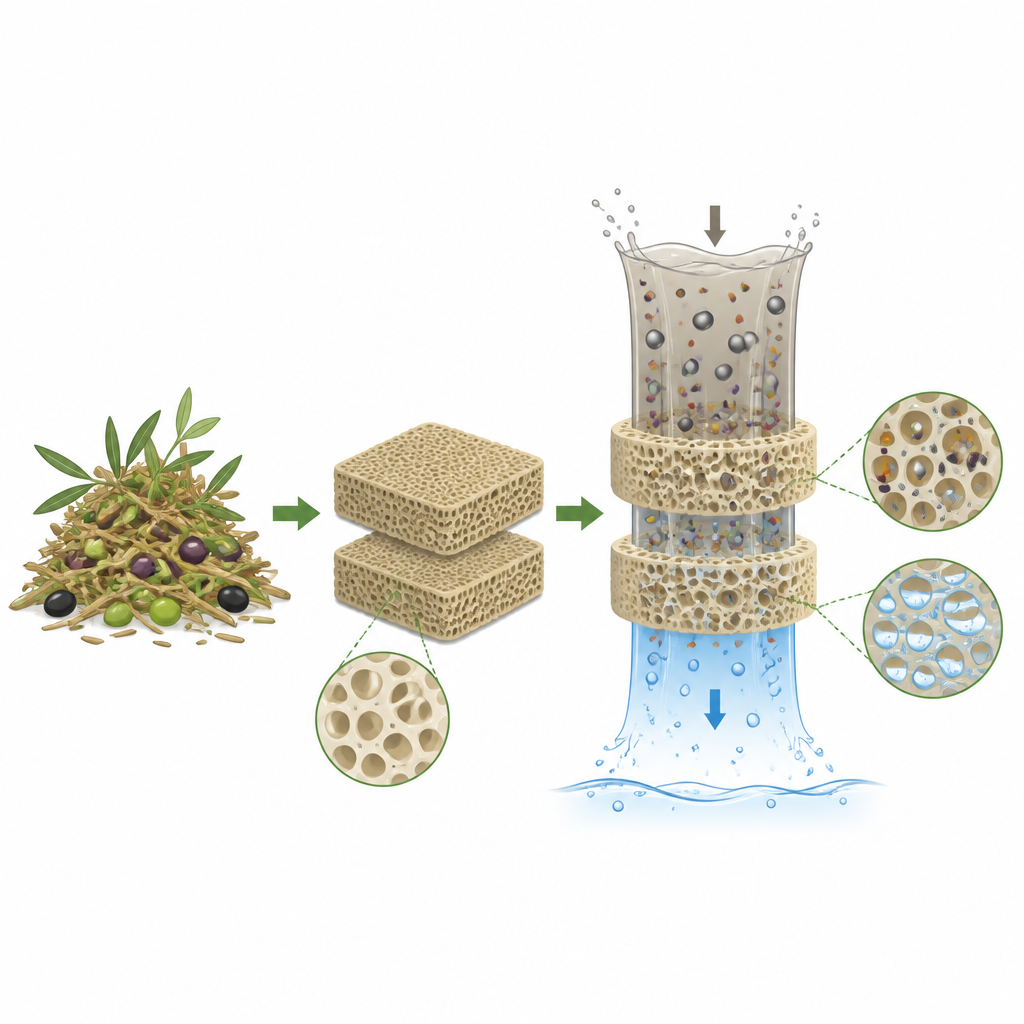
The researchers started with cellulose extracted from solid waste left after pressing olives, a material that is usually burned or thrown away. They chemically modified this cellulose to add carboxyl groups, which can strongly attract metal ions. Next, they reacted the modified cellulose with two different diisocyanate molecules to create two types of soft foams with urethane crosslinks. These foams, named CMC HMPUF and CMC PPUF, form a porous, springy structure with many tiny channels. The combination of high surface area, added carboxyl groups, and stable foam architecture turns the olive waste into a tailored filter that can be packed into simple cartridges.
How well the new foams clean water
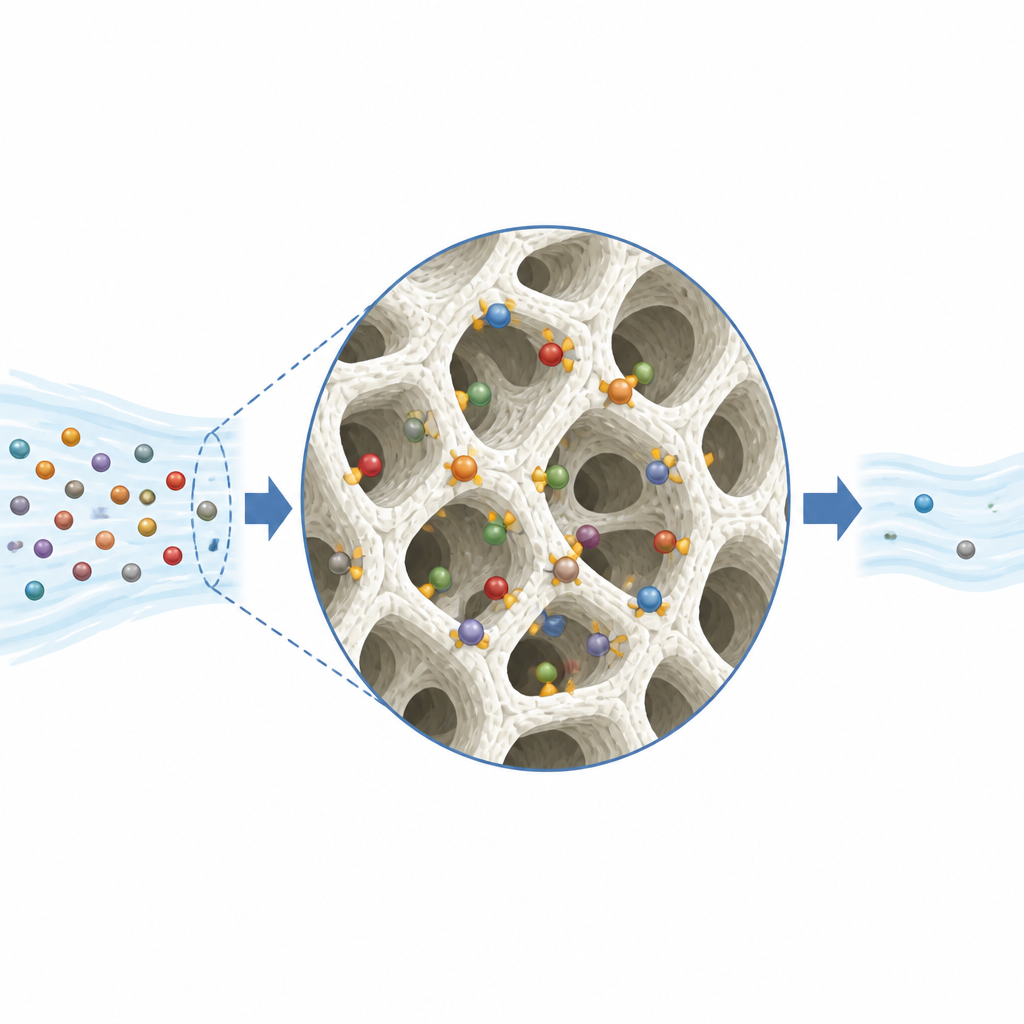
To test performance, the team first used lead in water as a model contaminant and adjusted conditions such as pH, contact time, temperature, and foam dose. They found that both foams removed lead most effectively at mildly basic conditions around pH 6 to 8, where the carboxyl groups on the foam surface carry negative charge and readily bind positively charged metal ions. Under optimized conditions, the foams captured around 29 to 33 milligrams of lead per gram of foam, with the process reaching near steady levels within about 30 minutes. Detailed analysis showed that the adsorption followed a pattern consistent with metals forming stable surface complexes and that the overall process happened spontaneously at the tested temperatures.
Real sewage tests and reuse of the filters
The scientists then moved from lab-made solutions to a real sewage sample from a treatment plant in Jericho, Palestine. When this water was passed through small columns packed with the foams, both materials removed a broad range of metals, including aluminum, copper, zinc, and uranium, often by more than 90 percent. Importantly, the foams could be regenerated: metals were washed out using an acid and chelating solution, and the foam was reactivated with a mild base. After five cycles of use and regeneration, the filters still retained more than 90 percent of their original removal efficiency, indicating that they can be reused multiple times rather than discarded after a single pass.
Peeking inside at the metal grabbing process
To better understand what happens at the microscopic level, the team used computer simulations based on quantum chemistry, Monte Carlo methods, and molecular dynamics. These calculations showed that lead ions fit snugly near oxygen-rich sites in the foam and form strong interactions with them, matching the experimental finding that adsorption energies are highly favorable and negative. The models also indicated that metal ions first approach and bind to accessible sites on the foam surface, then slowly diffuse into deeper regions, consistent with the observed adsorption behavior over time.
What this means for cleaner water
This work shows that agricultural waste, in this case olive industry residues, can be upgraded into specialized foams that efficiently strip toxic metals from wastewater. The filters work quickly under simple conditions, can handle complex real-world water samples containing many different metals, and can be regenerated several times. For non-specialists, the key message is that a common plant-based material can be redesigned into a reusable cleaning sponge for water, potentially helping treatment facilities reduce pollution while also giving new value to an industrial by-product.
Citation: Kaseeb, S., Deghles, A., Hamed, O. et al. Cellulose with urethan crosslinks decorated with ionic functionality for wastewater purification including design, synthesis, and theoretical studies. Sci Rep 16, 15385 (2026). https://doi.org/10.1038/s41598-025-34653-5
Keywords: wastewater treatment, heavy metal removal, cellulose foam, olive waste, adsorption