Clear Sky Science · en
Comprehensive proteomics analysis of bovine sperm head plasma membrane associated with fertility
Why this matters for farmers and families
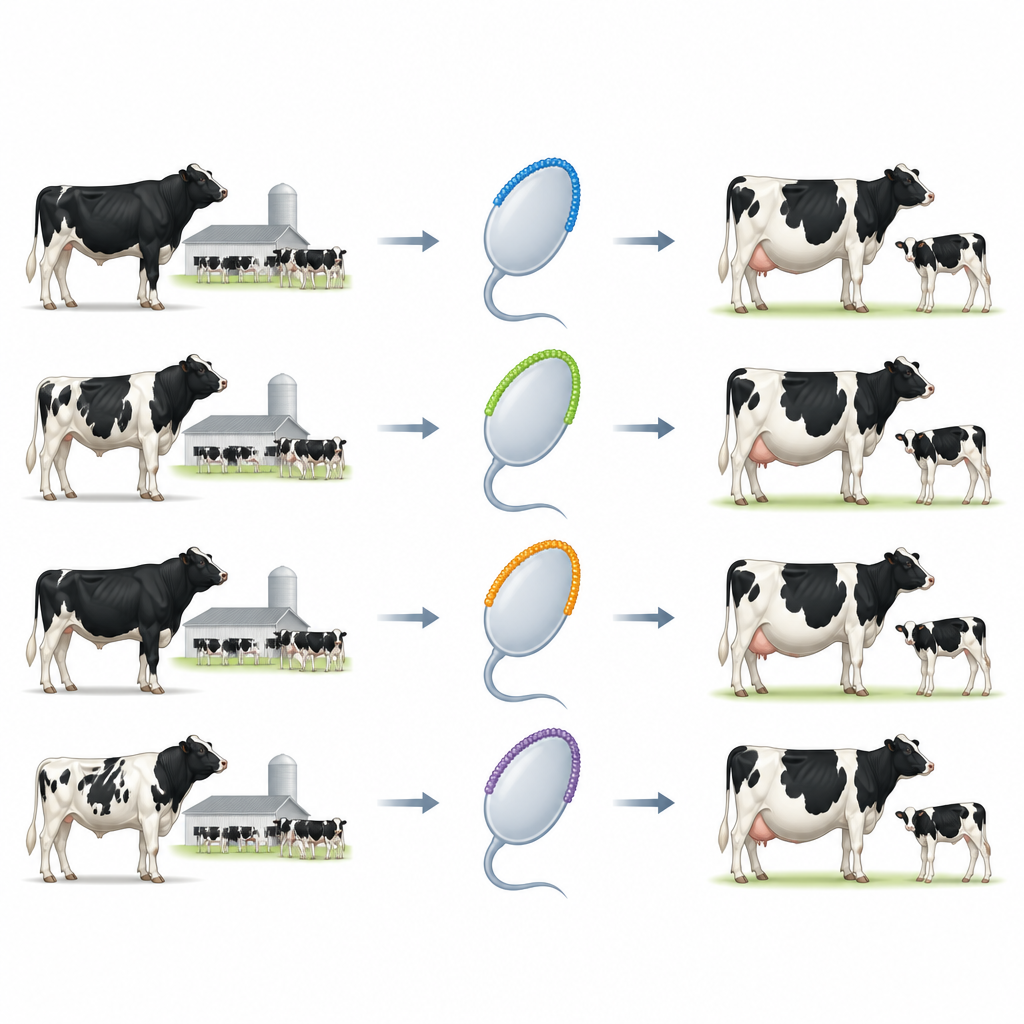
For dairy farmers, every successful pregnancy in the herd affects milk production, animal welfare, and the bottom line. Yet even when semen comes from healthy, well-tested bulls, only about half of artificial inseminations lead to a pregnancy. This study digs into the very surface of bull sperm heads to discover which tiny protein components are linked to better fertility, opening the door to more reliable tests for choosing bulls that can get cows in calf more consistently.
A closer look at the sperm’s outer shell
The work focuses on the thin outer skin of the sperm head, called the plasma membrane. This layer is the first point of contact with the egg and must stay intact and responsive as sperm travel, mature inside the female tract, and finally bind and fuse with the egg. Past studies examined whole sperm or semen fluid, but these can blur what is happening specifically at the head surface where recognition and fusion occur. By isolating just this head membrane from Holstein bull sperm, the researchers set out to catalog its protein building blocks and see how they differ between bulls that get more cows pregnant and those that get fewer pregnant.
Comparing high and low fertility bulls
The team collected fresh ejaculates from 16 Holstein bulls whose fertility in the field was already well measured using a bull fertility index based on thousands of inseminations per animal. Eight bulls were classified as higher fertility and eight as lower fertility, even though their basic semen traits, such as movement, looked similar. Using advanced mass spectrometry, they identified more than 22,000 proteins in the sperm head membrane across all bulls. Powerful statistical tools then compared protein levels between the three most fertile and three least fertile bulls, flagging 67 proteins whose abundance differed by at least twofold. Most of these proteins were more common in the high fertility group, while a smaller set appeared in lower amounts.
Networks of proteins that work together
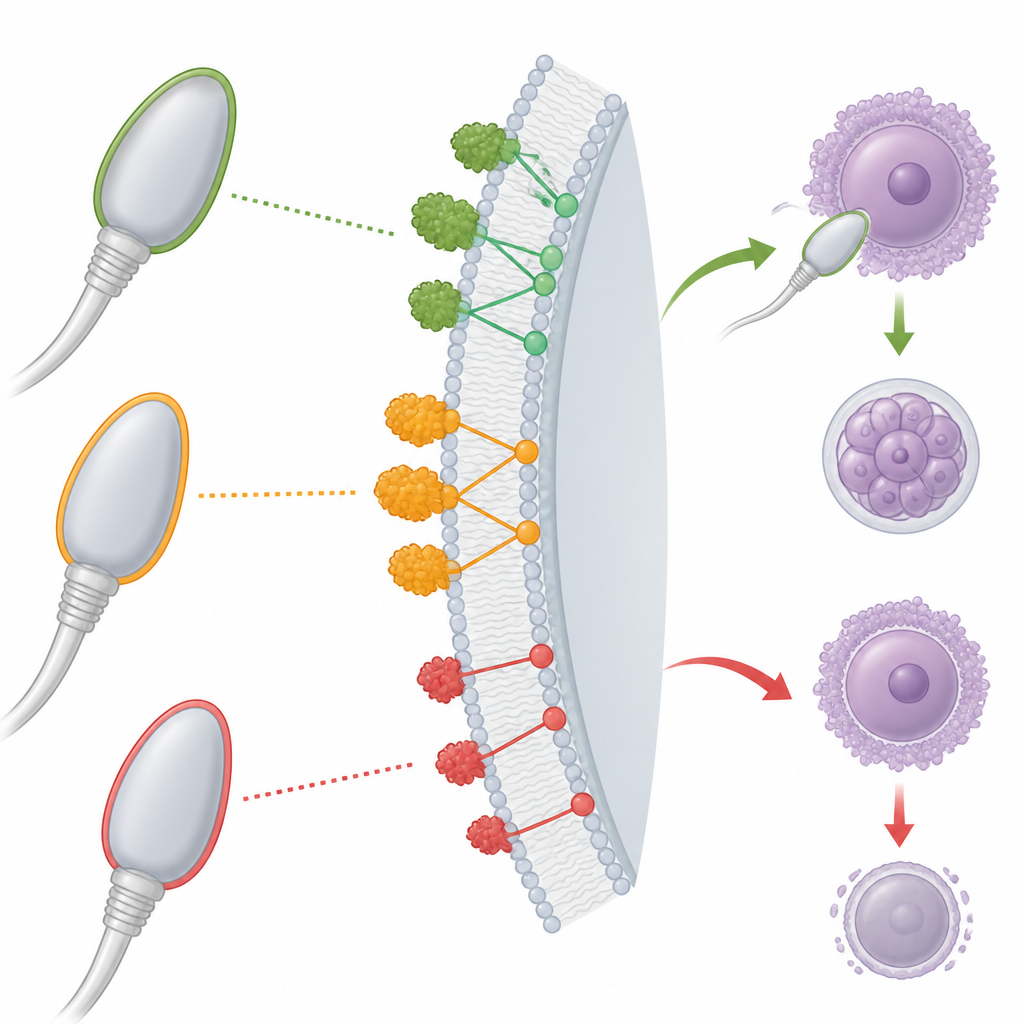
Finding different proteins was only the first step. The researchers then mapped how these proteins interact with one another, building large network diagrams that show clusters of tightly connected molecules. Many of the proteins that were more abundant in high fertility bulls were linked to known sperm jobs such as energy production, movement, structural support, and the chain of events that prepares sperm to bind and penetrate the egg. Others were linked to stress protection and keeping the membrane’s structure stable. In contrast, several proteins that were less abundant in high fertility bulls were associated with enzyme activity and transport processes that, when present at higher levels in the head membrane, may actually interfere with normal preparation for fertilization.
From laboratory patterns to real-world fertility
To test whether these protein differences really mattered beyond the six extreme bulls, the team checked how strongly each protein’s level tracked with fertility scores across all 16 animals. Over 40 of the 67 key proteins showed significant relationships with the bull fertility index, some positive and some negative. For example, proteins linked to the sperm’s internal scaffolding and energy systems tended to be higher in more fertile bulls, while certain signaling and ion-pumping proteins in the head membrane were linked to lower fertility when they were more abundant. These patterns suggest that a delicate balance of proteins on the sperm head helps control when and how sperm become capable of fertilizing an egg.
What the findings mean going forward
This study shows that only a small fraction of the many proteins on the sperm head membrane appear to be strongly tied to how fertile a bull is in real herds. These roughly 67 proteins form a coordinated set that influences movement, energy use, preparation for egg binding, and the actual interaction with the egg surface. For farmers and breeding companies, such proteins are promising candidates for future laboratory tests that could predict a bull’s fertility more accurately and quickly than waiting for field results. For science more broadly, the work highlights how the sperm head’s outer shell acts as an active control center for fertilization, not just a passive wrapper.
Citation: Imran, M., Buhr, M.M., Chumala, P. et al. Comprehensive proteomics analysis of bovine sperm head plasma membrane associated with fertility. Sci Rep 16, 15930 (2026). https://doi.org/10.1038/s41598-025-34626-8
Keywords: bull fertility, sperm membrane, proteomics, dairy cattle, fertility biomarkers