Clear Sky Science · en
Exploiting attP landing sites and gypsy retrovirus insulators to identify and study viral suppressors of RNA silencing
How viruses dodge a cell’s alarm system
Viruses do not simply invade and take over; they also sabotage the host’s own security systems. One of the most important of these is RNA interference, a molecular "alarm" that chops up viral genetic material before it can spread. Many viruses have evolved proteins that can switch off this alarm. This study uses fruit flies as a living test bed to understand how those viral "silencers of the silencing system" work, and how to build more reliable tools to find them. The results matter for anyone interested in how infections get the upper hand and how we might one day design better antiviral strategies.
A molecular tug-of-war inside cells
Cells in plants and animals share a powerful defense known as RNA interference, or RNAi. When a virus infects a cell, double-stranded pieces of viral RNA trigger this pathway, which slices up the virus’s genetic material and slows infection. Viruses have not taken this lying down: many now carry special proteins called viral suppressors of RNA silencing, or VSRs, that interfere with RNAi and allow the virus to replicate. Because these proteins evolved many times independently, their genes look very different from one virus to another, and researchers often rely on functional tests—rather than sequence similarity—to decide whether a protein is truly a VSR.
Using fly eyes as living readouts
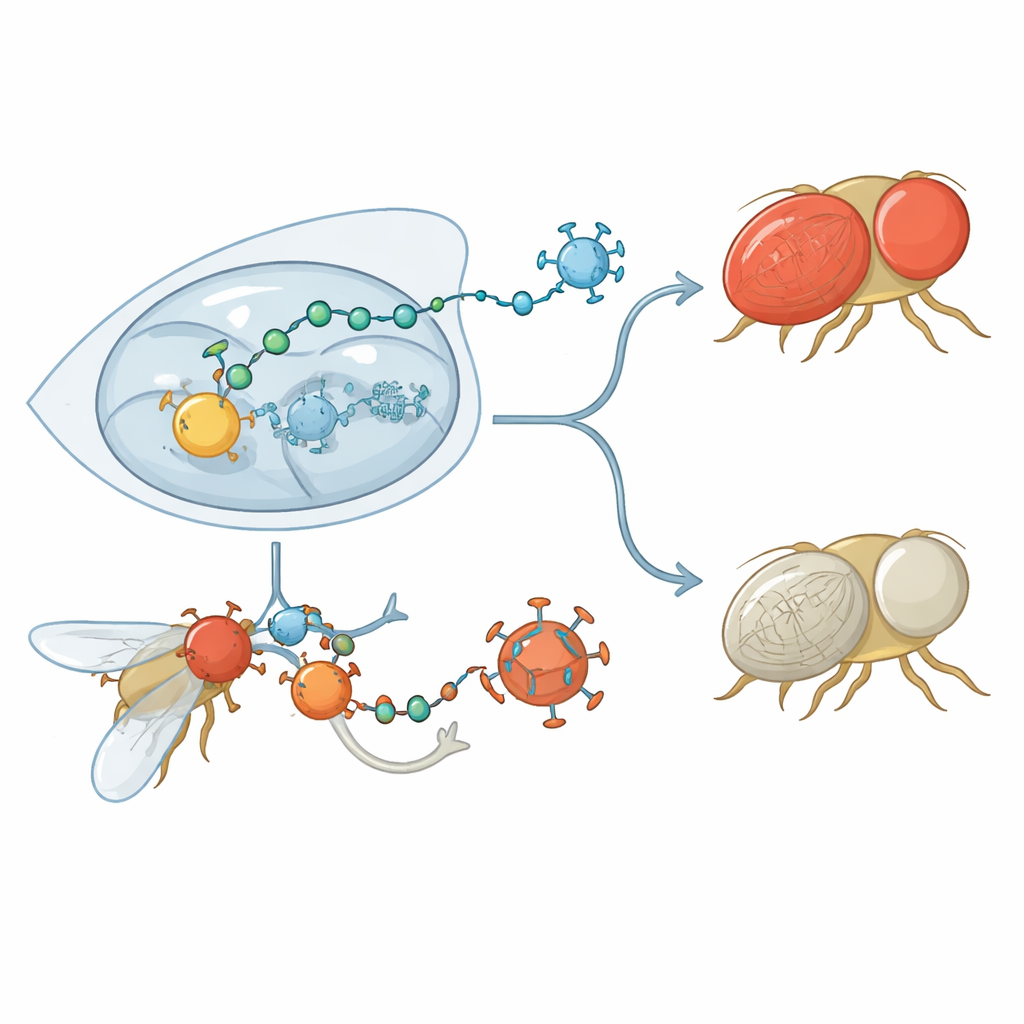
The authors built a clever fruit fly system in which eye color reports how well RNAi is working. A normal version of a fly gene called white gives deep red eyes, while silencing that gene through RNAi lightens the color toward orange or white. The team engineered flies that constantly produce an RNA hairpin targeting white in the eye, partially silencing the gene and creating a pale-orange pigment. They then crossed these “sensor” flies with others that produce a known VSR protein (DCV-1A from Drosophila C virus) in the same tissue. If the VSR protein successfully blocks RNAi, the white gene wakes back up and the eyes darken again. By measuring eye pigment, the researchers can quantify how strong a given VSR is in living animals.
Why location in the genome matters
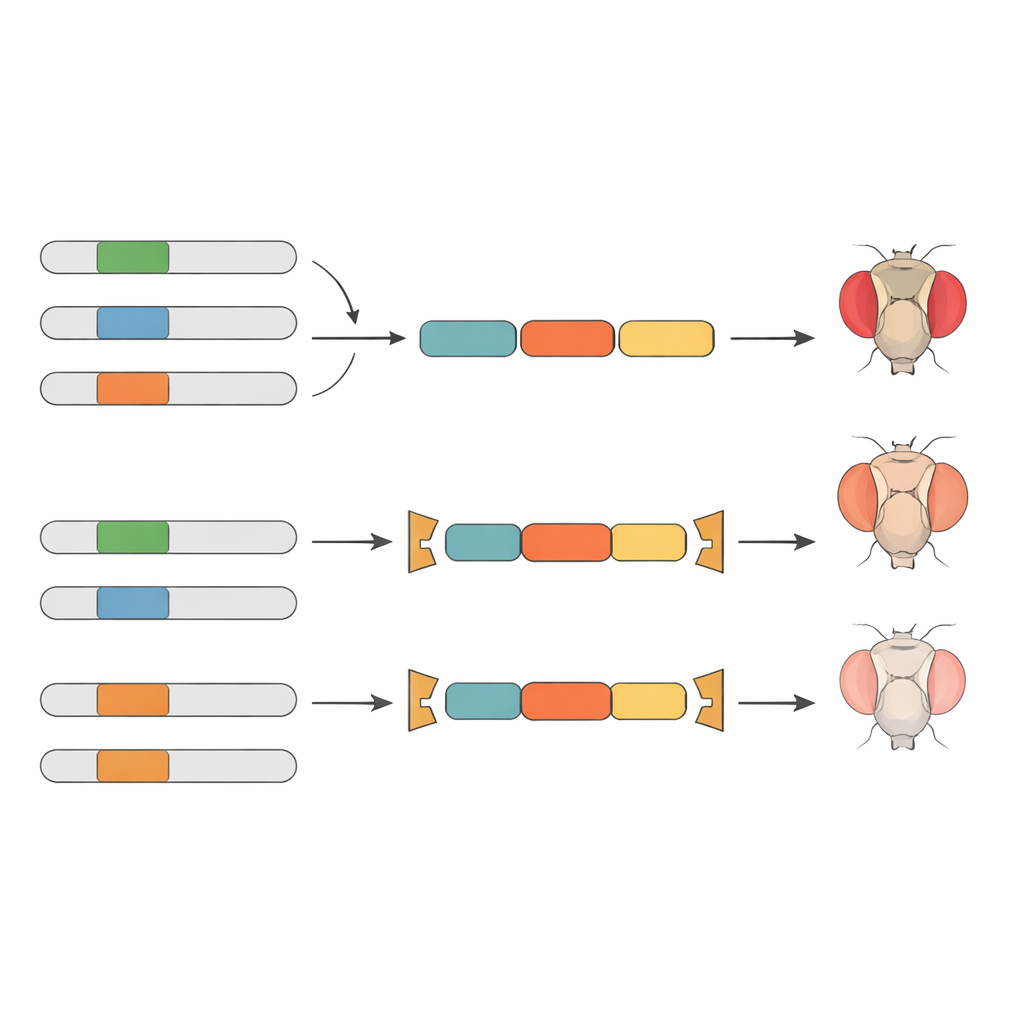
One complication in this kind of work is that the same gene can behave very differently depending on where it lands in the genome. Nearby stretches of DNA can act like local dimmers, turning expression up or down; these "position effects" can make a strong VSR look weak—or invisible—if it is inserted in a quiet neighborhood of the chromosome. To explore this, the team inserted the DCV-1A gene into three well-used docking sites in the fruit fly genome and compared the resulting eye colors. They found that one site (VK1) produced strong suppression of RNAi and dark eyes, while the others gave much weaker effects, even though the VSR protein itself was identical. This showed that where a VSR gene sits in the genome can dramatically change how easy it is to detect its activity.
Insulators that level the playing field
To tame these position effects, the researchers turned to DNA elements called gypsy insulators. These sequences act like boundary fences, shielding a gene from the influence of neighboring enhancers, silencers and tightly packed chromatin. When the team flanked the DCV-1A transgene with gypsy insulators, expression evened out: now all three genomic docking sites produced similarly strong RNAi suppression and dark eyes. In other words, the insulators helped create a standardized, high-expression background where VSRs could be compared fairly across different chromosomal locations. This makes the system a promising platform for screening candidate VSRs from many viruses.
When trusted tests miss the mark
The story did not end there. The authors also tested two other well-known VSRs: CrPV-1A from Cricket Paralysis virus and B2 from Flock House virus. CrPV-1A behaved as expected, clearly restoring eye pigment and confirming its suppressor role. But B2, despite its firmly established status as a VSR in other types of experiments, showed no detectable suppression in the fly eye assay—even though the protein was confirmed to be present at the right sites and under the same promoters. Prior work suggests that B2 must be active before the RNAi response is triggered, a timing requirement that this assay cannot meet. This mismatch highlights that even refined reporter systems can fail to reveal the activity of certain VSRs, especially those with unusual mechanisms or tight timing constraints.
What this means for future virus research
By combining standardized genomic landing sites with gypsy insulators, this study provides a more reliable way to measure how viral proteins interfere with a host’s RNA-based defenses in living flies. For many candidate VSRs, such an assay will be a powerful first pass, allowing researchers to compare strengths and weaknesses side-by-side. At the same time, the failure to detect B2’s known activity is a cautionary tale: no single test can capture all the ways viruses disarm their hosts. The authors argue that reporter systems should be used as part of a broader toolkit—including genetic rescue experiments and mechanistic studies—before deciding whether a viral protein truly lacks or possesses suppressor functions.
Citation: Gupta, A.K., Chennuri, P.R., Monfardini, R.D. et al. Exploiting attP landing sites and gypsy retrovirus insulators to identify and study viral suppressors of RNA silencing. Sci Rep 16, 9630 (2026). https://doi.org/10.1038/s41598-025-34423-3
Keywords: RNA interference, viral suppressors, Drosophila, transgenic reporter, gypsy insulator