Clear Sky Science · en
A novel automatic modulation recognition algorithm for OFDM signals based on FAFT
Why wireless signals need a sharper ear
Future 5G and 6G networks will juggle billions of phones, sensors, cars, and gadgets sharing the same crowded airwaves. To keep everything running smoothly and securely, base stations must quickly recognize what kind of radio signal they are hearing, even when that signal is buried in noise or distorted by buildings and fast-moving vehicles. This paper introduces a new way to give wireless receivers a much sharper "ear" for these signals while using far less computing power than many current techniques.
How radios tell signals apart
Every wireless transmission encodes information by changing certain properties of a radio wave, such as its amplitude or phase. These different ways of encoding are called modulation types. Recognizing them automatically is essential for smart spectrum sharing, electronic warfare protection, and secure links in the Internet of Things. Traditional recognition methods rely either on carefully crafted formulas from communication theory or on large neural networks that learn patterns directly from raw data. The first group can struggle in messy real-world channels, while the second often demands heavy hardware and long processing times, which are hard to afford in compact base stations.
A new shortcut tuned to modern signals
The authors focus on the kind of signals most common in 5G and 6G: orthogonal frequency-division multiplexing, or OFDM. OFDM packs information onto many closely spaced tones across the spectrum, creating a very characteristic pattern in frequency. Instead of treating these signals like any other waveform, the proposed method, called Fourier Adaptive Filter with Attention (FAFT), bakes this prior knowledge into the network itself. FAFT splits the problem into two coordinated views: a frequency view that looks directly at how energy is spread across tones, and a time view that examines how the signal changes from instant to instant. 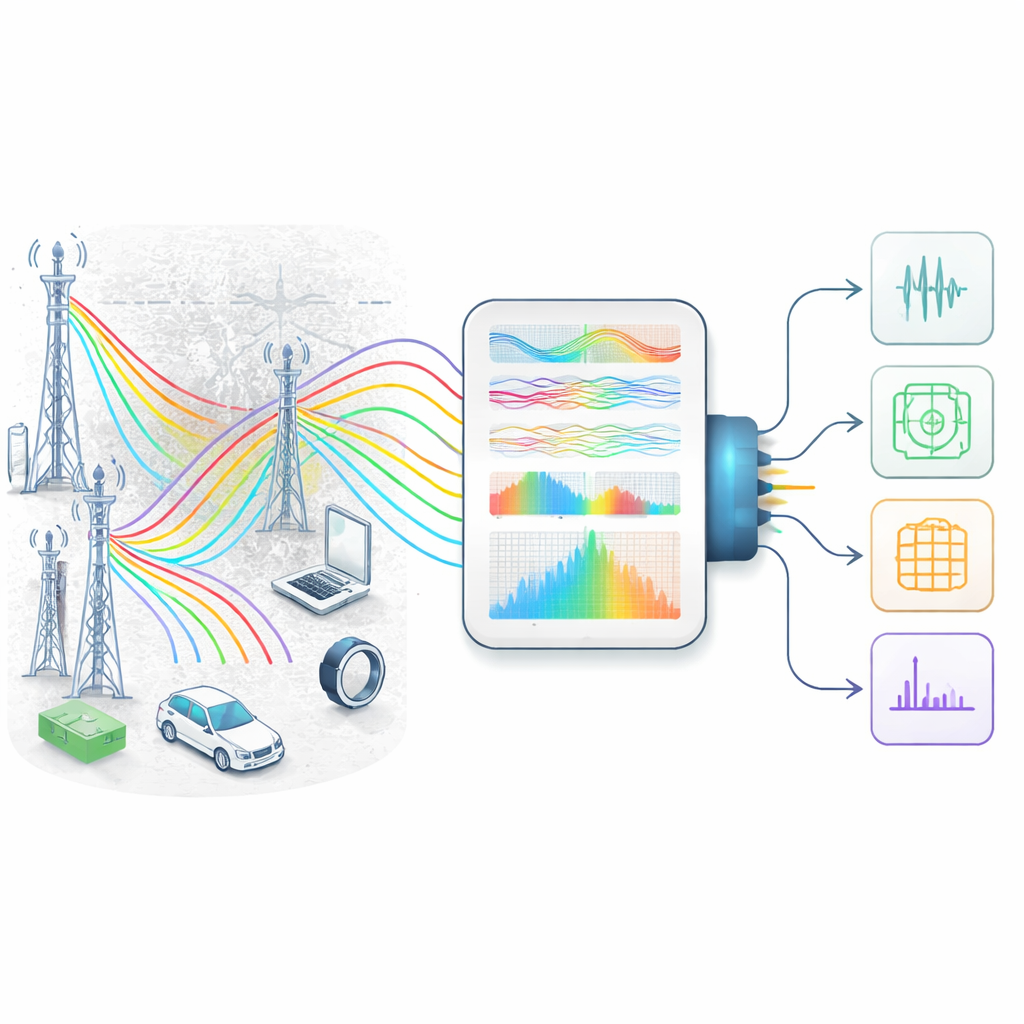
Letting frequency patterns stand out
In the frequency view, FAFT first uses the familiar fast Fourier transform to convert the incoming in-phase and quadrature samples into a spectrum. It then applies a learnable enhancement stage that acts like a smart equalizer, gently turning down erratic, noise-dominated ripples and boosting stable patterns linked to specific modulation formats. After that, a compact bank of digital filters learns which groups of tones to emphasize or suppress. A simple mathematical rule nudges these filters away from trivial or overly spiky behavior, encouraging broad, meaningful spectral shapes with just enough fine detail to distinguish similar modulations. This gives the network a clean, OFDM-aware fingerprint of each signal without resorting to a deep tower of generic layers.
Catching timing clues and fusing both views
At the same time, a lightweight time-domain branch scans the raw signal with shallow one-dimensional convolutions, capturing short-range structures such as symbol transitions and brief distortions that may not show up clearly in the spectrum alone. The outputs from the frequency and time branches are then stitched together and passed through an attention mechanism that learns how much weight to give each kind of feature under different channel conditions. In noisy scenes, the system may lean more on the cleaned-up spectral patterns; in other cases, it can rely more on timing cues. Finally, a small classifier converts this fused representation into a decision about which modulation type is present. 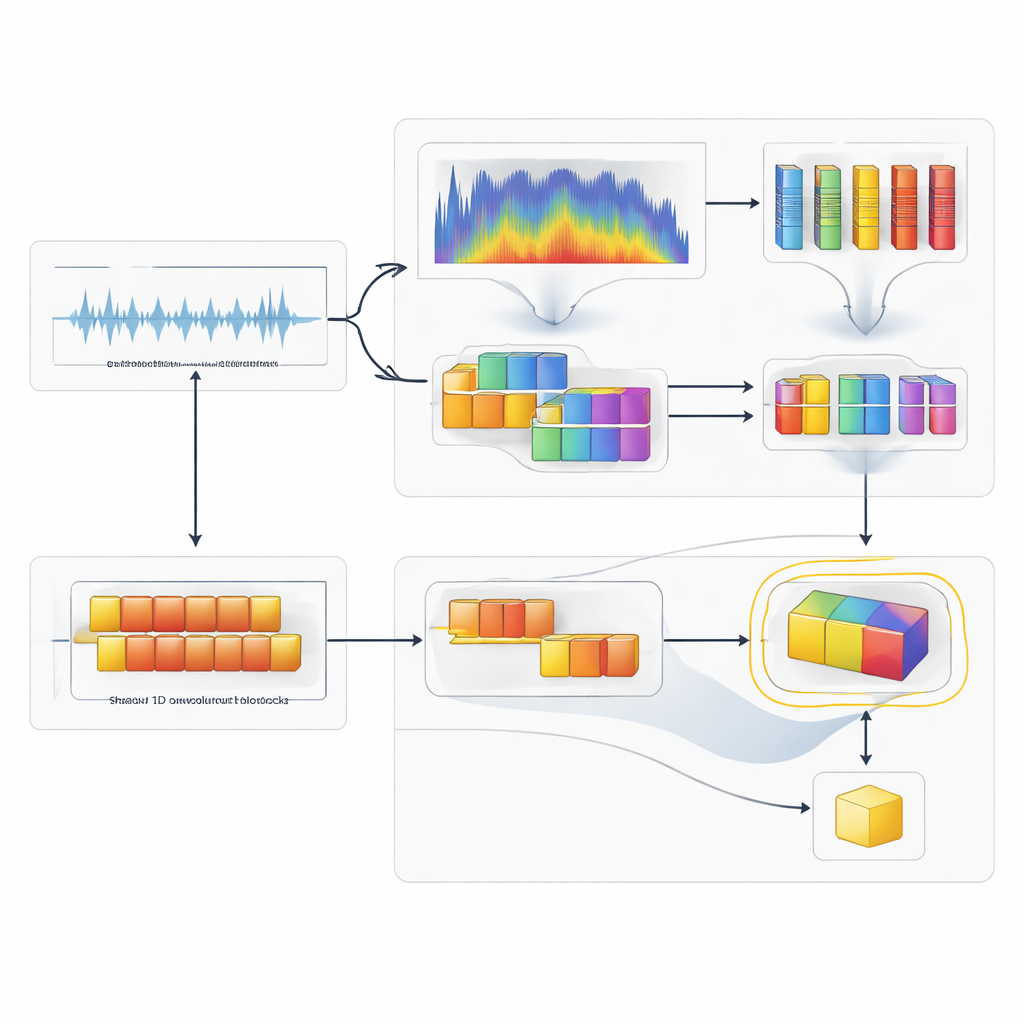
Putting the method to the test
To check that FAFT is useful beyond carefully controlled simulations, the authors test it on two well-known public datasets and on a new collection of real OFDM signals captured with radio hardware and a standardized vehicular channel model. Across these benchmarks, FAFT matches or beats several strong deep-learning competitors, including residual networks, hybrid convolution–recurrent models, and Transformer-based designs. It does so with roughly one-tenth or less of their parameter counts, and with similar or lower arithmetic cost. The gains are most striking at low signal-to-noise ratios, where the spectral enhancement module helps the model pick out the underlying modulation even when interference and multipath echoes are severe.
What this means for everyday networks
In plain terms, the study shows that building the quirks of modern OFDM waveforms directly into a neural network can yield smarter and leaner receivers. By combining a frequency-focused adaptive filter bank, a simple time-domain branch, and an attention-based fusion stage, FAFT offers accurate modulation recognition while keeping the model small enough for deployment in real base stations or edge radios. As 5G and 6G systems continue to grow more complex, such tailored, resource-efficient designs could help networks sense and manage their spectrum in real time, improving reliability and security without demanding massive new hardware.
Citation: Li, Y., Tang, X., Wang, L. et al. A novel automatic modulation recognition algorithm for OFDM signals based on FAFT. Sci Rep 16, 9614 (2026). https://doi.org/10.1038/s41598-025-33752-7
Keywords: automatic modulation recognition, OFDM, 5G 6G, deep learning, wireless communication