Clear Sky Science · en
Spatial joint modelling of multivariate longitudinal outcomes and cure proportion using latent Gaussian model with application to dataset on HIV/AIDS patients
Why place and health over time matter for kids with HIV
Modern treatment means many children living with HIV can grow up, go to school, and live long lives. But doctors still struggle to predict which children will do well and which remain at higher risk of serious illness. This study looks at how a child’s changing health over time and the town or district where they live together shape their chances of living a long life without HIV-related complications.
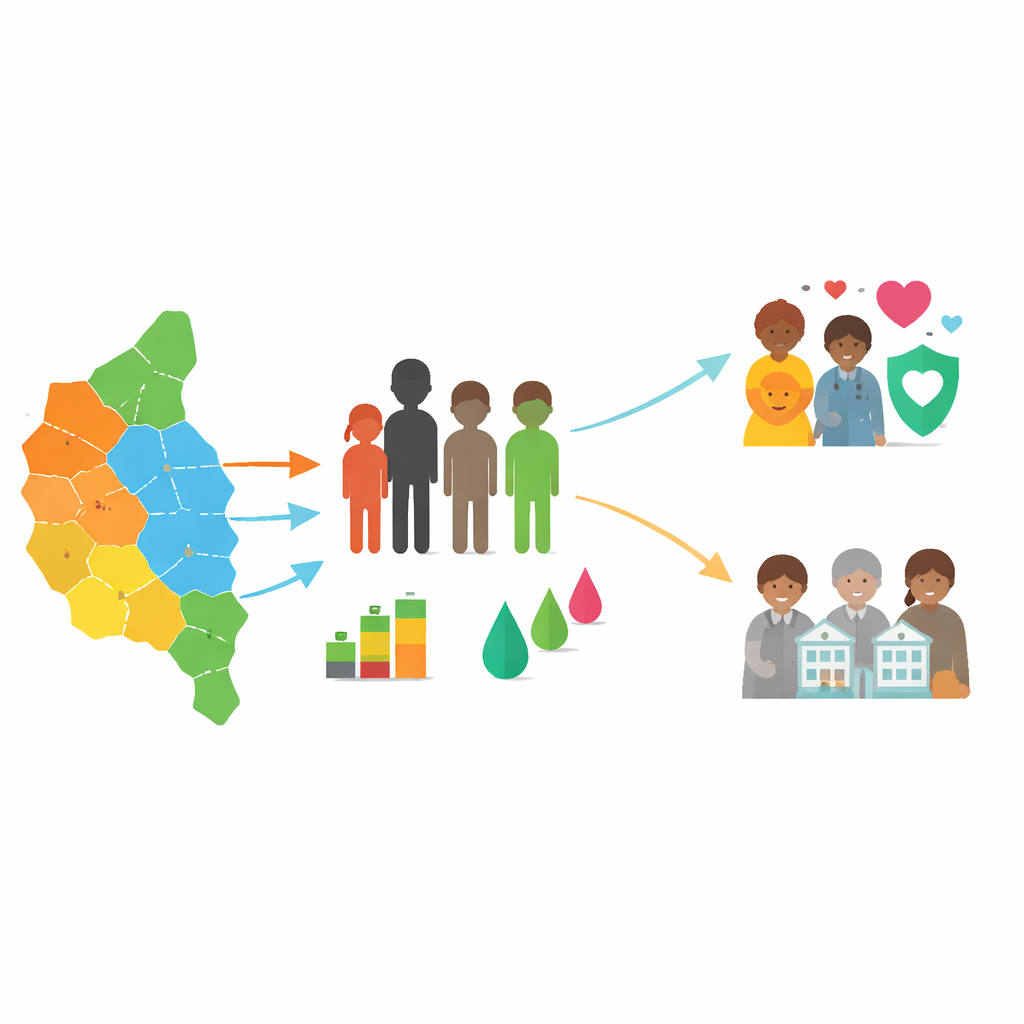
Following children’s health step by step
The researchers focused on two key health signals in children with HIV: immune strength, measured through CD4 cells in the blood, and body mass index (BMI), which reflects nutrition and growth. These measurements were collected repeatedly over time for each child. Rather than looking at a single snapshot, the study followed the ups and downs of these markers, capturing curved, non‑linear trends as children aged and received treatment.
Looking beyond averages to long-term survival
In many medical studies, it is assumed that if we wait long enough, every patient will eventually experience the bad outcome being studied, such as serious illness or death. In reality, especially with effective HIV drugs, some patients may never experience that event and can be thought of as effectively “cured” of the long‑term impact of the infection. The authors used a type of model that splits the population into two hidden groups: those who are still susceptible to the event and those who are long‑term survivors. They then asked how each child’s CD4 and BMI patterns over time help to tell these groups apart.
Adding the role of where children live
The study went a step further by recognising that place matters. All children in the data lived in Ogun State, Nigeria, but in different local government areas. Neighbouring areas often share similar health resources, diets, and living conditions, so the researchers allowed districts close to each other to have related chances of cure. They treated location as a hidden influence shared by children in the same area and used a modern “latent Gaussian” framework and fast approximate Bayesian tools to tie together health trajectories, survival chances, and geography in a single model.

What the model revealed about who does better
When they applied this model to data from a trial of a ready‑to‑eat therapeutic snack for children with HIV, several patterns stood out. Age and sex were stronger predictors of long‑term outcome than the snack itself. Younger children, especially those aged two to four years, tended to have higher chances of being in the long‑term survivor group. Girls generally had better cure probabilities than boys. Higher CD4 levels were linked to reduced risk of experiencing the bad outcome, underscoring the central role of immune recovery, while BMI played a smaller part. Across all children, the model estimated that about 61% belonged to the long‑term survivor group and 39% remained susceptible.
How place reshapes chances of cure
The spatial part of the model showed that cure probabilities were not evenly spread across Ogun State. Some districts, such as Remo and Odeda, had clearly higher average chances of cure, while others, including Ewekoro and parts of the state’s south, had lower values. Even after accounting for each child’s age, sex, and biomarkers, these location‑based differences remained important, hinting at underlying contrasts in healthcare access, nutrition, or social conditions between areas.
What this means for real-world care
Put simply, the study shows that a child’s long‑term outlook with HIV depends not only on their blood tests and body size, but also on where they live and how their health changes over time. By weaving together repeated measurements, survival outcomes, and geography in one framework, the researchers offer a sharper way to identify children and communities that need extra attention. Their approach suggests that many children can expect long, healthy lives, while also pointing policymakers toward specific districts and groups of patients where better support could close the survival gap.
Citation: Ekong, A.H., Olayiwola, O.M., Dawodu, G.A. et al. Spatial joint modelling of multivariate longitudinal outcomes and cure proportion using latent Gaussian model with application to dataset on HIV/AIDS patients. Sci Rep 16, 9635 (2026). https://doi.org/10.1038/s41598-025-33611-5
Keywords: HIV in children, long-term survival, spatial health disparities, longitudinal biomarkers, Bayesian joint modelling