Clear Sky Science · en
Analytical kernels for efficient constant Q transforms in dark matter searches with LIGO
Listening for dark matter in a new way
Gravitational wave observatories like LIGO are some of the most sensitive instruments ever built, and they may also be powerful antennas for dark matter. But fully exploiting their data has been held back by a basic computing problem: the best way to look for certain dark matter signals is so expensive that it becomes impractical on real data sets. This paper presents a new signal-processing method that keeps the full sensitivity of the ideal approach while slashing the computing cost, opening the door to more thorough dark matter searches in current and future detectors.
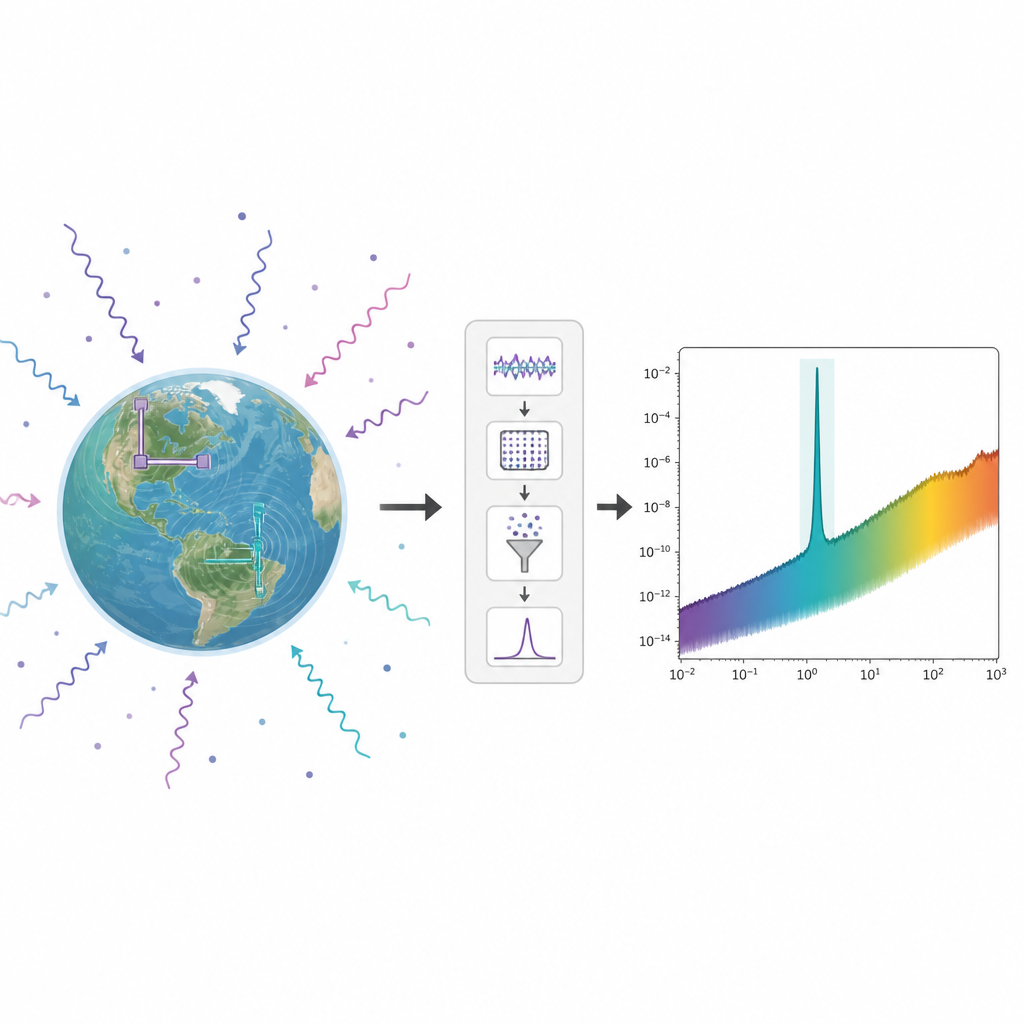
Why dark matter leaves a narrow musical trace
The authors focus on a popular class of ideas in which dark matter behaves like a gently oscillating field that permeates space. In this picture, instead of rare particle collisions, dark matter produces tiny, nearly continuous ripples that nudge physical constants or optical components inside gravitational wave detectors. These ripples show up as extremely narrow peaks in the frequency spectrum of the detector output. However, the motion of the Earth through our galaxy blurs each peak slightly, so the best observing time depends on the frequency: low tones remain coherent for many hours, while high tones change within minutes. Any successful search must adapt to this changing coherence time across a very wide frequency range.
The challenge of zooming in across many pitches
Standard tools like the fast Fourier transform cut data into equal-sized chunks and work well when the same time span is appropriate at all frequencies. For ultralight dark matter, that assumption fails. A more suitable tool is the “constant Q” transform, or logarithmic power spectral density, which adjusts the time window for each frequency bin so that every part of the spectrum is treated optimally. Unfortunately, a straightforward implementation scales with the square of the data length, making it thousands to millions of times slower than fast algorithms and essentially unusable for long stretches of LIGO data. Previous dark matter searches therefore relied on clever approximations, grouping frequencies into bands with fixed windows and accepting small losses in sensitivity and extra post-processing steps.
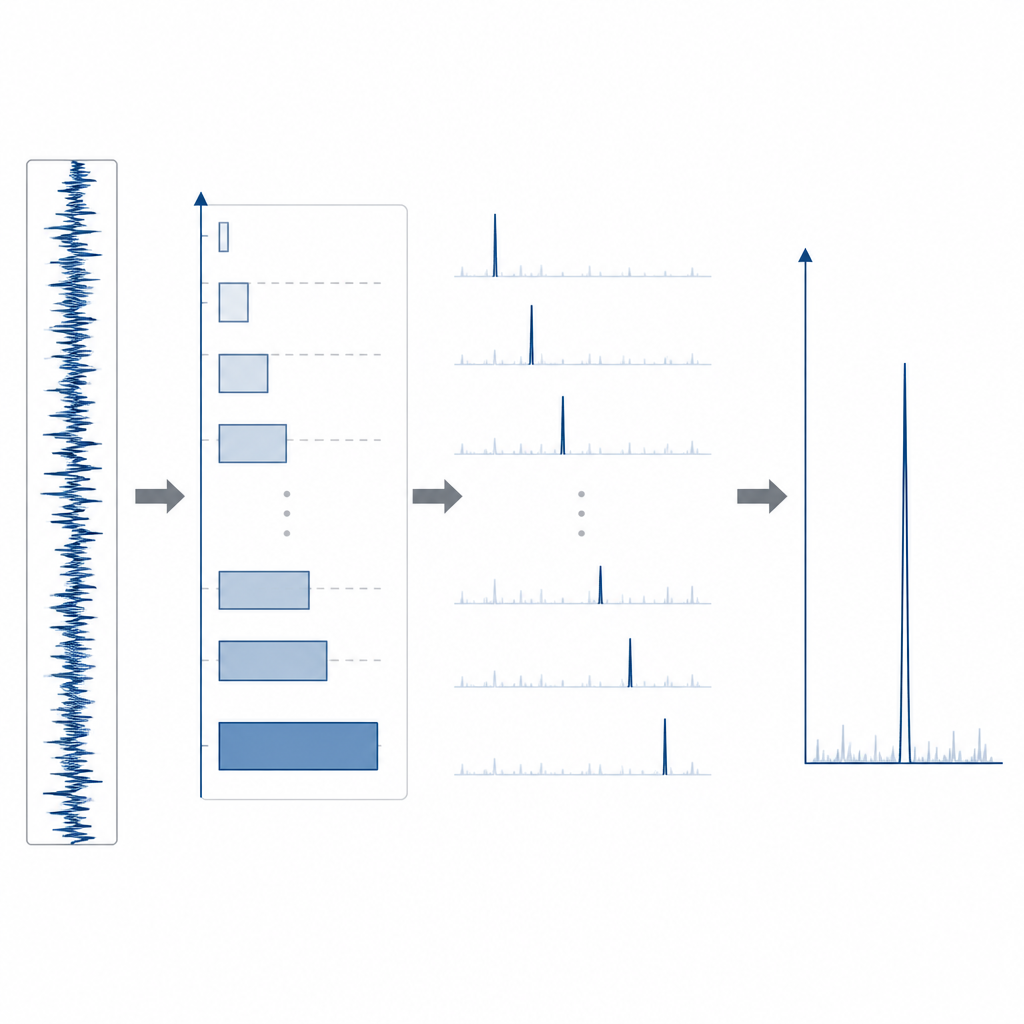
A shortcut inspired by digital music
Drawing on techniques from computer music analysis, the authors recast the constant Q transform so that the heavy work happens in frequency space rather than in the time domain. They separate the calculation into the actual detector data and a mathematical kernel that encodes how each frequency bin is weighted. While this kernel is broad and costly to handle in time, its counterpart in frequency is sharply peaked: only a handful of values matter, and the rest can be treated as effectively zero. By exploiting this sparsity, they design a “zero-suppressed” version of the transform that keeps the exact answer but avoids almost all unnecessary operations. A key advance is that they derive an analytical form for the kernel, so it never has to be pre-computed or stored for millions of frequency bins.
Turning speed into stronger limits
With this new framework, a single fast Fourier transform of the data is enough to feed all frequency bins of the logarithmic spectrum, after which only lightweight, highly selective operations are needed. The team applies the method to LIGO’s third observing run, reanalyzing data previously studied with an approximate approach. They find that the new method boosts the signal-to-noise ratio up to the theoretical maximum while reducing computing costs, achieving about an order-of-magnitude speedup over the earlier fast-Fourier-based approximation and far outperforming a brute-force calculation. Using detailed models of the detector background based on flexible spline fits and skewed statistical distributions, they search for excess power that would indicate scalar-field dark matter and instead obtain tighter upper limits on its possible couplings.
What this means for future observatories
Although no dark matter signal is found in this study, the method itself is a powerful new tool. Any experiment that needs a logarithmic spectrum tuned to changing coherence times, from ground-based interferometers like LIGO and GEO600 to planned space missions such as LISA, can now perform fully optimal analyses without prohibitive computing costs. By making the most sensitive type of search feasible at scale, this work increases the chances that future gravitational wave detectors will not only hear distant cosmic collisions but also catch the faint, steady hum of dark matter itself.
Citation: Göttel, A.S., Raymond, V. Analytical kernels for efficient constant Q transforms in dark matter searches with LIGO. Sci Rep 16, 15364 (2026). https://doi.org/10.1038/s41598-025-33428-2
Keywords: LIGO, dark matter, gravitational waves, signal processing, constant Q transform