Clear Sky Science · en
Role of RGO and RGO-Pt as an attractive electrocatalyst for efficient electrochemical reduction of U(VI) in HNO3
Turning nuclear waste into a useful resource
Nuclear power can deliver a lot of electricity without releasing greenhouse gases, but it leaves behind spent fuel that is hard to manage. This fuel still contains valuable uranium and plutonium that can be recycled if we can separate them cleanly and safely. The paper described here looks at a smarter way to prepare a special form of uranium needed in reprocessing plants, using modern carbon-based materials to make the job faster and less wasteful.
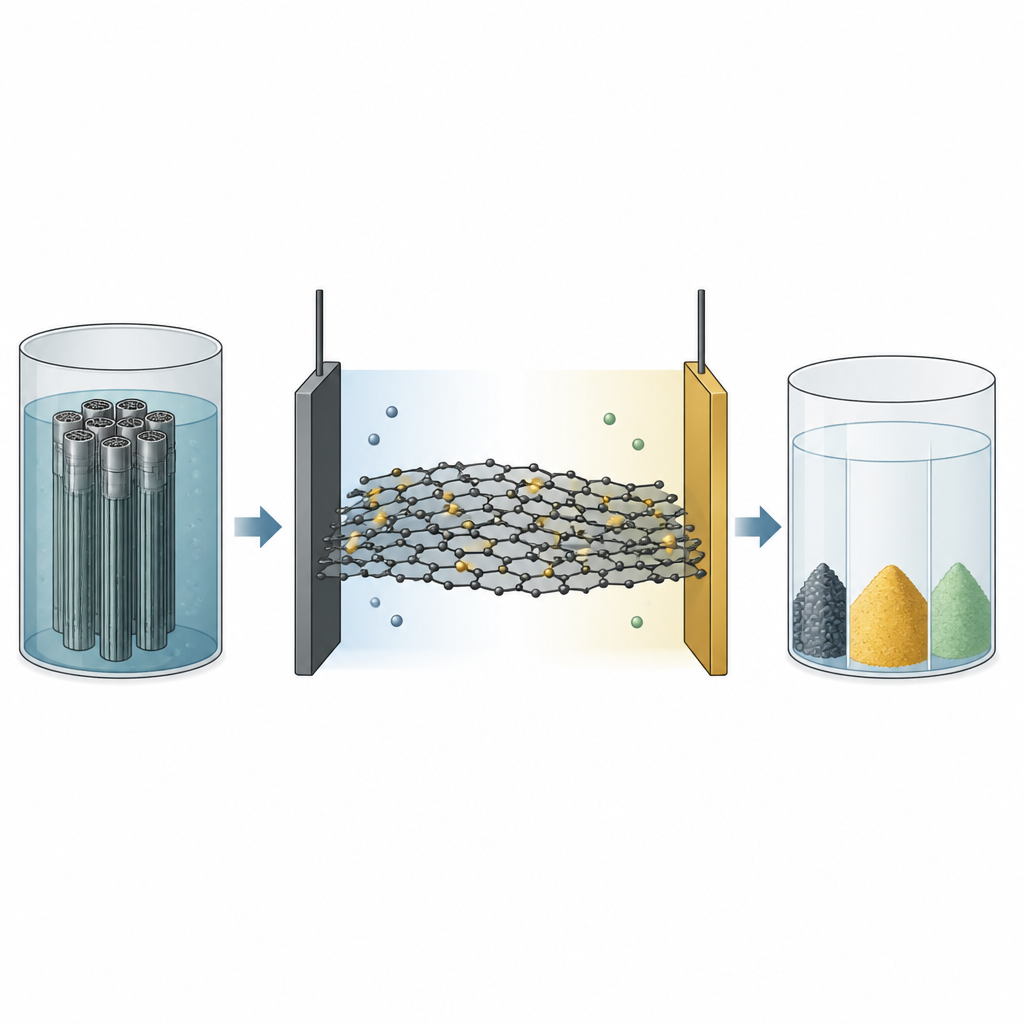
Why this special uranium matters
When used fuel rods come out of a reactor, they contain a mix of uranium, plutonium, and many highly radioactive byproducts. Many countries use a chemical scheme called the PUREX process to recover uranium and plutonium so they can be reused and to shrink the long-term hazard of the waste. A key step in this process relies on a form of uranium called U(IV), which acts as a helper that changes plutonium into a state where it can be separated from uranium. Making enough U(IV) reliably, and without adding extra chemicals to the waste stream, is therefore central to efficient recycling of nuclear fuel.
Limits of today’s electrodes
Current reprocessing plants often make U(IV) by running an electric current through a nitric acid solution that contains uranium. Metal plates made of titanium, or sometimes platinum, serve as the negative electrode where uranium is reduced to U(IV). These materials, however, need a large "push" in voltage before the reaction proceeds at useful speed. At those high voltages, they also encourage the solution to release hydrogen gas instead of focusing on changing uranium. This side reaction wastes electricity and lowers the fraction of current that actually goes into making U(IV), a measure known as faradaic efficiency.
New carbon sheets with tiny metal helpers
The researchers explored a different kind of electrode made from thin sheets of carbon known as reduced graphene oxide, or RGO. These sheets provide a large surface area and good electrical contact. The team also made versions where tiny platinum particles were evenly scattered across the carbon, forming RGO-Pt materials with controlled platinum content. Using a range of microscopy and spectroscopy tools, they confirmed that the carbon sheets were well formed, the platinum particles were only a few billionths of a meter across, and the two components were tightly integrated.
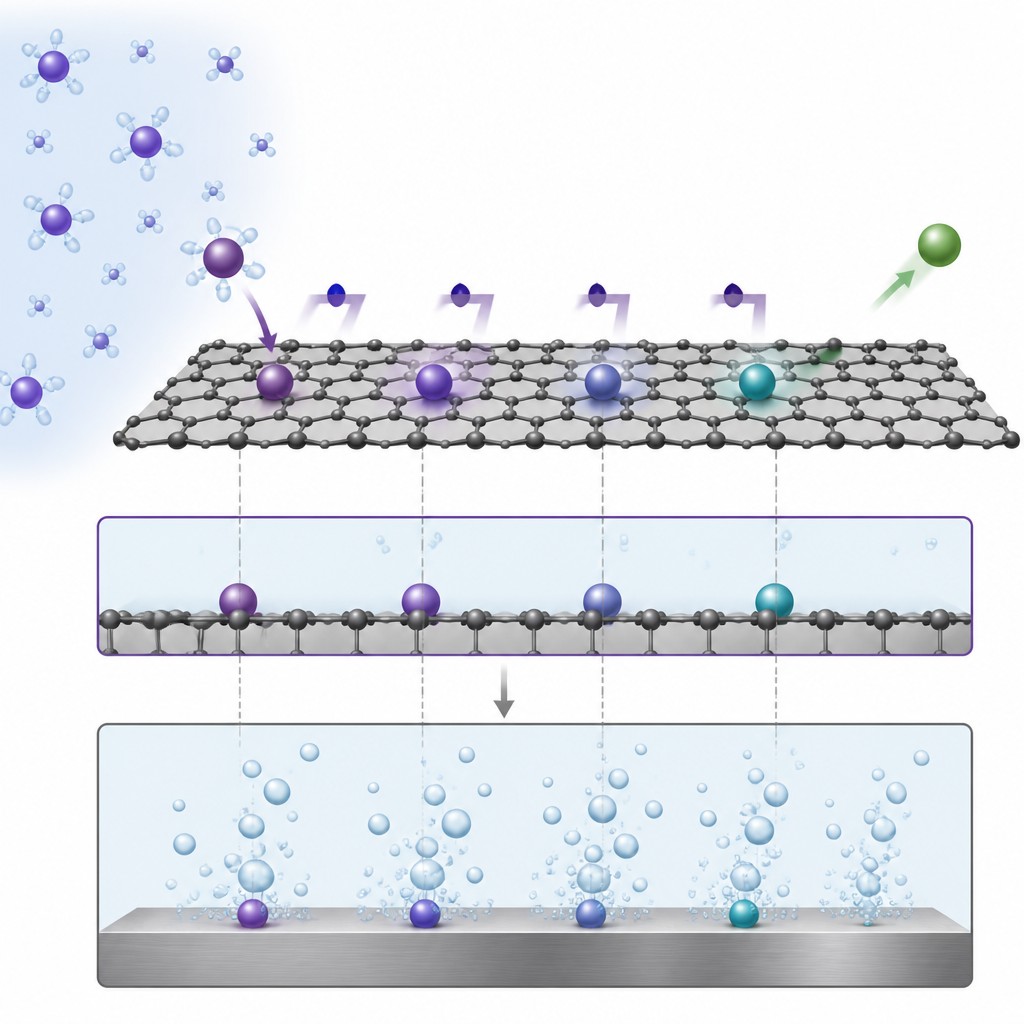
How these new electrodes change the reaction
By running detailed voltage sweeps and measuring current and electrical resistance, the authors showed that uranium behaves differently on RGO than on plain metal. On standard titanium or platinum, uranium is reduced in two distinct stages, passing through an intermediate form that can slow the process. On RGO, the same change from U(VI) to U(IV) happens in a single combined step, helped by oxygen-containing sites on the carbon surface that stabilize the fleeting intermediate. This single-step pathway, together with a lower overall resistance, means that the reaction can proceed at lower voltage. When platinum nanoparticles are added to the carbon, the current at modest voltages becomes even higher, although this also tends to accelerate hydrogen formation.
Balancing speed and unwanted gas
The study compared how easily hydrogen bubbles form on each material and found that bare RGO strongly suppresses this side reaction. RGO-Pt and pure platinum, by contrast, are very good at making hydrogen, which is a mixed blessing: it is useful in some technologies but harmful here because it steals current away from uranium. This means the best choice of electrode depends on the operating conditions. If the process is run at relatively low voltage and moderate production rates, RGO-Pt offers high speed. At higher voltages, where reprocessing plants may want very high output, bare RGO is more attractive because it keeps hydrogen in check and directs more of the electrical energy into making U(IV).
What this means for nuclear fuel recycling
For a lay reader, the key message is that carefully designed carbon sheets, with or without tiny metal particles, can steer an important nuclear chemistry step along a more efficient path. By lowering the energy cost and limiting wasteful gas formation, RGO-based electrodes could help future reprocessing plants generate the needed form of uranium more cleanly and at larger scale. This, in turn, supports safer and more resource-conscious recycling of nuclear fuel, helping nuclear power contribute to low-carbon electricity with better control over its long-lived wastes.
Citation: Pal, K.K., Ghosh, C., Pandian, R. et al. Role of RGO and RGO-Pt as an attractive electrocatalyst for efficient electrochemical reduction of U(VI) in HNO3. Sci Rep 16, 15729 (2026). https://doi.org/10.1038/s41598-025-32358-3
Keywords: uranium reduction, electrocatalysis, nuclear fuel reprocessing, graphene electrodes, PUREX process