Clear Sky Science · en
Effects of robotic hand-assisted rehabilitation on motor function and daily living activities in acute stroke: a randomized controlled trial
Robots Lend a Helping Hand After Stroke
For many people who survive a stroke, the hardest part of recovery is getting their hands to do simple jobs again: buttoning a shirt, lifting a cup, or turning a jar lid. These small actions make the difference between relying on others and living independently. This study explores whether adding a soft, glove-like robot to standard therapy can speed up the return of hand skills in the crucial first weeks after a stroke.
Why Hand Recovery Matters So Much
Stroke is one of the leading causes of long-term disability worldwide. Even when people regain some movement in the shoulder and elbow, the hand and fingers often remain stiff, weak, and clumsy. That makes everyday tasks like dressing, eating, and personal care slow or impossible. Traditional rehabilitation methods, such as hands-on exercises with a therapist, can help, but they are limited by time, effort, and how many repetitions a person can tolerate. Because the brain is especially “rewireable” in the first months after a stroke, there is a strong push to find ways to intensify practice during this window so that more function can be saved.
A Robot Glove Joins Standard Therapy
To test the added value of robotic help, the researchers ran a randomized controlled trial with 30 adults who had experienced a stroke within the previous six weeks. Everyone received a well-established approach known as neurodevelopmental therapy, three times a week for eight weeks, focused on improving posture, arm control, and hand use. Half of the participants were also given 25 minutes of extra training in each session using a soft robotic hand device, similar to an assistive glove. This device could move all the fingers passively, support individual fingers, practice pinch grips, assist voluntary movement, or mirror the motions of the healthy hand. Patients practiced real-world tasks such as moving buttons, stacking checkers, and turning cards, first with the robot and then on their own to reinforce learning.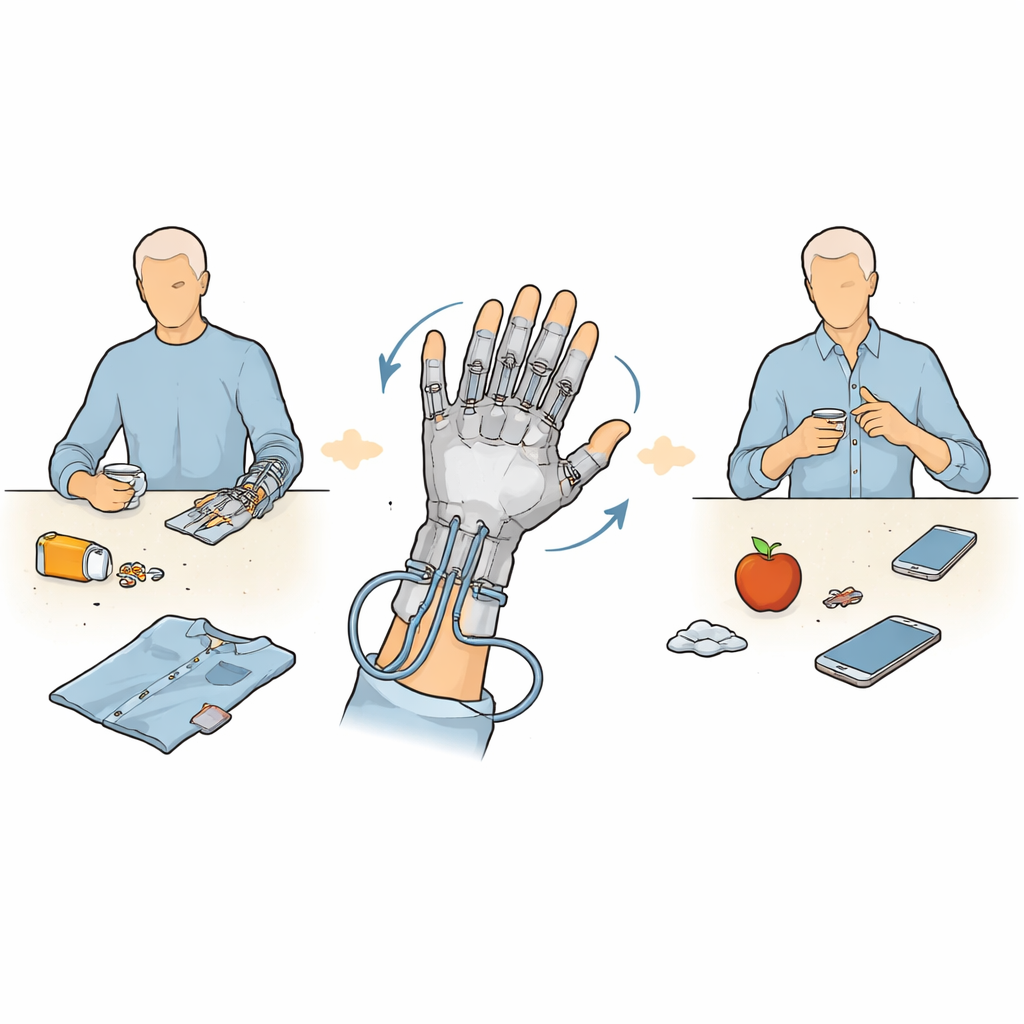
Measuring Everyday Change
The team tracked several aspects of recovery before and after the eight-week program. They measured fine finger control using the Nine Hole Peg Test, in which participants place and remove small pegs as quickly as possible. Hand usefulness in daily tasks was scored with a questionnaire called ABILHAND, while overall independence in activities like feeding and dressing was rated with the Barthel Index. They also evaluated how much the arm and hand were limiting function (using the DASH questionnaire) and checked muscle stiffness, or spasticity, with a standard clinical scale. These tools together captured not just lab performance, but how well people could actually use their hands in everyday life.
Stronger Gains With Robotic Help
Both groups improved over the course of treatment, but the group that trained with the robot glove advanced more. Their fine motor skills improved substantially more than those of the standard-therapy group, as shown by faster peg test times. They also reported larger gains in how capable their hands felt during real activities and in their overall independence with daily tasks. In numbers, the robotic group nearly doubled the improvement in daily living scores compared with the control group. By contrast, muscle stiffness did not change much in either group, likely because most participants started with only mild spasticity. Statistical analyses that adjusted for small starting differences between groups confirmed that the added robotic training produced meaningfully better functional outcomes, not just random variation.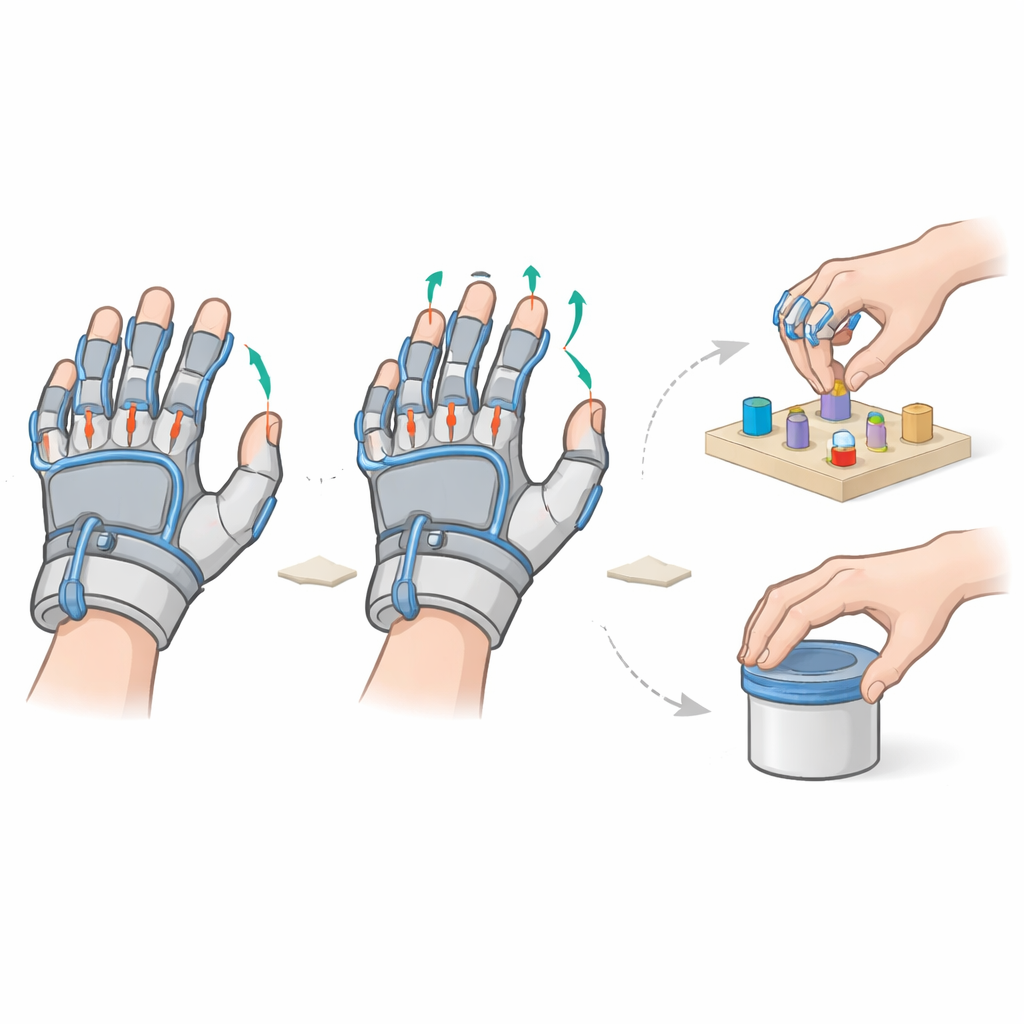
What This Means for Patients and Clinics
In plain terms, adding a soft robotic glove to standard hand therapy helped people recovering from a recent stroke use their hands more quickly and more effectively in daily life. The robot did not replace the therapist; instead, it amplified therapy by providing many more precise, repetitive, and goal-directed movements when the brain was most ready to relearn. The study was small and did not test robotic therapy alone or track long-term results, and the device could not be used by those with the most severe weakness. Still, the findings suggest that, as part of a broader rehabilitation program, hand-focused robotic training could become an important tool to help stroke survivors regain independence sooner.
Citation: Sunnetci, M.A., Menek, B. Effects of robotic hand-assisted rehabilitation on motor function and daily living activities in acute stroke: a randomized controlled trial. Sci Rep 16, 11638 (2026). https://doi.org/10.1038/s41598-025-32258-6
Keywords: stroke recovery, robotic rehabilitation, hand function, fine motor skills, daily living independence