Clear Sky Science · en
Optimizing precision in quantum metrology through engineered environments
Sharper Measurements from Quantum Light
Everyday technologies, from GPS navigation to medical scanners, rely on precise measurements of time, distance, and fields. Quantum physics promises to push this precision far beyond what classical devices can offer, but fragile quantum states are easily disturbed by their surroundings. This article explores a clever way to turn that usually harmful environment into an ally, using engineered light fields to make single-photon measurements more accurate and more robust over time.
Turning the Environment into a Useful Tool
In most setups, any contact between a quantum system and its environment washes out the delicate superpositions that give quantum devices their edge. Traditional models treat this disturbance as a one-way process: information leaks into the surroundings and never comes back, steadily degrading performance. The author instead considers environments with a kind of memory. In these settings, information can flow back to the quantum system, briefly restoring its order and boosting the precision of measurements. The work focuses on a single photon whose polarization (its orientation of oscillation) carries the quantity to be measured as a tiny phase shift.
Shaping Light with a Tilted Cavity
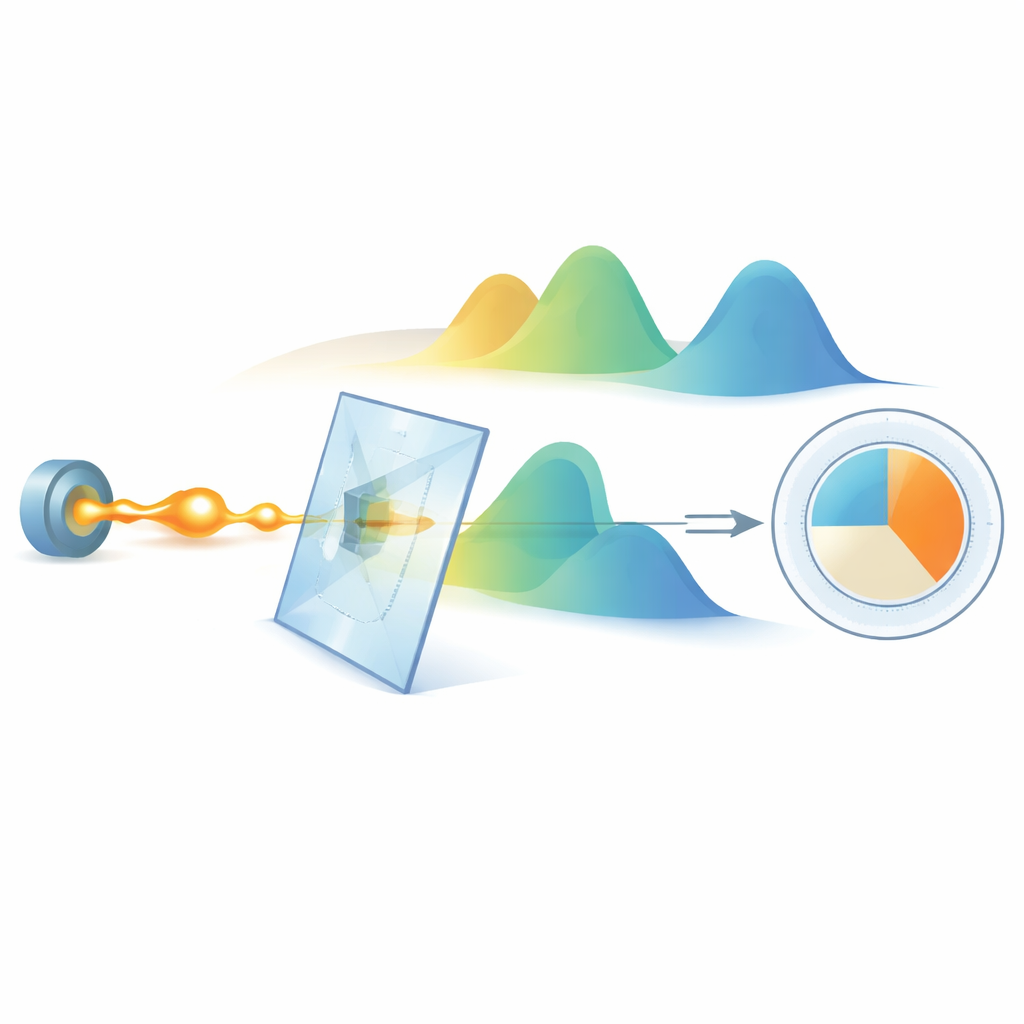
To create this memory-rich environment, the study uses a design inspired by existing photonic experiments. A Fabry–Pérot cavity and an interference filter shape the photon’s frequency spectrum. By gently tilting the cavity, the spectrum can be tuned from a single smooth peak, which acts like a memoryless bath, to a split double peak, which carries strong correlations over time. Several knobs can be adjusted: the tilt angle that balances the two peaks, the overall spectral width that sets how broad they are, and the tiny difference in refractive index between two polarizations, which controls how quickly their phases separate. Together, these settings determine how strongly the photon couples to its environment and how much memory the environment retains.
Watching Precision Fade and Revive
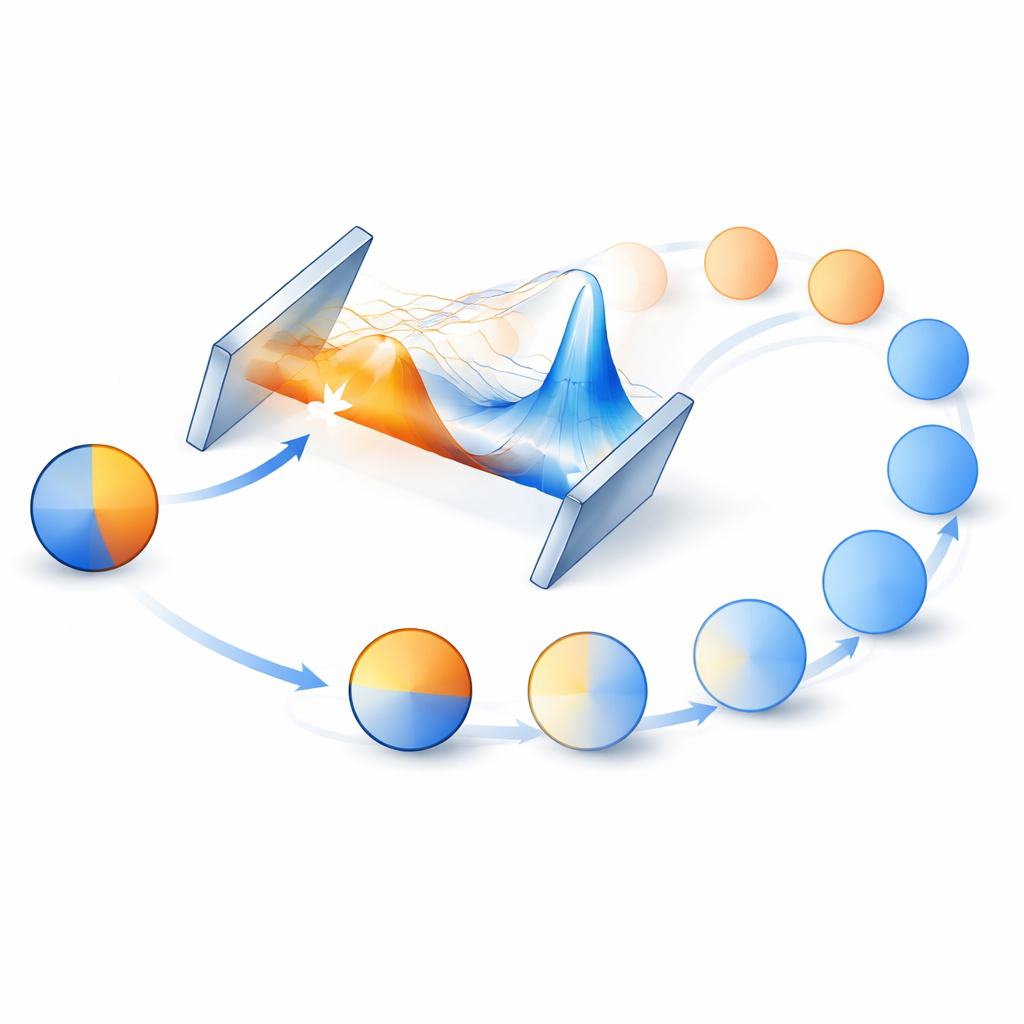
The central quantity tracked in this work is the quantum Fisher information, a standard measure that tells how precisely a hidden parameter—here, the phase imprinted on the photon—can be estimated in principle. In a simple, memoryless environment, this information falls smoothly over time, meaning measurements become steadily less accurate. When the cavity is tuned to produce two balanced frequency peaks, the story changes dramatically: the information no longer just decays, but oscillates. Periods of loss are followed by revivals, indicating that the environment is handing useful information back to the photon. Narrower spectral widths and smaller differences in refractive index stretch out these revivals, allowing high-precision intervals to last longer and to reappear multiple times.
Purity, Disorder, and Quantum Memory
To connect these precision gains to the underlying physics, the author also studies the photon’s quantum “purity,” quantified by a standard entropy measure. When the environment is memoryless, entropy rises steadily as the photon becomes more mixed and less useful for fine measurements, mirroring the smooth drop in quantum Fisher information. In the engineered, memoryful environment, entropy itself oscillates: whenever the information about the phase revives, the photon briefly regains its purity. These synchronized swings show that environmental memory not only preserves structure in the photon’s state but actively restores it, partially undoing earlier damage from noise.
Implications for Future Quantum Devices
The study concludes that carefully structured environments can markedly improve the performance of quantum measurement schemes, even in the presence of realistic noise. By tuning simple, experimentally accessible parameters—such as a cavity’s tilt, the spread of allowed frequencies, and small material properties—researchers can create conditions where precision repeatedly rebounds instead of fading away. This approach offers a practical recipe for designing next-generation quantum sensors and communication links that maintain their advantage in imperfect, noisy conditions, bringing quantum-enhanced metrology closer to real-world applications.
Citation: Berrada, K. Optimizing precision in quantum metrology through engineered environments. Sci Rep 16, 10560 (2026). https://doi.org/10.1038/s41598-025-31810-8
Keywords: quantum metrology, non-Markovian dynamics, photonic cavities, quantum sensing, environment engineering