Clear Sky Science · en
Bayesian-optimized GRU network modeling for thermal error compensation in gantry guideway grinder spindle
Why heat quietly bends big machines
Modern factories rely on giant computer-controlled grinders to shape metal parts with hair-width precision. Yet as these machines run, their spinning shafts slowly warm up and stretch, nudging the cutting tool away from where it should be. This paper explores a smarter way to predict and cancel out those tiny heat-driven shifts in a heavy gantry grinder, so that even after hours of work, the machine still cuts exactly where it is supposed to.
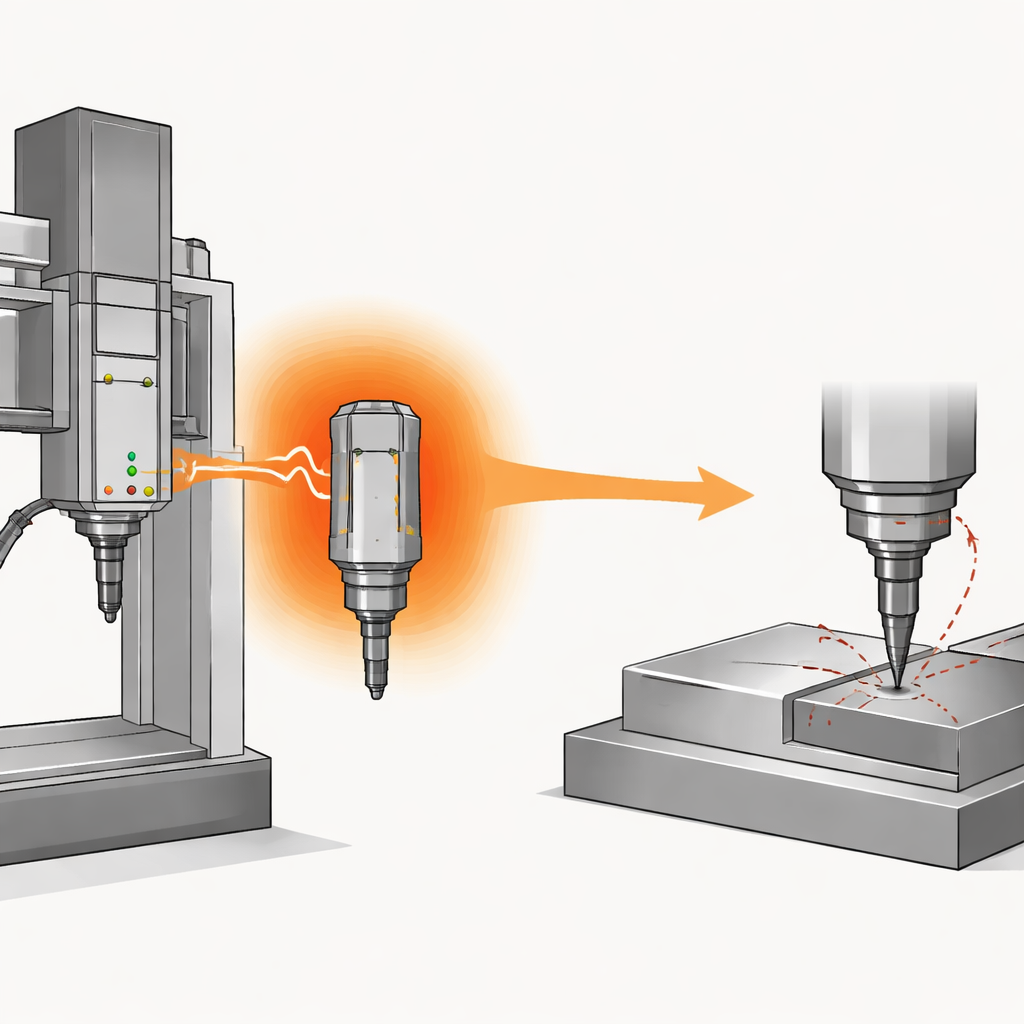
Hidden motion inside a massive grinder
The study focuses on the spindle, the spinning heart of a large gantry guideway grinder used to finish long, flat surfaces. When this spindle rotates at high speed, its bearings, motor, and nearby parts generate heat. That heat slowly spreads through the metal, making parts expand in different directions. The team carefully measured both the temperature at several points on and around the spindle, and the tiny shifts in position of the spindle tip along three directions. They found that, while sideways motion was only a few micrometers, the spindle could lengthen by more than 150 micrometers along its axis, a large change by precision-machining standards.
Finding the few temperatures that matter most
Covering the spindle with temperature probes provides rich data, but also creates a problem: too many overlapping signals can confuse a prediction model and slow it down. To avoid this, the authors used a data-mining approach to pick out just the most informative temperature points. They relied on a decision-tree method, which automatically ranks each sensor by how strongly it helps explain the measured motion of the spindle. Then, through a step‑by‑step elimination and testing process, they narrowed the original set of seven temperature locations down to a smaller group. The most important sensors sat near the front bearing area, confirming that this zone is the main source of heat build-up and thermal expansion.
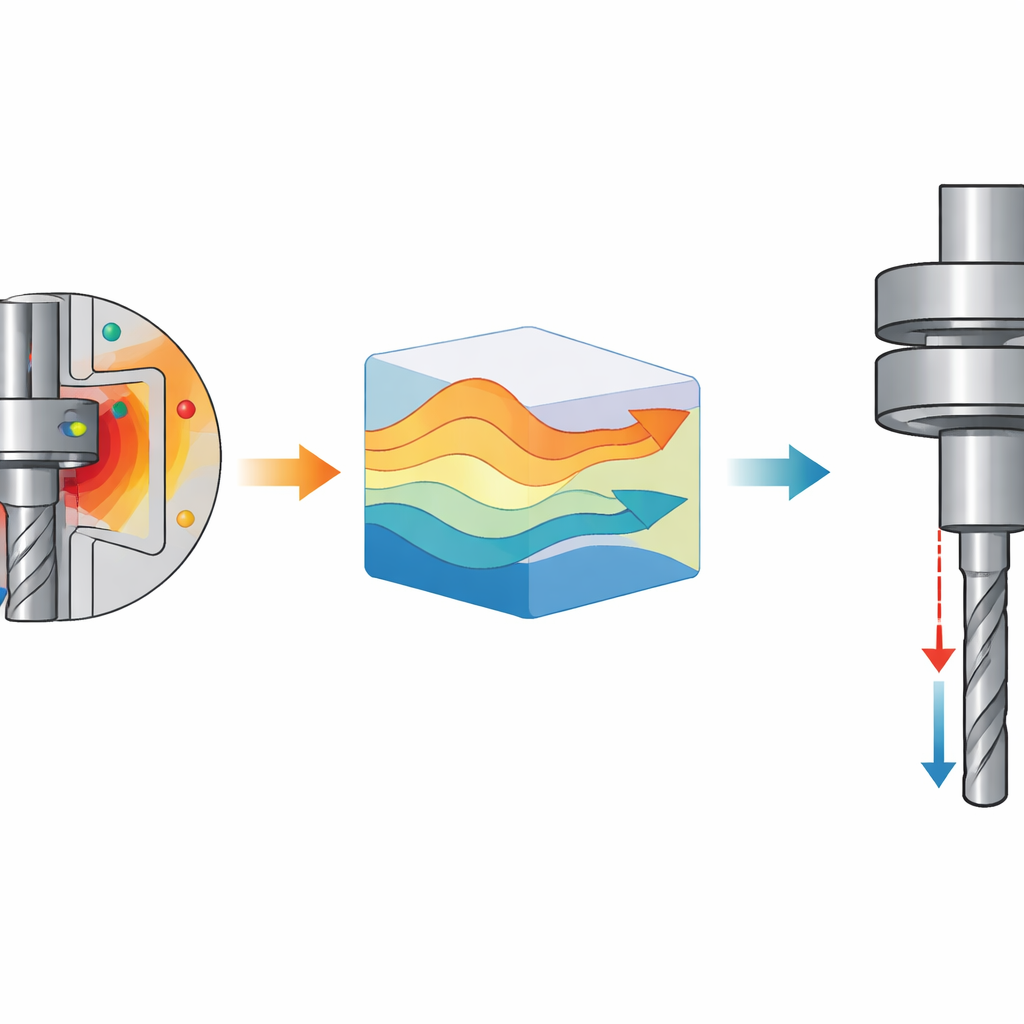
Teaching a neural network to follow slow drifts
To turn temperature histories into accurate forecasts of spindle stretch, the researchers built a prediction model using a type of recurrent neural network called a gated recurrent unit, or GRU. This kind of network is designed to handle time series: it looks at streams of data and learns how past conditions influence future changes. In this case, the model took in the selected temperature signals and tried to reproduce the measured axial (lengthwise) motion of the spindle as it warmed up under different speeds. Because the warming process is gradual and delayed, a memory‑aware model like GRU is well suited to track the slow drift between heat build‑up and mechanical movement.
Letting statistics tune the model automatically
Neural networks depend heavily on design choices such as how many internal units they have, how fast they learn, and how many samples they see at once. Instead of picking these settings by trial and error, the team used a strategy called Bayesian optimization. This method treats the model’s performance as a landscape to be explored, using probability to decide which new combinations of settings are most promising to test next. Step by step, it homes in on a set of parameters that make the GRU predictions as accurate as possible with relatively few experiments, avoiding the trap of getting stuck in a merely “good enough” configuration.
Sharper predictions, straighter cuts
When the optimized GRU model was tested at a spindle speed it had not seen during training, it predicted thermal stretch with errors well below a micrometer on average, and with an almost perfect match between predicted and measured curves. Compared with more traditional models, including a basic GRU, a long short‑term memory network, and another GRU tuned by a different search algorithm, the Bayesian-optimized version consistently gave the smallest errors. For a layperson, this means the grinder’s control system can know in advance exactly how much the spindle will grow as it heats, and adjust its motions to keep the tool tip on target. The result is more accurate parts, less trial-and-error correction, and better use of large, expensive machining centers in high-precision manufacturing.
Citation: Zhu, S., Deng, J., Chen, H. et al. Bayesian-optimized GRU network modeling for thermal error compensation in gantry guideway grinder spindle. Sci Rep 16, 10713 (2026). https://doi.org/10.1038/s41598-025-31679-7
Keywords: machine tool accuracy, spindle thermal error, precision grinding, neural network prediction, Bayesian optimization