Clear Sky Science · en
Tensorial quantum mechanics
Why this new view of quantum reality matters
Quantum physics underpins technologies from lasers to MRI scanners, yet its standard textbook story still leans on puzzling ideas like particles that are waves, mysterious collapses, and outcomes that depend on how we choose to look. This paper revisits the birth of quantum theory and argues that we can describe the quantum world more objectively and more richly by returning to Werner Heisenberg’s original mathematics and then enlarging it. The authors introduce “tensorial quantum mechanics,” a framework that keeps close to what experiments actually record and promises a clearer picture of quantum phenomena, including the elusive phenomenon of entanglement.
From early quantum puzzles to a working recipe
In the 1920s, physicists struggled to make sense of strange spectral lines seen in the lab. Heisenberg broke with the picture of tiny planets orbiting a nucleus and instead built a theory directly from measured patterns of light intensities. Mathematically, his approach used arrays of numbers called matrices, which naturally captured the discrete, non-classical behavior revealed by experiments. Soon after, Erwin Schrödinger proposed a wave equation that looked more familiar to classically trained physicists, and Paul Dirac recast the theory in terms of vectors and abstract states. This “standard” version of quantum mechanics, still taught today, works extremely well for predicting measurement results but rests on a patchwork of ideas that sit uneasily together.
How the standard story left key pieces out
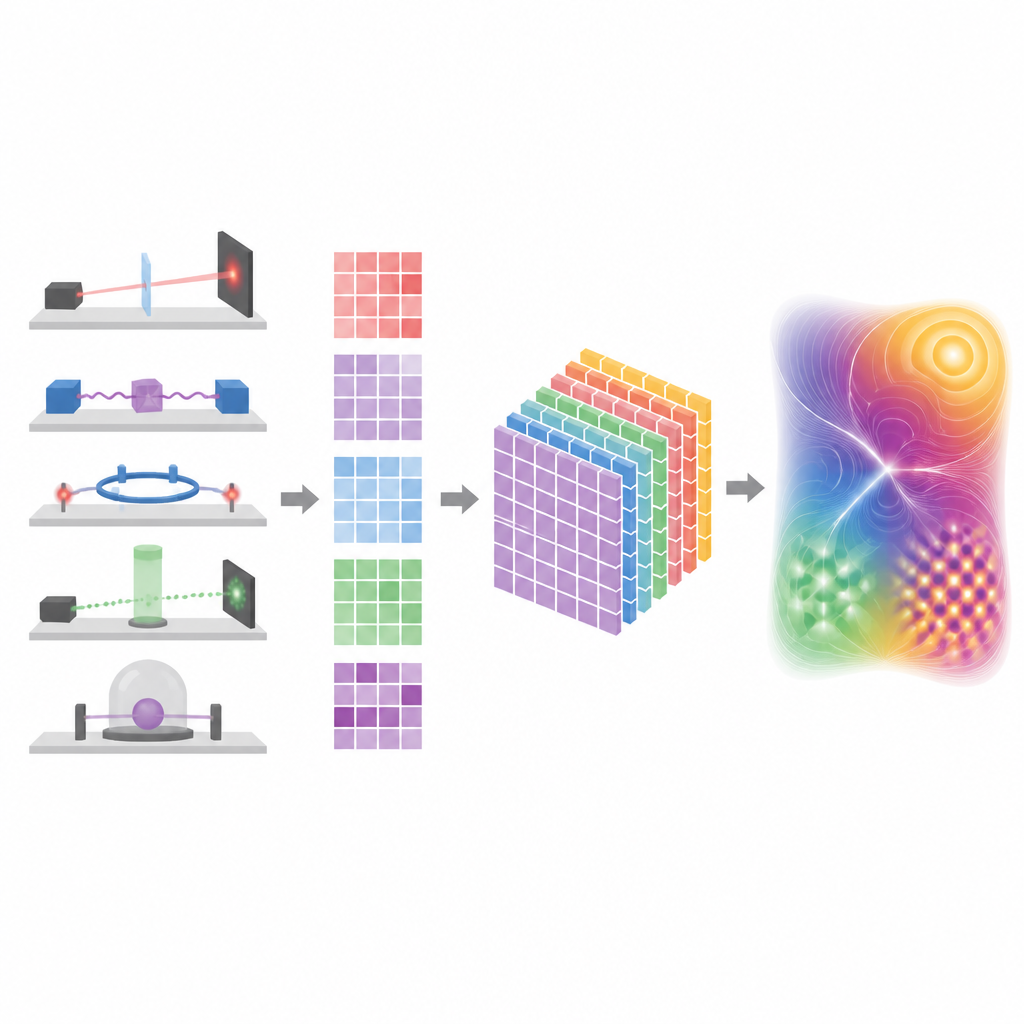
The authors argue that in moving from matrices to vectors, the community quietly discarded a huge amount of meaningful experimental structure. Heisenberg’s original scheme allowed every matrix, of any size, to stand for a concrete measurement set-up with well-defined patterns of intensities between 0 and 1. Dirac’s vector-centered approach kept only a thin slice of these possibilities, the so-called pure states, and reintroduced the rest as “mixed” states interpreted as statistical blends. At the same time, the focus shifted from stable intensity patterns to single yes-or-no outcomes, framed as evidence for microscopic particles. To connect these outcomes with the smooth evolution predicted by Schrödinger’s equation, the standard story brought in an extra rule: during measurement, the evolving state abruptly “collapses.” Such collapses, however, have never been directly observed, and they clash with the otherwise continuous dynamics of the theory.
A different way to connect theory and experience
Instead of adding ever more “interpretations” on top of the standard recipe, the authors follow Heisenberg and Einstein in treating a physical theory as a tight link between mathematics, concepts, and what laboratories actually measure. On this view, experimental data are not raw givens but are always understood through concepts that tell us what counts as the “same” situation under changing conditions. In classical physics, particles and fields play that role. In the quantum case, the authors propose that the primary elements are not particles or single events but “powers of action” with definite intensities. These intensities are quantified by the same mathematical rule that Born originally introduced, but now they express how strongly each power is present, rather than our ignorance about unseen particles. Because intensities are treated as fundamental, they can be assigned consistently across all experimental contexts, avoiding the well-known contextuality puzzles that plague the standard view.
Extending matrices to tensors in the lab
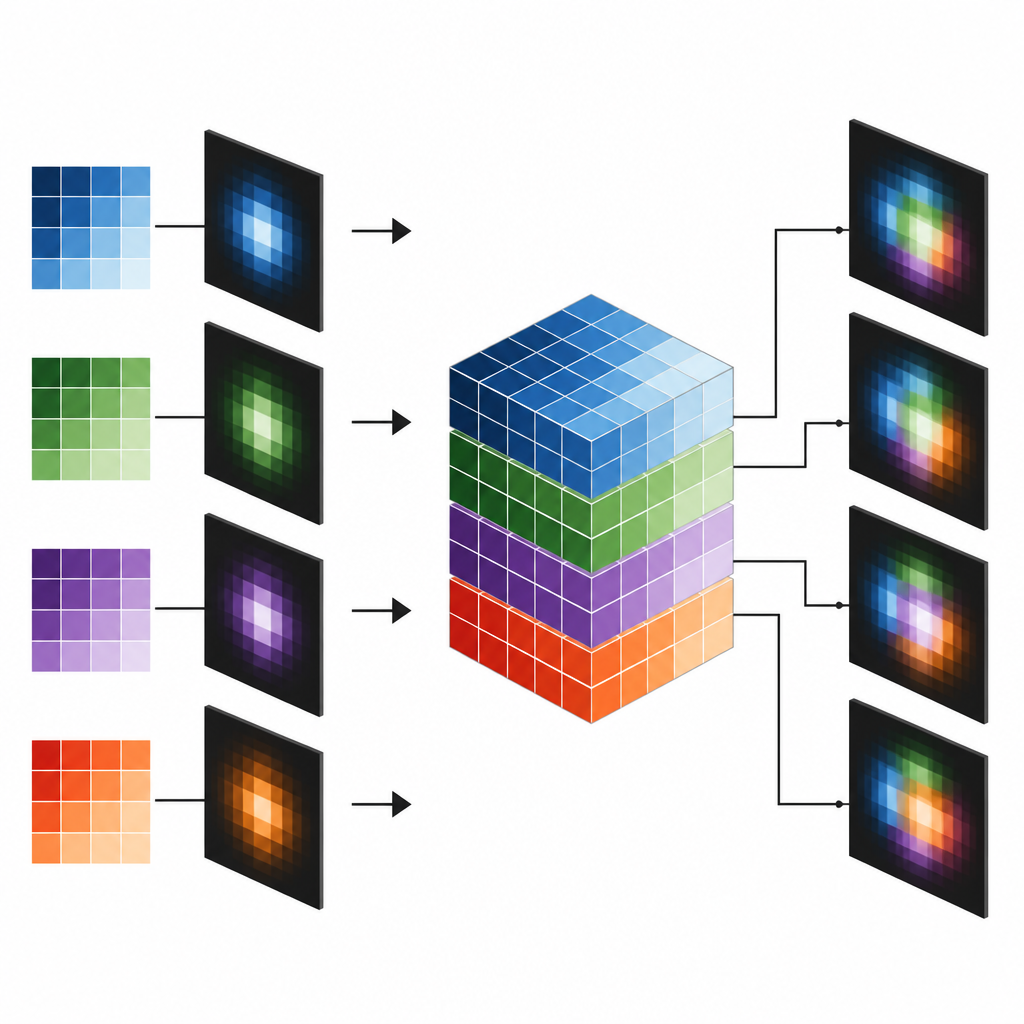
Building on this conceptual shift, the paper generalizes the mathematics from matrices to higher-dimensional objects called tensors. Each tensor encodes an entire experimental arrangement involving many detector screens and many possible joint effects. In this “tensorial quantum mechanics,” a single screen corresponds to the familiar vector description, two screens match the usual matrix language, and any number of screens fit naturally into a single tensorial object. The authors show how changes in detector layouts correspond to changes of mathematical basis, and they prove theorems that guarantee the underlying intensities remain invariant even as the lab set-up is rearranged. This offers a clean way to talk about complex multi-partite entanglement as patterns of correlated powers of action across many screens, rather than as fragile links between drifting particles in space.
What this new picture tells us
In place of the standard image of quantum systems that are sometimes waves, sometimes particles, and that suffer unexplained collapses when we look at them, tensorial quantum mechanics offers a more unified view. Quantum reality is described as a structured web of powers of action, each with a definite intensity that can be probed through carefully designed experiments. By returning to Heisenberg’s emphasis on invariant intensity patterns and extending his matrices to tensors, the authors claim we can recover all the successful predictions of quantum theory while also capturing a wider range of phenomena, especially in multi-partite entanglement experiments. For a lay reader, the key message is that quantum theory need not be a mysterious recipe about particles popping in and out of existence; it can instead be seen as a precise, objective description of how measurable patterns of influence are distributed and related in the microscopic world.
Citation: de Ronde, C., Fernández Mouján, R. & Massri, C. Tensorial quantum mechanics. Sci Rep 16, 15883 (2026). https://doi.org/10.1038/s41598-025-30083-5
Keywords: quantum mechanics, Heisenberg matrix mechanics, tensorial quantum mechanics, quantum entanglement, quantum foundations