Clear Sky Science · en
Flexible and printable thermoelectric films based on FeCl3 doped P3HT
Turning Heat into Power with Plastic-like Films
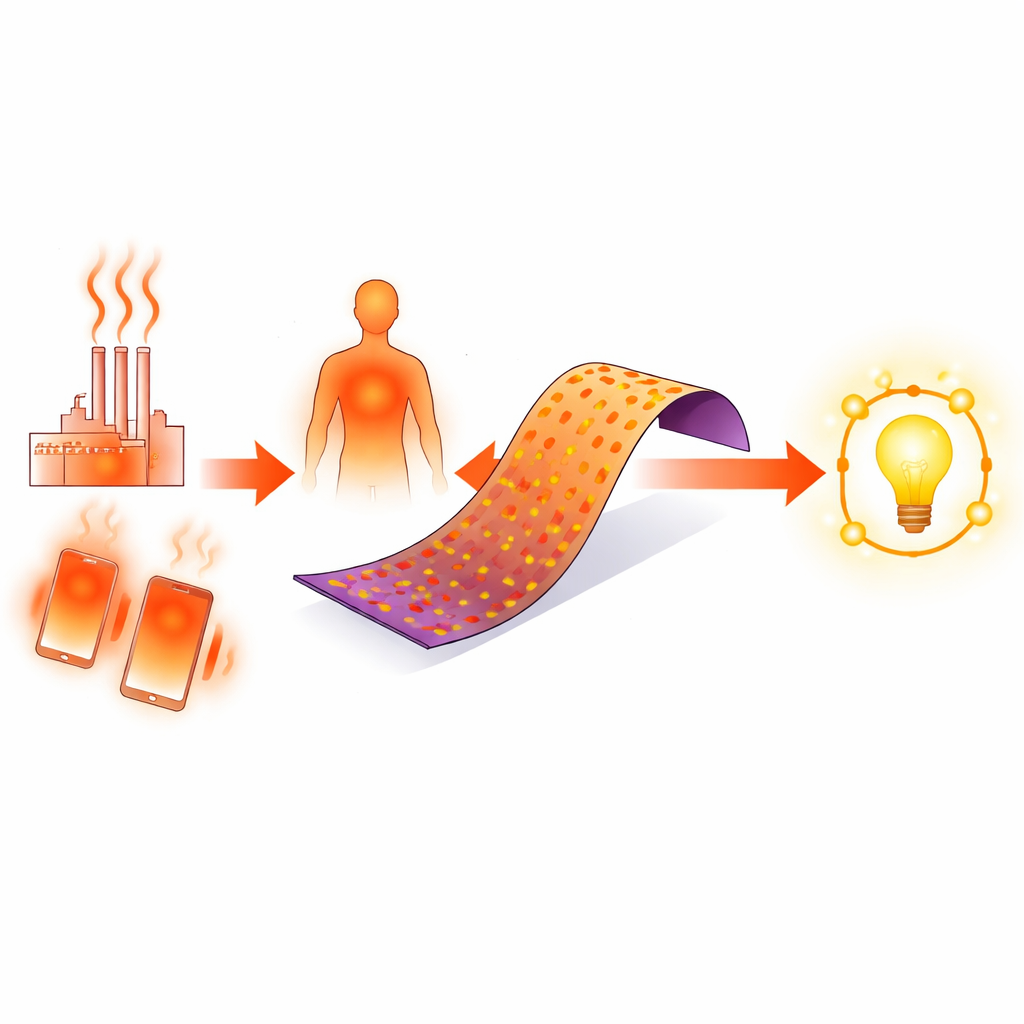
Every day, enormous amounts of heat from car engines, factories, gadgets, and even our own bodies simply drift away into the air. Imagine if some of that warmth could be quietly turned back into electricity using something as simple and flexible as a plastic sheet. This study explores exactly that idea: a bendable, printable film that can harvest waste heat and convert it into usable power, potentially opening the door to low-cost, wearable, and disposable energy harvesters.
Why Waste Heat Is a Missed Energy Opportunity
Thermoelectric materials generate electricity when one side is hotter than the other, acting like solid-state heat engines with no moving parts. Traditional versions are made from brittle, often toxic inorganic crystals that are hard to shape and expensive to process. The researchers instead focus on a well-known “plastic” semiconductor called P3HT, which is already used in flexible electronics. By improving how this soft material moves electrical charges while keeping heat flow low, it could become a smart coating or film that scavenges small amounts of power from temperature differences in everyday environments.
Cooking Up Flexible Power Films
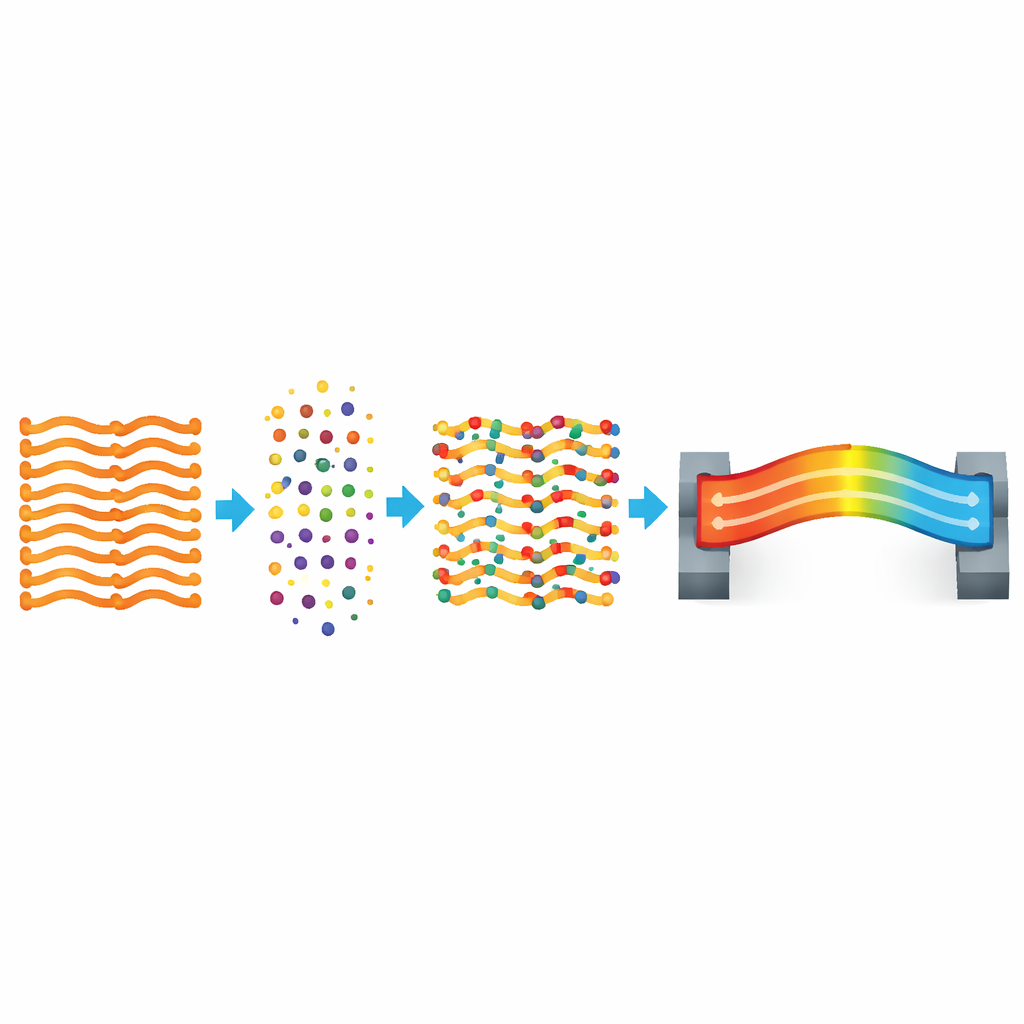
To build these thermoelectric films, the team dissolved P3HT in a solvent and drop-cast it onto a flexible plastic support, creating smooth, thin layers about twelve micrometers thick—roughly one-tenth the width of a human hair. They then dipped these dried films into solutions containing different amounts of an iron salt, FeCl3. This “doping” step, similar in spirit to adding a pinch of salt to change the flavor of a dish, alters how electrons and ions move through the material. As the FeCl3 soaks in, the film’s color changes from golden to shiny black, and once dry, the doped films peel off as free-standing, bendable sheets that can be handled without breaking.
How Doping Rebuilds the Inner Landscape
Under the microscope and in structural tests, the doped films look and behave very differently from the original P3HT. X-ray and vibrational measurements show that the orderly, crystalline packing of the polymer chains becomes more disordered as FeCl3 enters between them, pushing chains apart and creating new electronic states. Surface imaging reveals that smooth films turn into increasingly granular, rough landscapes, with tiny particles growing as the doping level rises. Chemical fingerprinting confirms that iron and chlorine ions are firmly embedded in the polymer, partially oxidizing its backbone and creating mobile charge states known as polarons and bipolarons. Together, these changes rewire the material’s internal pathways for both electronic and ionic motion.
From Quiet Film to Active Power Generator
The most striking effect of this molecular makeover is on the film’s electrical behavior. The undoped P3HT starts off as a very poor conductor, with negligible power output. After doping with a moderate FeCl3 concentration (the sample called P40), its electrical conductivity jumps by more than ten thousand times, while the voltage generated per degree of temperature difference—the Seebeck coefficient—also rises to unusually high values for a polymer. This combination yields a power factor, a key measure of thermoelectric performance, that surpasses many comparable organic materials. When the doping is pushed even higher, performance actually drops, likely because excessive ions and disorder start to block smooth charge flow, showing that there is a clear “sweet spot” in how much dopant the film can beneficially host.
What This Could Mean for Everyday Devices
In simple terms, the study demonstrates that a common organic semiconductor, when carefully doped with an inexpensive iron salt, can be turned into a flexible sheet that converts small temperature differences into electricity far more efficiently than before. The best-performing films remain thin, bendable, and printable, making them promising candidates for large-area coatings on clothing, packaging, or electronics that quietly recycle waste heat. While more work is needed to fine-tune the chemistry and integrate these films into complete devices, the findings show a clear path toward soft, scalable thermoelectric harvesters built from materials closer to plastics than to traditional rigid crystals.
Citation: Rathi, V., Sathwane, M., Singh, K. et al. Flexible and printable thermoelectric films based on FeCl3 doped P3HT. Sci Rep 16, 9570 (2026). https://doi.org/10.1038/s41598-025-22821-6
Keywords: thermoelectric polymers, flexible electronics, waste heat harvesting, conductive plastics, energy harvesting films