Clear Sky Science · en
Strength estimation of damaged wood by Xylotrechus arvicola Olivier in grapevine branches in relation to the density
Why vine breakage matters to wine lovers
Behind every glass of wine stands a vineyard full of woody trunks and branches that must survive decades of wind, rain and the heavy weight of ripening grapes. In northern Spain, a wood-boring beetle called Xylotrechus arvicola is silently tunneling through grapevine branches, weakening them until they crack and snap. This study asks a practical question with big economic stakes: how much does this insect hollow out the wood, and how badly does that damage the strength of vines that support grape crops year after year?
A hidden pest inside the vine
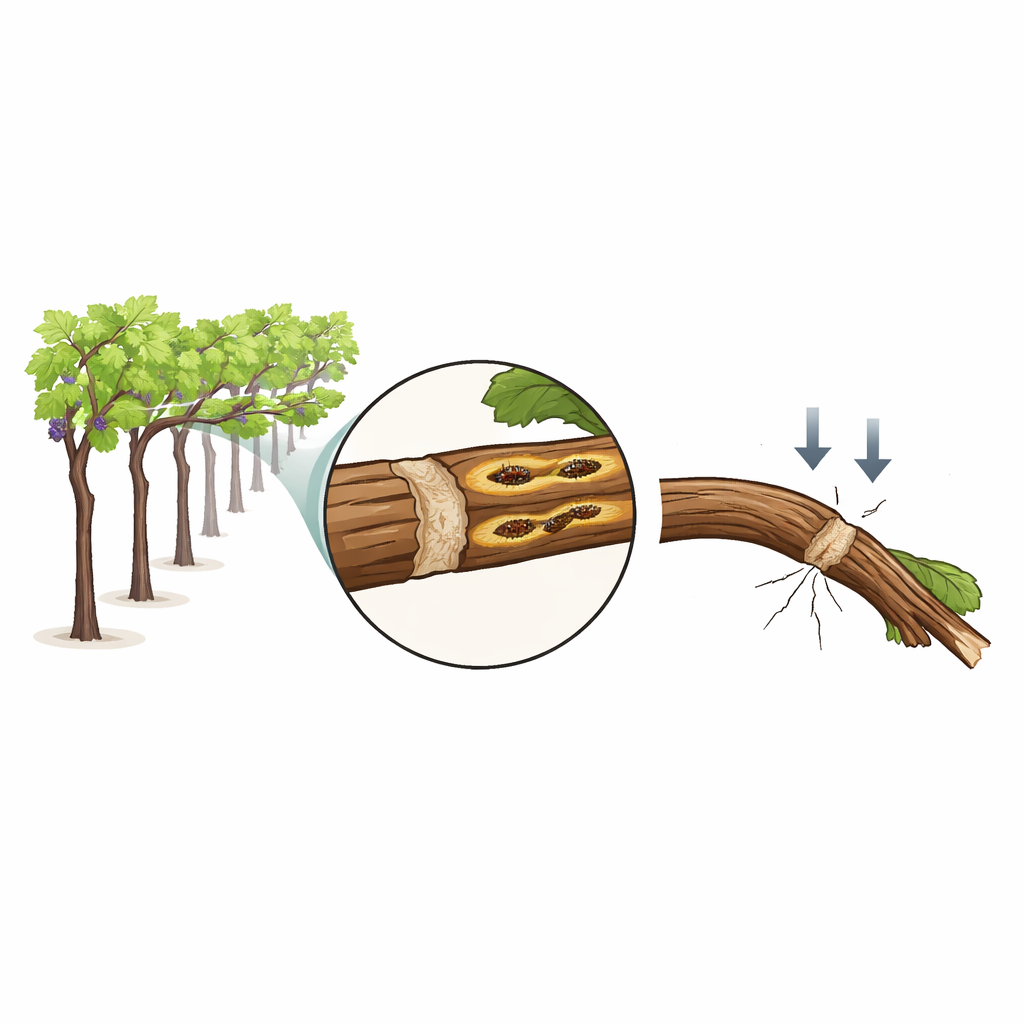
Growers in some of Spain’s main wine regions have long noticed broken branches and declining vines in the “Prieto Picudo” grape variety. The culprit is the larval stage of Xylotrechus arvicola, a longhorn beetle whose grubs live inside the wood for up to two years. As they feed, the larvae carve galleries through the grapevine branches, directly eating the tissues that transport sap and indirectly inviting wood-rotting fungi in through their exit holes. Over time, the affected sections become drier, lighter and structurally weaker, setting the stage for sudden breakage under wind, machinery vibration or the static load of grape clusters.
Testing how solid the wood really is
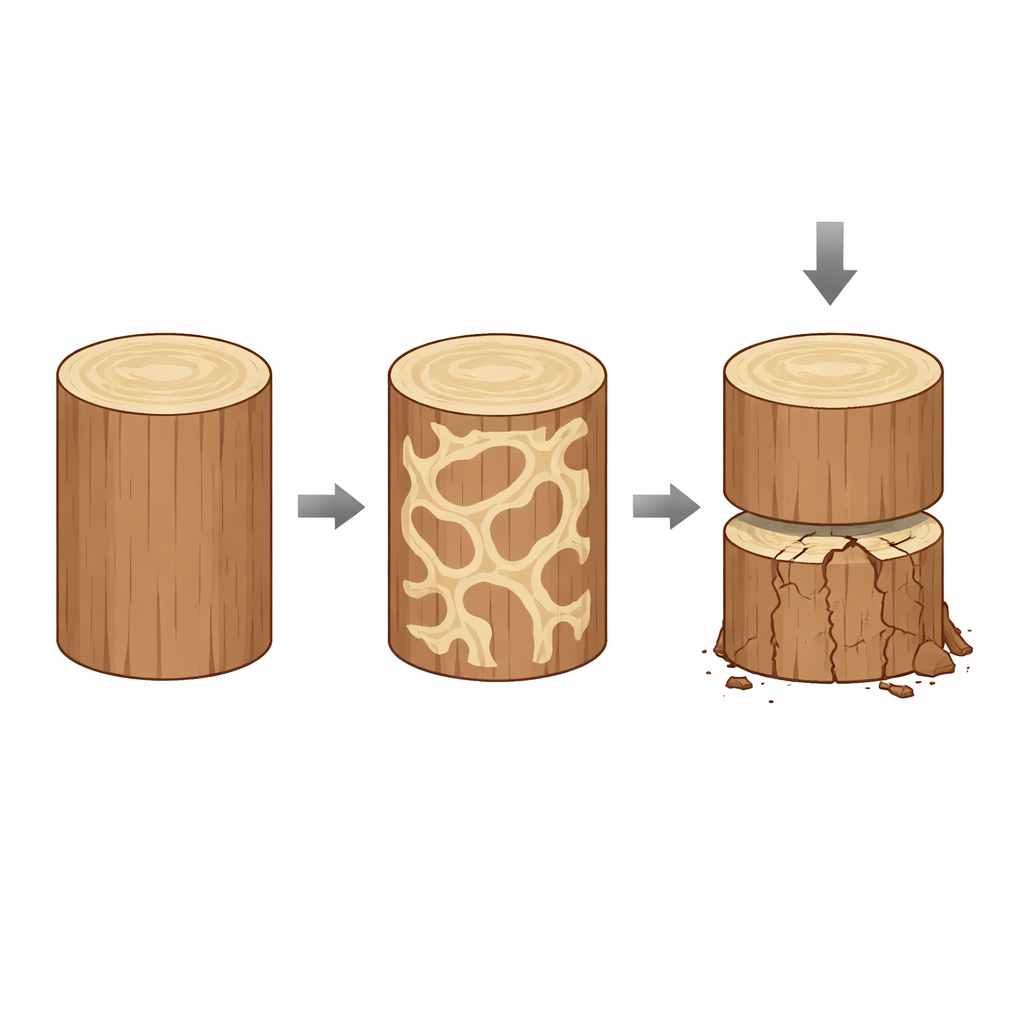
To move beyond field impressions and broken-branch counts, the researchers collected branches from a commercial vineyard in León, Spain, where vines had been attacked for many years. They cut small, standardized blocks of wood both from apparently healthy branches and from branches showing signs of beetle damage. Some samples were tested fresh, mimicking natural field moisture (“unconditioned”), while others were dried in an oven (“conditioned”). For each piece, they measured density—effectively how much wood substance is packed into a given volume—and then compressed the samples along the grain in a hydraulic press until they failed. This approach allowed them to link how dense the wood was to how much load it could bear before crushing or cracking.
Hollowed wood is lighter and weaker
The comparisons were stark. Undamaged wood consistently had higher density than damaged wood: about 20 percent higher in dried samples and roughly one-third higher in fresh, field-like samples. The lower density in damaged wood reflects both the empty tunnels left by larvae and the loss of structural tissue to decay. In both damaged and undamaged pieces, compressive strength rose with density—the denser the wood, the more load it could withstand. Yet at the same density, damaged wood still tended to be weaker, showing that changes in internal structure, not just lost mass, undermine its strength. Interestingly, healthy wood was strongest in its natural moist state, while damaged wood performed slightly better when dried, underlining how moisture and damage interact in complex ways.
How the branches give way
When the samples finally failed under the press, most of them did so in much the same way: by cracking along the direction of the wood fibers. This cracking mode dominated in both damaged and undamaged samples, whether they were fresh or dried, and other failure types such as shear or crushing were far less common. That means the beetle does not change how the wood breaks so much as how easily it does so. The galleries, degraded cell walls and altered moisture behavior together reduce the effective load-bearing area, concentrate stresses and hasten the moment when long cracks race through the branch.
What this means for vineyards
For growers of the “Prieto Picudo” variety, the message is clear: branches with lowered density due to Xylotrechus arvicola attack are more prone to structural failure under real vineyard conditions. Because density and strength track together, branches that feel lighter or show external beetle symptoms are mechanically compromised, even if they still look serviceable. The authors suggest that careful monitoring of wood condition and a pruning strategy that selectively removes low-density, damaged branches could help maintain vine stability and extend vineyard life. Although the study was limited to one grape variety and a modest number of samples, it demonstrates that a small beetle can significantly alter the physical backbone of grapevines, reminding us that the quality and reliability of wine production depend as much on unseen wood mechanics as on sun, soil and grape chemistry.
Citation: Antolín-Rodríguez, A., Zanfaño, L., Ramírez-Lozano, D. et al. Strength estimation of damaged wood by Xylotrechus arvicola Olivier in grapevine branches in relation to the density. Sci Rep 16, 9571 (2026). https://doi.org/10.1038/s41598-025-20934-6
Keywords: grapevine wood, longhorn beetle, vineyard mechanics, wood density, branch breakage