Clear Sky Science · en
Shear strength of light weight concrete elements model based on deep neural network and COVID-19 optimization
Why lighter concrete and smart math matter
Buildings and bridges are getting taller, longer, and more efficient, and engineers are looking for materials that are strong yet light. Lightweight concrete helps cut the weight of structures and improve insulation, but predicting how it will crack and fail under certain kinds of forces is tricky. This study shows how a modern form of artificial intelligence, combined with an algorithm inspired by the spread of COVID-19, can predict one key property of lightweight concrete more accurately than current design rules, potentially leading to safer and more efficient structures.

The challenge of keeping concrete from tearing
When a concrete beam in a building or bridge carries loads, it can fail in different ways. One of the most sudden and hard-to-predict modes is called shear, where diagonal cracks form and slice through the beam. Traditional design formulas used in major building codes around the world are deliberately conservative, but they often disagree with each other and can misjudge how real beams behave. The problem becomes even tougher with lightweight concrete, whose lower weight and different aggregates change how cracks form and how forces travel through the material, weakening certain internal mechanisms that normally help resist shear.
How a deep learning model reads structural behavior
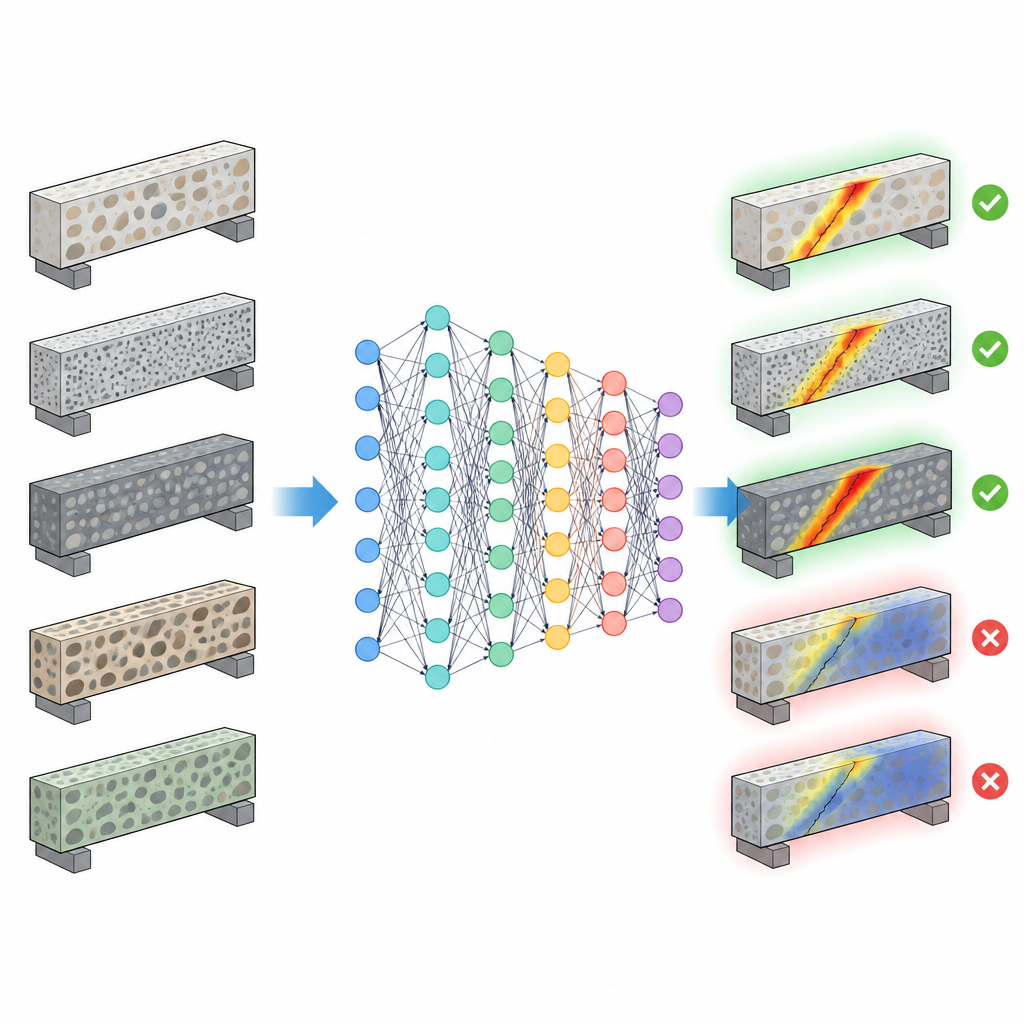
To tackle this, the authors built a deep neural network, a kind of AI model made of many layers of simple processing units that detect patterns in data. They trained this network on experimental results from lightweight concrete beams, feeding it geometric details, material strengths, steel reinforcement properties, and how the load is applied. Instead of starting from random settings, they tuned the network’s initial internal parameters using a special search strategy nicknamed the COVID-19 optimization algorithm, which borrows ideas from how an infection spreads, dies out, or is contained. This smarter starting point helps the network learn faster and avoid getting stuck in poor solutions.
Testing against real beams and design rules
The researchers then put their model to the test by comparing its predictions with actual laboratory measurements and with three widely used design codes from the United States, Europe, and Japan. They paid special attention to data regions where behavior becomes highly nonlinear, meaning small changes in inputs can produce large and irregular jumps in shear strength. In exactly these challenging zones, the deep network tracked the test results much more closely than the code equations, which tended to drift away. Measured over the entire dataset, the new model produced the lowest average error and the tightest match between predicted and observed strengths, while still performing well under repeated cross-checks that guard against overfitting.
What the model reveals about key ingredients
Beyond simply predicting numbers, the authors used their trained network to probe which beam and material properties matter most. The analysis highlighted the effective depth of the beam, the compressive strength of the concrete, its unit weight, and the beam width as the strongest drivers of shear capacity in lightweight concrete. In contrast, some factors often assumed to be important, such as aggregate size and the amount of flexural steel, showed surprisingly low influence in this dataset, raising questions for future experiments and suggesting that designers may want to focus more closely on a narrower group of parameters when refining rules for lightweight mixes.
What this means for future structures
For non-specialists, the main takeaway is that a carefully trained deep learning model can act like a skilled interpreter between laboratory tests and everyday design practice. In this study, the COVID-19 optimized network did a better job than existing code formulas at estimating how lightweight concrete beams resist tearing forces, especially in difficult cases where behavior is far from simple. While engineers will still rely on codes for regulatory approval, tools like this model could help them spot overly conservative or potentially unsafe designs and move toward lighter, more efficient structures that make smarter use of materials.
Citation: Shamseldin, M.A., Deifalla, A.F., Kontoni, DP.N. et al. Shear strength of light weight concrete elements model based on deep neural network and COVID-19 optimization. Sci Rep 16, 15513 (2026). https://doi.org/10.1038/s41598-025-20538-0
Keywords: lightweight concrete, shear strength, deep neural network, structural engineering, optimization algorithm