Clear Sky Science · en
Study of half-metallic ferromagnet RhHfVGa for spintronic and thermoelectric applications
New materials for cooler gadgets and greener power
Modern electronics face two big challenges: packing more information into smaller spaces without overheating, and finding new ways to harvest wasted heat as useful electricity. This study looks at a newly designed metal alloy called RhHfVGa and asks a simple question with big consequences: can one single material both move digital information more efficiently and turn heat into power? Using advanced computer simulations, the authors show that this alloy has a rare combination of magnetic and heat-to-electricity properties that could make future gadgets faster, cooler, and more energy efficient.
A specially ordered metal mix
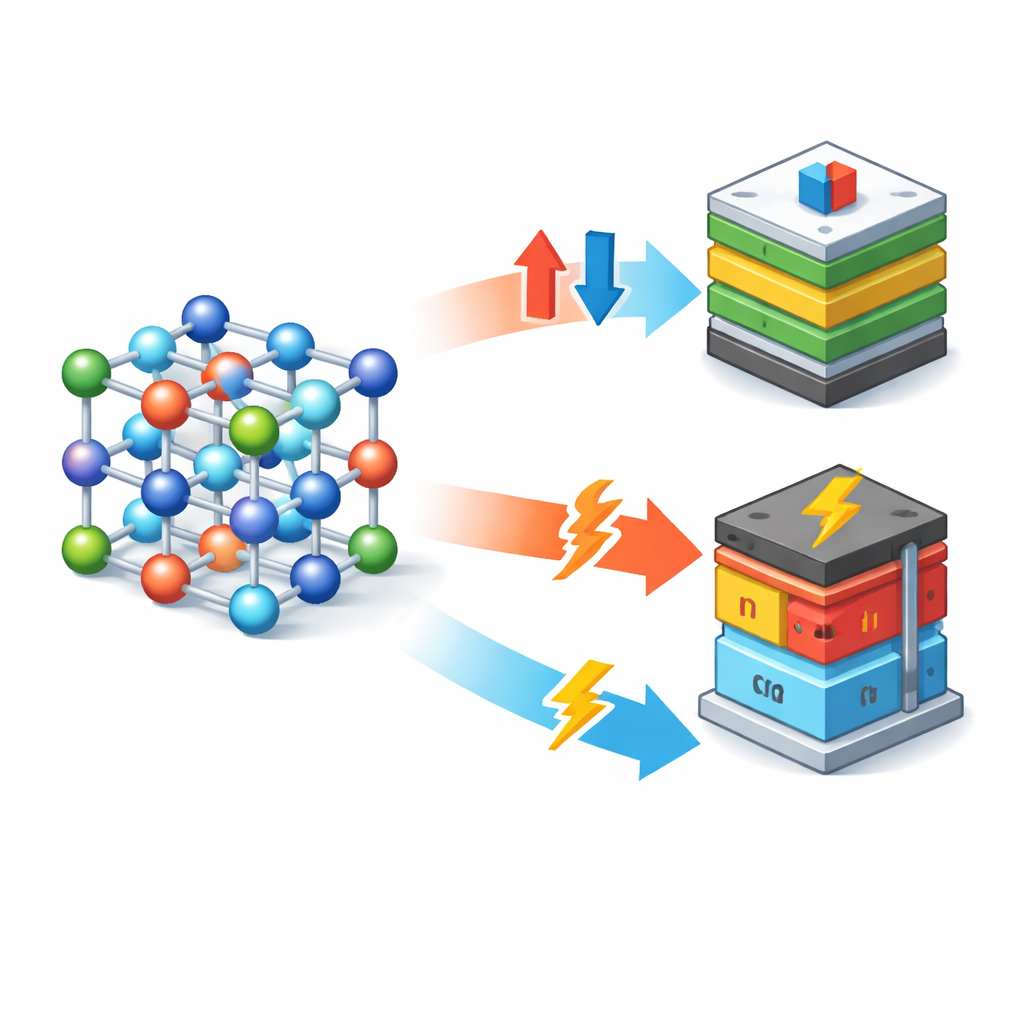
RhHfVGa belongs to a family of materials known as Heusler alloys, which are built by arranging four different elements in a very precise three‑dimensional pattern. The researchers first checked whether this new combination of rhodium (Rh), hafnium (Hf), vanadium (V), and gallium (Ga) would be stable in the real world. Their calculations show that the atoms naturally settle into an orderly, repeating structure and that forming the crystal actually releases energy rather than consuming it. This means the alloy should be both chemically stable and, in principle, synthesizable in the laboratory under normal conditions. The crystal also prefers a magnetically ordered state, where the tiny magnetic needles associated with electrons line up in the same direction.
Acting like a metal and an insulator at the same time
The most striking feature of RhHfVGa is how it handles electrons with different “spin” directions. In ordinary metals, electrons of all spins flow more or less equally. In this alloy, detailed calculations reveal a split personality: for one spin direction it behaves like a good metal, while for the opposite spin it behaves like a semiconductor with a clear energy gap. This kind of behavior, called half‑metallicity, leads to nearly 100% spin‑polarized current—essentially a pure stream of one spin type. The team confirms that this arises from how the d‑orbitals of rhodium, hafnium, and vanadium overlap and form bonding and non‑bonding states. The total magnetic moment they find fits a simple counting rule known in this family of materials, adding confidence that the predicted electronic structure is robust.
Magnetism that survives extreme heat
Spin‑based electronics, or spintronics, can use electron spin to store and process information more efficiently than traditional charge‑based circuits. For such devices to work in real products, their magnetic order must persist far above room temperature. By comparing the energy of different magnetic arrangements, the authors estimate a Curie temperature of about 1060 K for RhHfVGa—well over 700 °C. This suggests that the material would keep its magnetic character even under harsh operating conditions. The calculations also show that most of the magnetism comes from the vanadium atoms, with small reinforcing or opposing contributions from the other elements. Together with the 100% spin polarization, this makes RhHfVGa an appealing candidate for magnetic memory elements and spin‑selective contacts in advanced electronics.
Turning waste heat into useful electricity
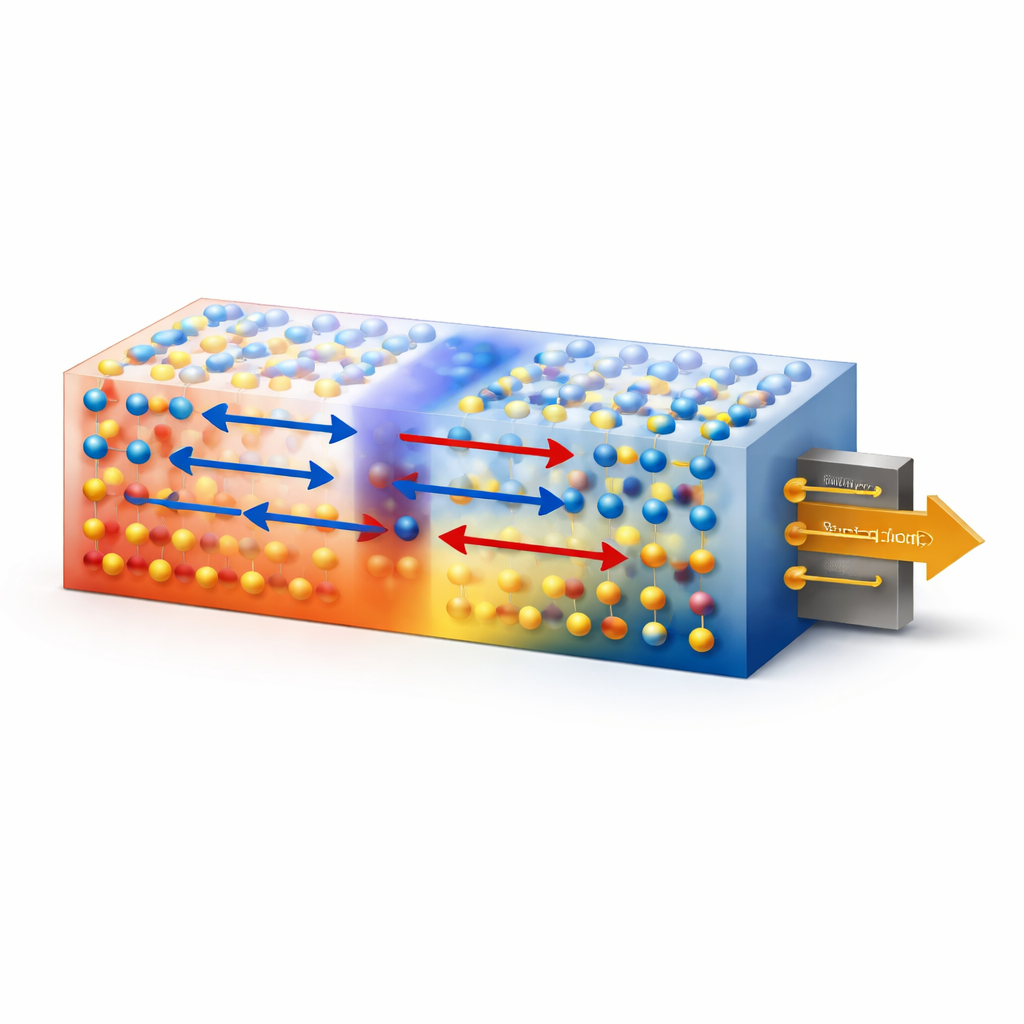
Beyond its magnetic tricks, RhHfVGa also shows promise as a thermoelectric material—one that can turn a temperature difference directly into electrical power. The researchers used a standard transport model to predict how voltage, electrical current, and heat flow change with temperature. They find that the alloy prefers to carry negatively charged carriers (n‑type behavior), and that its electrical conductivity increases strongly with temperature as more carriers are activated across its modest energy gap of roughly 1 to 1.3 electronvolts. The heat capacity and related thermal quantities behave in line with well‑tested models of solids, supporting the reliability of the calculations. Most importantly, the computed dimensionless efficiency measure, ZT, lies between about 0.82 and 1.65 over a broad temperature range—values that place RhHfVGa in the same league as several established thermoelectric materials.
Why this material matters
In simple terms, RhHfVGa is predicted to be both an excellent spin filter and a respectable heat‑to‑electricity converter, while remaining stable and strongly magnetic at high temperatures. This unusual blend of traits means the same material could, in principle, help build faster, low‑power memory or logic devices and also recycle their waste heat back into useful energy. Although these results are based purely on theory and still need experimental confirmation, they provide a roadmap for chemists and engineers seeking multifunctional alloys that support greener, more efficient electronics and energy technologies.
Citation: Zineb, H., Fatima, B., Fatiha, B. et al. Study of half-metallic ferromagnet RhHfVGa for spintronic and thermoelectric applications. Sci Rep 16, 9567 (2026). https://doi.org/10.1038/s41598-025-18539-0
Keywords: spintronics, thermoelectric materials, Heusler alloys, half-metallic ferromagnets, energy harvesting