Clear Sky Science · en
A hybrid experimental-numerical framework for prestressed concrete bridge model validation and sensor placement optimization: a case study
Why smart sensing on bridges matters
Most of us cross bridges every day without thinking about how they stay safe. Yet traffic, wind, and age slowly change how a bridge moves and vibrates. Engineers now use small motion sensors and computer models to listen to these vibrations and spot trouble early. This study explains how the layout of those sensors on a real concrete bridge can make the difference between a blurred picture and a sharp one, and shows a practical way to choose where sensors should go.
Listening to a working bridge
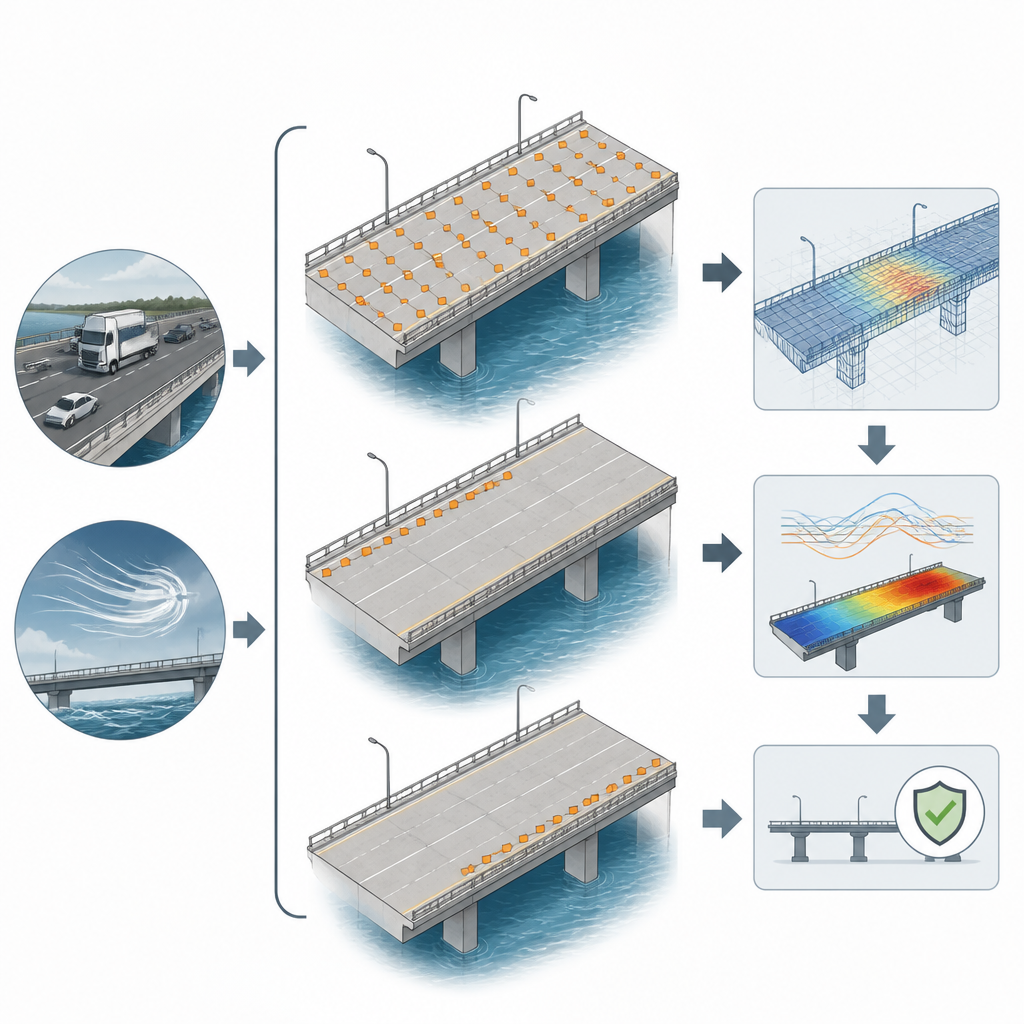
The researchers focused on a busy road bridge in Sydney built from prestressed concrete beams and a reinforced concrete deck. Rather than closing the bridge or applying special test loads, they used normal traffic as a natural source of vibration. Ten small devices that measure acceleration were attached to the road surface and recorded tiny up and down, side to side, and lengthwise motions while cars and trucks passed. From these recordings the team extracted the bridge’s natural vibration patterns, which act like a fingerprint of its structural health.
Three ways to spread the sensors
To see how sensor layout affects what engineers can learn, the team tested three arrangements. One spread sensors across almost the full width of the deck, giving broad coverage from side to side. The other two used the same number of sensors but concentrated them on only one half of the bridge at a time, pairing one edge with the middle strip. These “half width” layouts reflect real-world limits such as cost, lane closures, and difficult access, where it may not be practical to blanket the entire bridge with instruments.
What the vibrations revealed
The recorded signals were converted from time histories into frequency curves that show the main tones at which the bridge likes to vibrate. For all three layouts, the first few tones lined up closely, and the overall vertical bending of the span looked similar. However, when the researchers compared detailed vibration shapes from the field with those from a finely built computer model of the bridge, clear differences emerged. The half width layouts matched the model better for both low and higher vibration patterns, with agreement above 90 percent in many cases. The full width layout captured the broad behaviour of the bridge but blurred some finer details and higher modes because the sensors were spaced farther apart across the deck.
Using data science to choose sensor spots
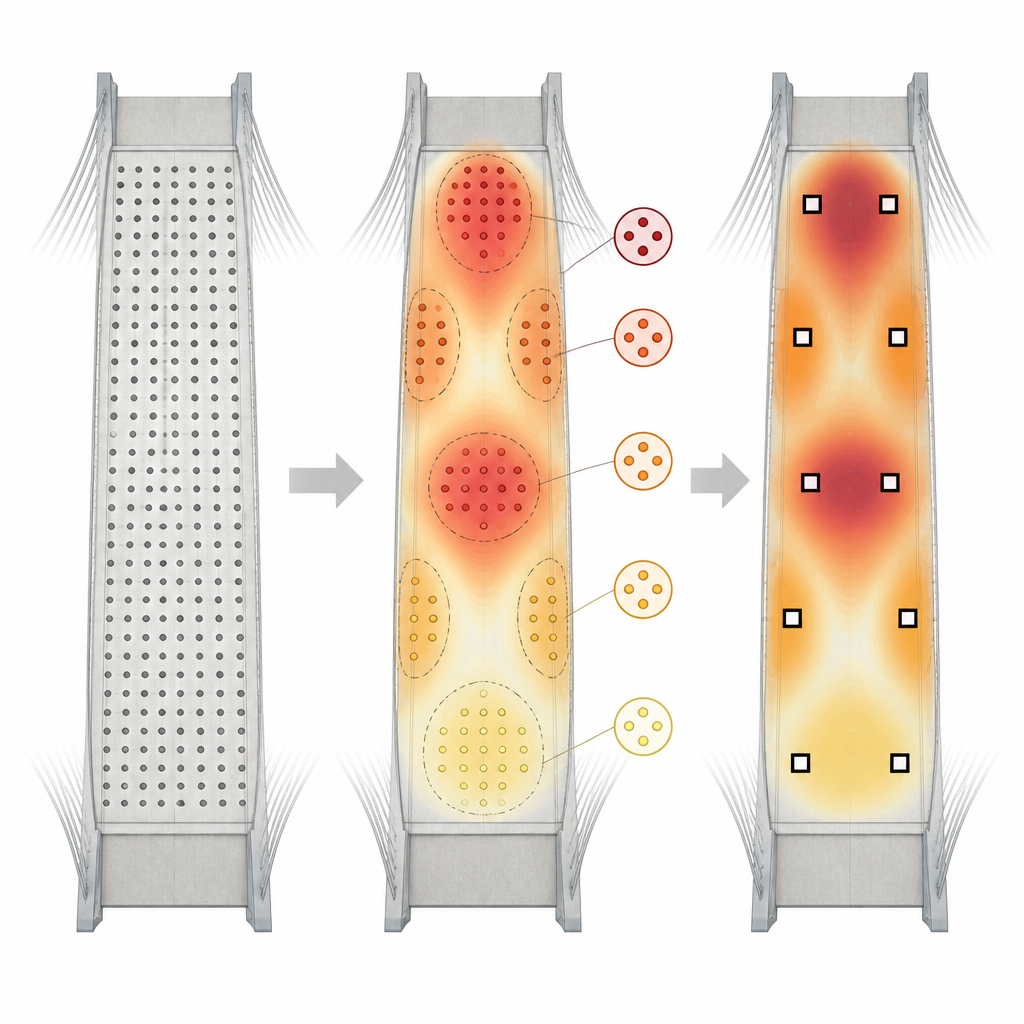
Beyond the three test layouts, the team explored how to design an even smarter sensor plan. They started from a detailed digital model of the deck, which contains thousands of points where the structure might move or carry stress. Using a clustering method called k median, they grouped these points and chose sensor locations that kept each group close to at least one sensor. They then added a twist: points that experienced larger stress changes in the main vibration shapes were given more weight. This stress based version pulled sensors toward regions that matter most for safety, such as areas where loads concentrate. A simple search method checked if small shifts of sensor positions could further improve coverage, but the clustering already came close to the best solution.
What this means for everyday bridges
For this concrete bridge, the study shows that sensor placement strongly shapes how clearly engineers can see its dynamic behaviour. If the goal is to understand the overall condition of the whole span, a full width sensor layout still has advantages because it covers more of the structure at once. If the main concern is how heavy traffic affects particular lanes or high stress zones, concentrating sensors on part of the deck can actually give cleaner information and better agreement with computer models. The hybrid framework tested here, which blends field measurements, digital models, and data driven sensor planning, offers a practical path to safer, more efficient monitoring of many everyday bridges.
Citation: Jayasinghe, S.C., Mahmoodian, M., Alavi, A. et al. A hybrid experimental-numerical framework for prestressed concrete bridge model validation and sensor placement optimization: a case study. Sci Rep 16, 15800 (2026). https://doi.org/10.1038/s41598-025-18215-3
Keywords: bridge monitoring, sensor placement, vibration analysis, finite element model, structural health