Clear Sky Science · en
Decentralized federated deep Q-learning for IoMT security: leveraging MK-VQFHE and blockchain with IPFS
Why safer connected medical devices matter
From fitness trackers to intensive‑care monitors, more and more medical devices are online and constantly streaming data. This "Internet of Medical Things" promises faster diagnoses and better care, but it also opens the door to hackers who could tamper with records or disrupt life‑critical equipment. This paper explores a new way to let hospitals learn from huge amounts of patient data while keeping that data locked away from prying eyes—and even from the computers that analyze it.
The problem with today’s smart hospitals
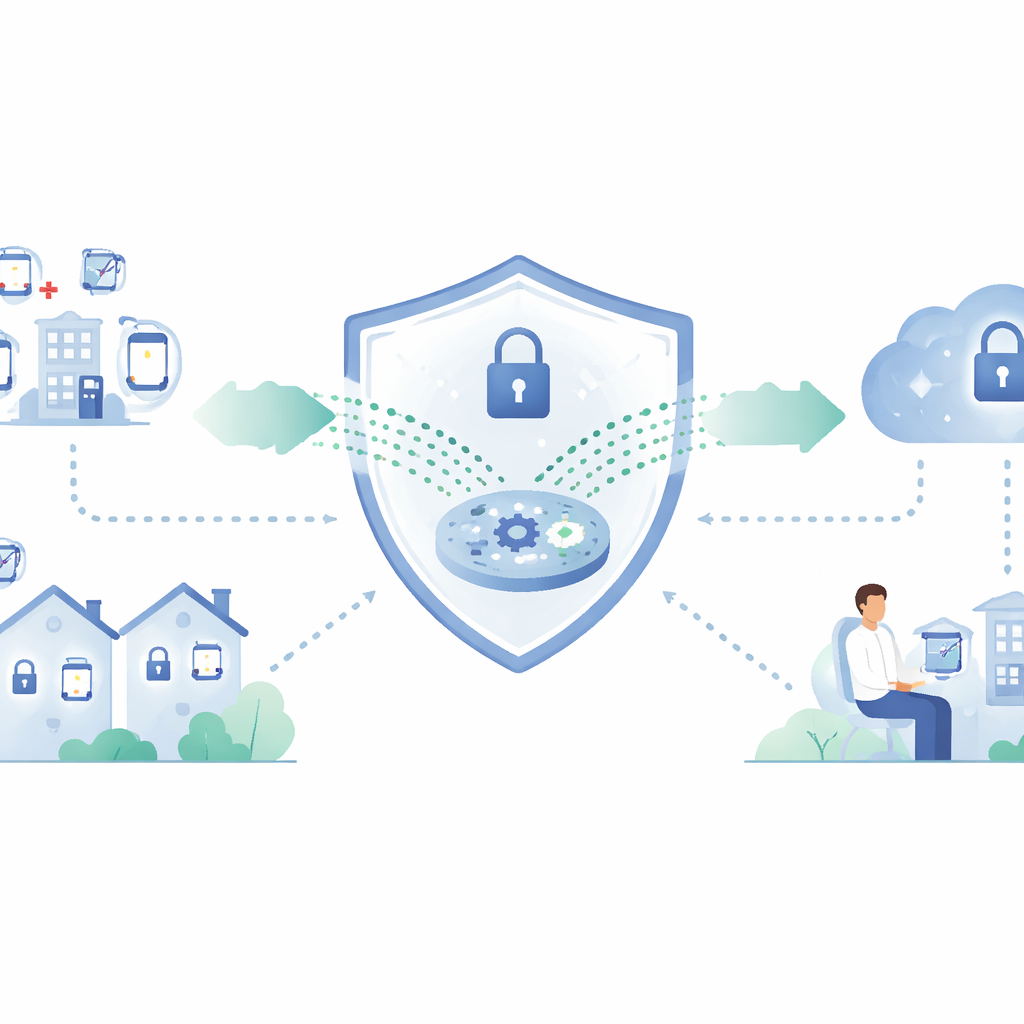
Modern medical sensors and hospital systems generate what computer scientists call big data: vast, fast, and varied information that can be mined for early signs of disease or cyber‑attacks. Traditionally, all of this data is shipped to a central cloud server, where machine‑learning models are trained. That central point becomes a tempting target. Attackers can eavesdrop, steal or alter records, or overload the server. Even privacy rules such as HIPAA and GDPR struggle to keep pace when raw patient data is routinely copied and moved across networks. Earlier attempts to fix this with advanced learning and blockchain tools helped, but they often relied on a single coordinating server, used plain (unencrypted) data, or could not prove that remote computations were done correctly.
Learning from data without seeing it
The authors propose a framework that combines several ideas into one end‑to‑end secure pipeline. First, hospitals and testbeds supply network and patient‑related data from three public sources of medical‑IoT traffic. Before any analysis, each site encrypts its data using a scheme called Multi‑Key Verifiable Quaternion Fully Homomorphic Encryption. While the name is technical, the core idea is simple: data is locked in such a way that remote servers can still perform calculations on it, yet never see the underlying values. Multiple keys allow many parties to contribute data, and built‑in checks let them verify that the server’s encrypted answers are honest, all without exposing the secrets.
Sharing intelligence without sharing records
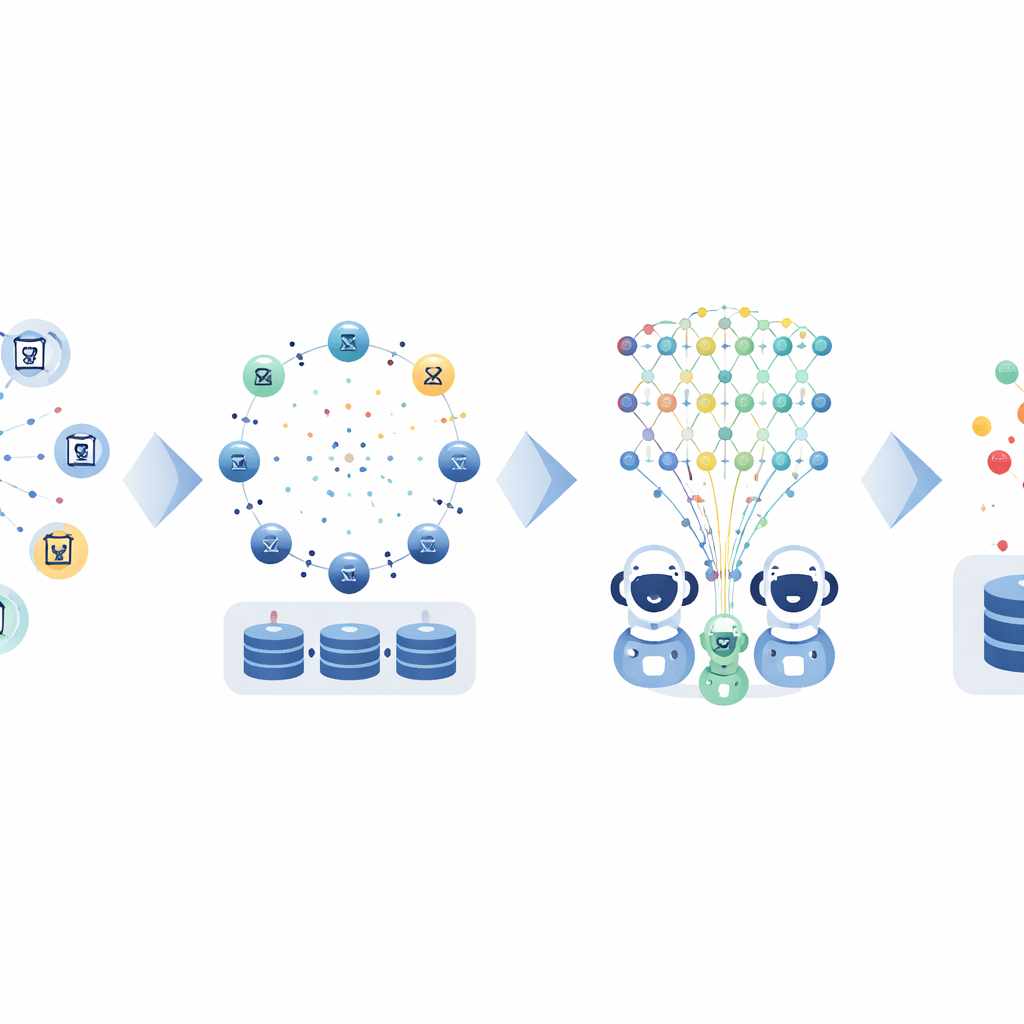
On top of this encryption, the system uses a style of collaborative training called federated learning. Instead of sending patient records to a central location, each participating device or gateway trains a local model on its own encrypted data and transmits only model updates. The authors extend this idea with a multi‑agent deep Q‑learning setup tailored to spotting network threats. Two learning "agents" observe patterns in device traffic and learn, through trial and reward, which behaviors look normal and which resemble attacks. A reward function balances two goals: catching more intrusions and keeping communication overhead low, both crucial for resource‑constrained medical devices.
Making the ledger tamper‑proof and scalable
To coordinate many dispersed learners without trusting any single server, the framework turns to blockchain technology. Model updates and references to stored data are written to a distributed ledger so that no participant can secretly rewrite history. Large encrypted files themselves are kept off‑chain in the InterPlanetary File System, a peer‑to‑peer storage layer that identifies files by their content rather than by a fixed location. Only compact content identifiers are stored on the blockchain, easing storage demands while still guaranteeing integrity. A consensus protocol known as Practical Byzantine Fault Tolerance lets the network agree on valid updates even if some nodes are faulty or malicious, and does so with lower delay and higher throughput than a widely used alternative tested by the authors.
How well does the approach work?
The researchers evaluate their system on three different medical‑IoT security datasets that include both normal behavior and a variety of attack types. Across all of them, their method detects intrusions with accuracies between about 99.2% and 99.4%, slightly outperforming several popular deep‑learning baselines, such as convolutional and recurrent neural networks, which fall below 99%. At the same time, the proposed encryption scheme encrypts and decrypts faster than standard public‑key methods like RSA and other homomorphic tools used for comparison. The blockchain layer, when combined with IPFS, adds only a modest delay per learning round while providing strong guarantees that model updates and stored records have not been tampered with.
What this means for patients and providers
In everyday terms, this work shows that it is possible for hospitals and device makers to pool their experience of cyber‑attacks and unusual behavior, train powerful detection systems, and still keep raw patient data sealed and under local control. By proving that encrypted computations are correct, spreading trust across many nodes, and filtering out malicious traffic with high accuracy, the proposed framework moves connected healthcare a step closer to being both smart and safe. While further real‑world testing and simplification are needed before such systems become routine, the study outlines a practical path toward learning from sensitive medical data without ever truly revealing it.
Citation: ChandraUmakantham, O., Ravi, K., Marappan, S. et al. Decentralized federated deep Q-learning for IoMT security: leveraging MK-VQFHE and blockchain with IPFS. Sci Rep 16, 13896 (2026). https://doi.org/10.1038/s41598-025-13519-w
Keywords: Internet of Medical Things, federated learning, healthcare cybersecurity, blockchain, privacy-preserving AI