Clear Sky Science · en
Multimodal data on bipedal locomotion during prolonged treadmill recordings at varying speeds
Why studying walking and running matters
Every step you take reflects a complex dance between muscles, joints, and the ground beneath your feet. Understanding this dance helps scientists design better sports gear, safer rehab programs, and smarter wearables. This article presents a rich open dataset of people walking, hiking, and running on a treadmill while covered in sensors, giving researchers a detailed view of how the body moves and how forces act on it over long periods of time.
How the treadmill lab was set up
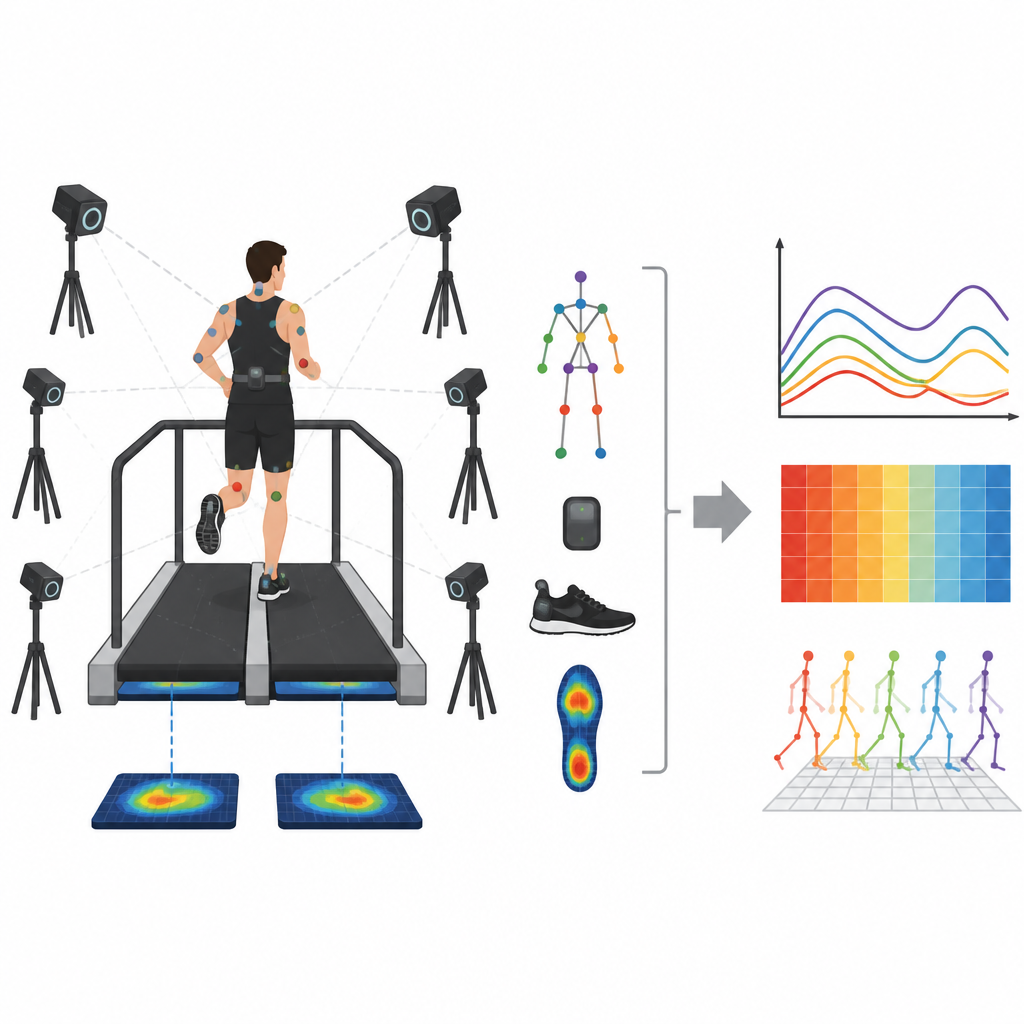
To capture natural yet carefully controlled movement, the team invited 18 healthy adults into a high tech gait laboratory. Participants wore tight sports clothing, their own neutral running shoes, and a safety harness over a dual belt treadmill. Under the insoles of each shoe, special pressure sensing inserts measured how hard different parts of the foot pressed on the ground. Small motion sensors were taped to each shoe and to the lower back, while 43 reflective markers were attached to key points on the body so that an array of infrared cameras could track full body motion in three dimensions.
What the volunteers actually did
Each person completed three treadmill sessions that together lasted about 40 minutes. The treadmill speeds were carefully controlled to cover comfortable walking, brisk hiking like you might do on a trail, and running at two faster levels. Sessions mixed active periods and short rests, starting with a warm up and ending with a cool down. Most participants also ran at the highest speed tested. This mix created long, continuous recordings with many changes in speed, which is closer to how people move outside the lab than simple short straight walks.
Many sensors, one shared timeline
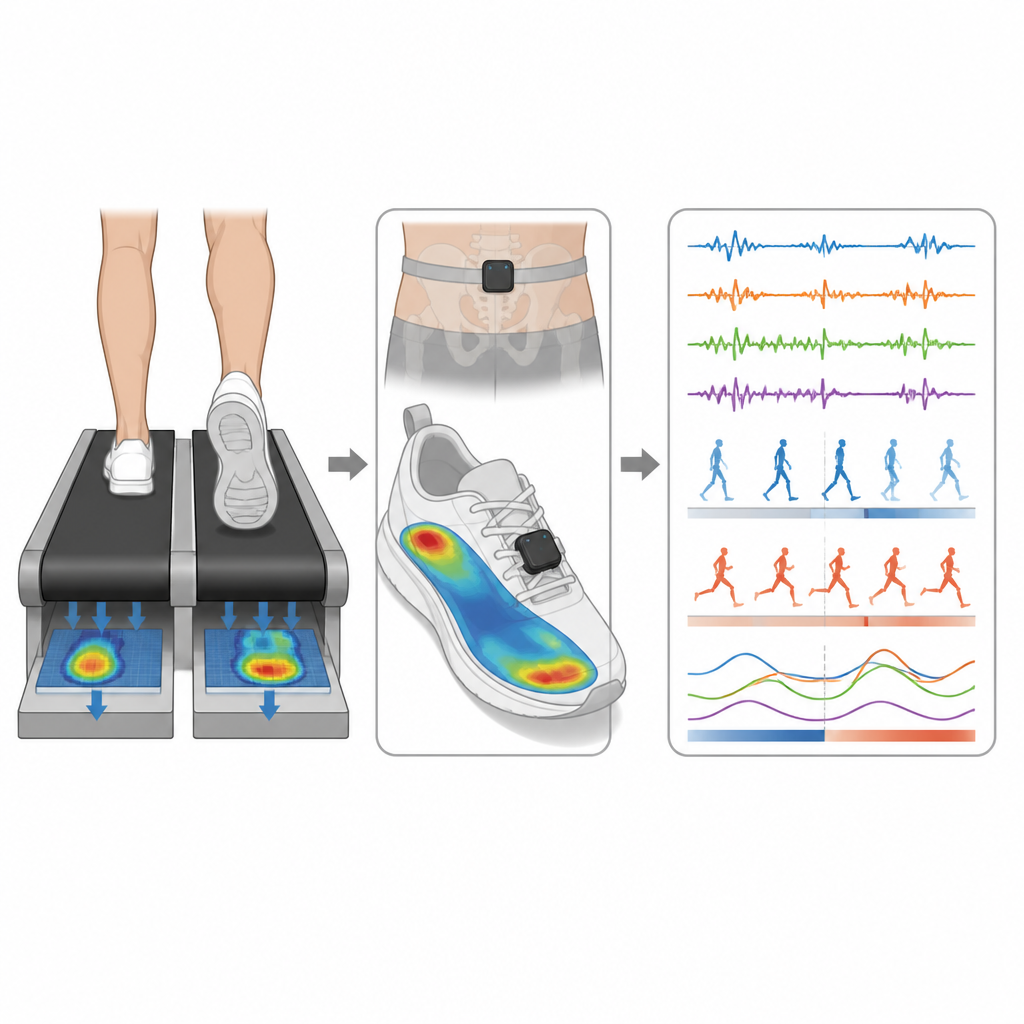
During these sessions, several systems recorded data at the same time. The treadmill’s built in force plates measured how strongly each foot pushed and pulled on the ground. The motion capture cameras followed the marker positions to reconstruct joint angles for the legs, hips, arms, and pelvis. The wearable sensors recorded acceleration and rotation at very high sampling rates, and the pressure insoles logged how loads shifted across the sole of the foot. The researchers manually aligned the start of each recording and also provide event lists, such as the exact moments each foot touched down or lifted off, so users can fine tune the timing between devices.
How the data were cleaned and packaged
Raw motion capture recordings often include brief gaps, mislabelled markers, or small timing issues. The team used a series of standardised processing steps to reconstruct missing marker positions, check the quality of labelling, and convert everything into widely used file formats. They report that nearly all trials had complete or near complete marker information, with more than 99 percent of markers correctly tracked on average. To make reuse easier, they grouped the data into participant level archives and documented the exact processing pipelines and custom computer scripts, all of which are shared openly.
What this resource can be used for
The final dataset follows modern open science rules, meaning it is easy to find, access, combine with other data, and reuse. Researchers can explore how joint angles and ground forces change from walking to running, test methods for estimating forces from wearable sensors alone, or study how people adapt during longer exercise bouts. Others can build or check computer models of running power output without repeating the entire experiment. By releasing not only the measurements but also the tools used to process them, the authors provide a robust foundation for future work in sports science, rehabilitation, and wearable technology.
Citation: Krumm, D., Koska, D., Wakode, J. et al. Multimodal data on bipedal locomotion during prolonged treadmill recordings at varying speeds. Sci Data 13, 761 (2026). https://doi.org/10.1038/s41597-026-07445-3
Keywords: gait analysis, treadmill running, wearable sensors, plantar pressure, biomechanics dataset